Macbeth: whose duty, whose voice and whose grief?
By UK GCSE English Literature · independent study · myAudience
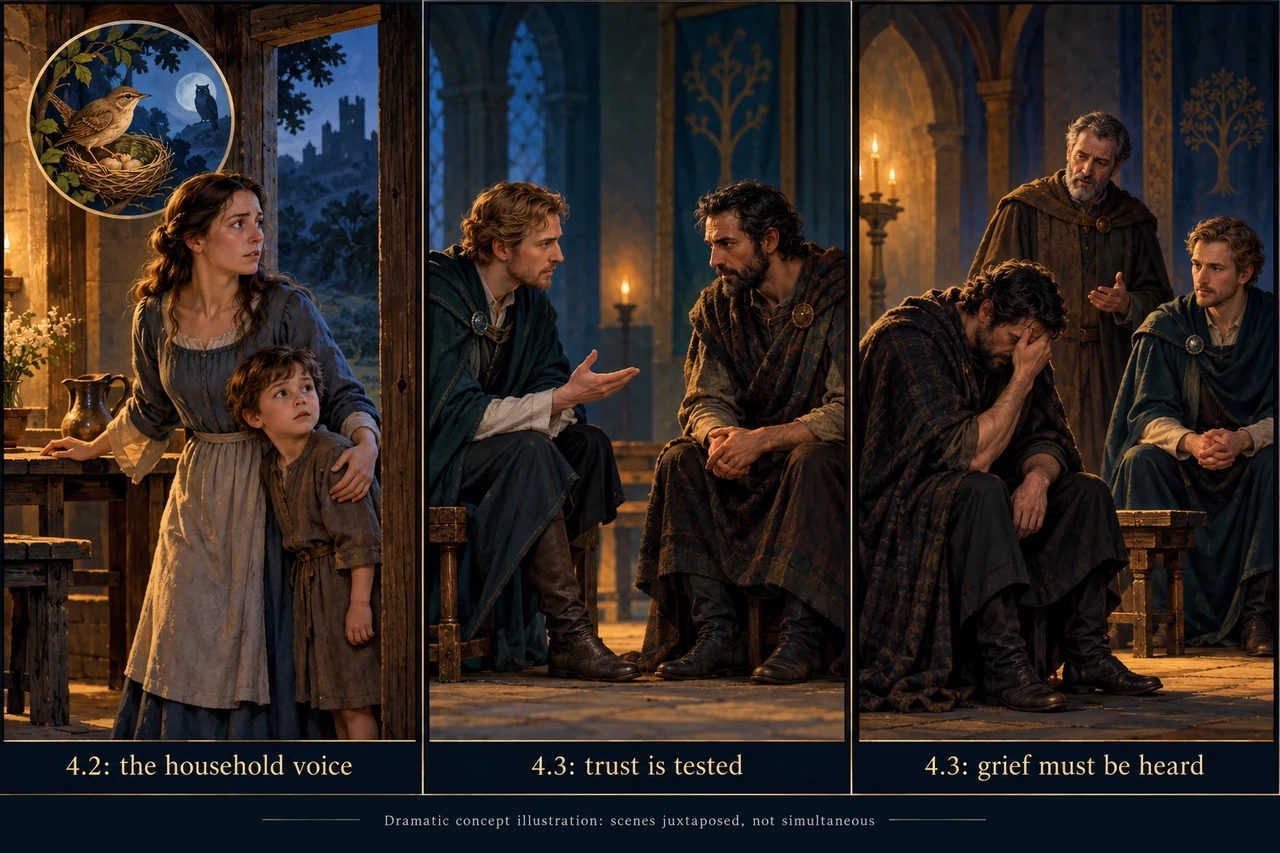
myAudience original dramatic/concept illustration · Original commissioned illustration
Macbeth: whose duty, whose voice and whose grief?
A whole-play argument becomes more demanding when it admits voices that the protagonist would rather exclude. Read 4.2 and 4.3 in sequence. Lady Macduff experiences her husband's departure as abandonment; Macduff argues in England for action against a tyrant. These are differently situated accounts of duty, not a simple opposition between a foolish wife and a heroic man. The audience can understand the public need for resistance while recognising the household cost of an action taken without her participation. Distinguish three questions: why Macduff leaves, whether his departure protects his family, and who is responsible for ordering their deaths. A failure of protection does not transfer Macbeth's responsibility for the attack to its victims.
Lady Macduff's image of a wren defending its young against an owl gives political judgement a small domestic scale. The contrast in size matters: protective action need not depend on strength sufficient to win. Her image challenges departure through a model of care that remains present in danger. It does not establish that she knows the safest military strategy, or that a real wren could guarantee survival. Read the image beside her complaint that fear has displaced love: it is an argument formed in vulnerable circumstances. A competing interpretation could emphasise the limits of her information rather than dismiss her voice; her lack of access to the political plan is itself part of the dramatic inequality.
The exchange with her son briefly changes the scene's rhythm. Questions and quick replies create a relationship rather than merely provide facts about treason. The child's observation that numerous dishonest people might overpower honest ones exposes a gap between a moral rule and the power needed to enforce it. Calling the scene comic need not mean that it is harmless: wit makes this household recognisable before the threat arrives. A production could allow laughter to stop sharply when the messenger enters. That is a proposed effect, not a universal audience reaction. The boy contradicts his mother's claim that his father is dead; therefore paraphrase the conversation as imaginative argument, not a report that Macduff has died.
The messenger's warning creates urgency but not an assured escape route. Lady Macduff's statement that she has done no harm is immediately tested by a world in which good conduct offers inadequate protection. Her recognition of that danger is not consent to it. The murderers then bring the state's language of treachery into the household; the label works as an instrument of violence rather than a demonstrated legal finding. Do not turn an accusation uttered by an attacker into the play's verdict. The audience's advance knowledge of the attack changes the later scene: Ross's news reaches Macduff after spectators have encountered the people now reduced to a report of loss.
Malcolm's testing of Macduff in 4.3 asks a different question about trust. He claims predatory appetites and an absence of the virtues appropriate to kingship, then retracts those claims when Macduff refuses the prospect of such rule. A literal reading that takes every statement as a confession would miss the scene's reversal. Yet calling the deception a test does not prove that its method is ethically uncomplicated. Macduff initially accommodates some proposed vices before reaching refusal. One reading presents necessary caution in a dangerous political world; another questions how much corruption resistance is willing to tolerate for the sake of succession. Both must explain the eventual rejection and Malcolm's stated purpose rather than invent concealed facts.
Later, Macduff's repeated questions delay his absorption of the news. Repetition can enact difficulty in accepting an event rather than mere ignorance: the facts are supplied, but the relationship they describe resists being reduced to information. Malcolm proposes revenge as medicine. Macduff insists that feeling is also part of manhood, answering a violent model that has already been used against Macbeth. The scene does not keep feeling and action permanently separate: Macduff proceeds towards confrontation. Its richer contrast is between action that tries to erase emotion and action that follows recognition of what has been lost. A metaphor of medicine is a character's way of framing revenge, not a claim that revenge cures psychological injury.
A rigorous thesis might argue that tyranny damages the conditions under which people can discharge their duties: care, honesty and resistance become harder to reconcile. Challenge that thesis with an objection: Malcolm's cautious test and the final alliance show that trustworthy political action remains possible. Answer by narrowing the claim. Damaged conditions are not the same as total impossibility, and restored political succession does not restore the household. A reasoned essay can move from Lady Macduff's image of protection, through Malcolm's qualified trust, to Macduff's insistence on feeling. It should show how the sequence alters judgement rather than present three quotations with the same explanation.
The illustration places the household, the test and the news in separate panels: they are consecutive contexts, not simultaneous action. The wren-and-owl inset visualises Lady Macduff's metaphor; neither animal is a required live stage prop. Macduff is absent from the household panel, and Malcolm has not been crowned in the English meeting. Invented dress and light suggest theatrical situations, not evidence about medieval Scotland or an original production. Return to the actual dialogue before treating the pictured expressions as an argument. Image: dramatic illustration, not a historical document. Reading anchors: Macbeth 4.2 and 4.3 in a lawful complete edition.
Worked example: Original task: Develop a qualified paragraph showing how 4.2 prevents an uncomplicated reading of Macduff as an exemplary defender. Connect it to the later grief without blaming the victims.
Establish the household viewpoint and distinguish it from the political plan.
Analyse the wren metaphor as an argument for present care.
Use sequence to connect the audience's earlier encounter with Macduff's later news.
Weigh the necessity-of-resistance counterreading and retain Macbeth's responsibility.
Answer: Lady Macduff complicates heroic resistance by judging it from the people it leaves exposed. Her wren, small yet willing to defend its young against a stronger bird, makes staying present a measure of care rather than of probable military success. That image does not prove that Macduff could have saved the household; it makes the cost of departure audible in a voice excluded from the public plan. The scene's placement then changes his later grief: the audience has met the mother and son before Ross describes their deaths, so the news is more than a loss belonging to the absent father. Macduff's insistence on feeling recognises a cost that political action cannot reverse. Resistance may be necessary, but necessity does not make every consequence invisible. The argument should therefore question the completeness of his heroic role while retaining Macbeth's responsibility for ordering violence.
Check your understanding: Transfer: Critique these claims: (a) Malcolm admits he is worse than Macbeth. (b) Macduff causes the murders because he leaves. (c) Feeling makes Macduff unable to act. Then form a defensible three-part thesis using 4.2 and 4.3.
Answer: (a) The vices are claimed during a test and then retracted; analyse the reversal and purpose, not the first speech alone. (b) Departure leaves a real protection problem, but Macbeth orders the attack. Vulnerability, causal conditions and culpability must be distinguished. (c) Macduff says he must also feel and proceeds to confrontation, so emotion and action coexist. A thesis: tyranny fractures duties by making household protection, candid trust and public resistance difficult to reconcile; the scenes recover a capacity for principled action but cannot restore the dead. Test it against Malcolm's eventual honesty and Lady Macduff's limited knowledge.
Why: A strong answer uses precise situation, speaker and sequence; explains rather than merely labels the bird image; responds fairly to counterevidence; and preserves the distinction between uncertainty, protection and responsibility. A different judgement is defensible if it accounts for the test's retraction and refuses invented plot facts. This is an original analytic rubric, not an mark scheme.