Unseen poems: compare uncertainty without inventing a biography
By UK GCSE English Literature · independent study · myAudience
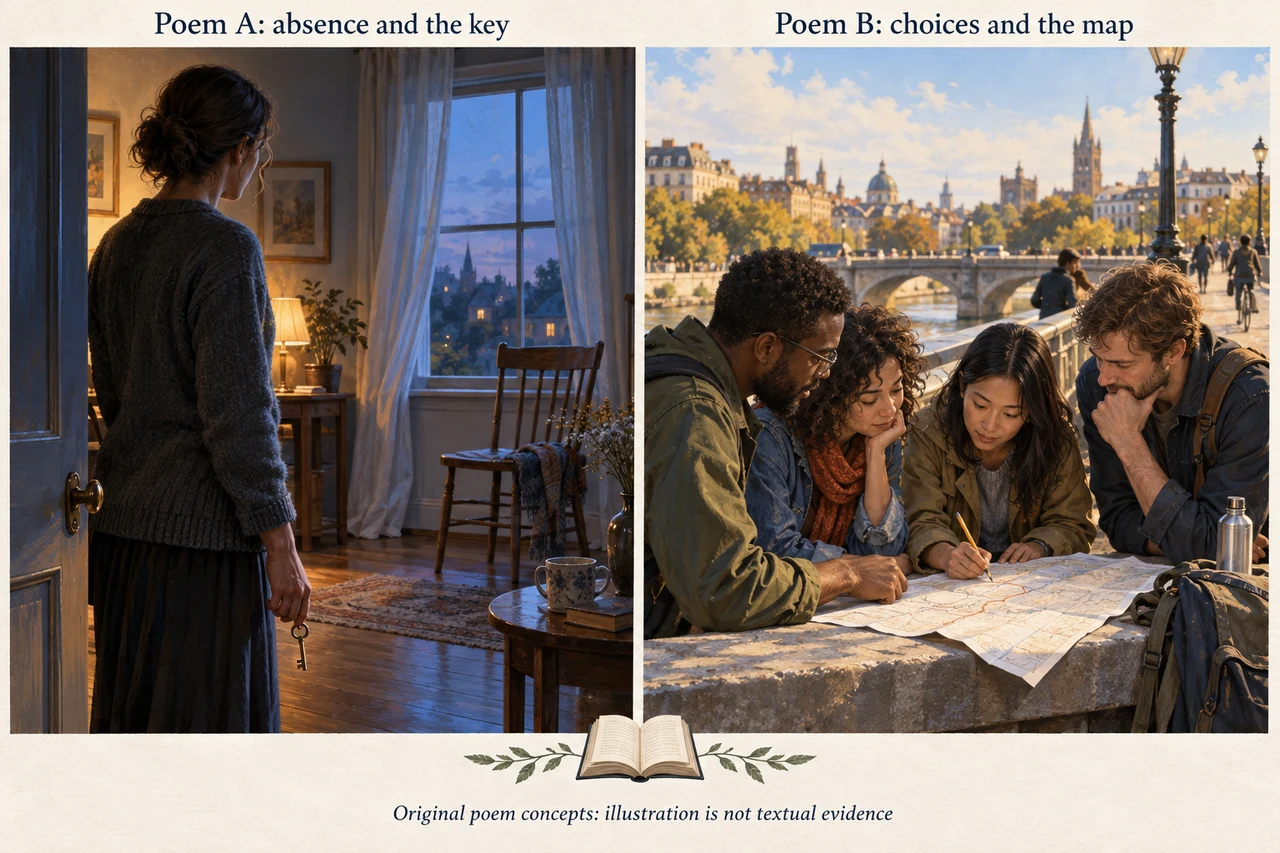
myAudience original dramatic/concept illustration · Original commissioned illustration
Unseen poems: compare uncertainty without inventing a biography
Unseen reading begins with the words given, not a guessed biography. The following two short poems were written originally for this lesson; they are neither anthology poems nor reproduced examination material. Poem A, 'The key': 'I turn the key. The quiet room is there. / Your chair keeps watch beside the evening pane. / I fold the words I meant to leave in air / and find the door has shut on them again. / Outside, the buses practise going on; / their windows carry other people's light. / I keep the key until the warmth has gone, / then set it down: a small weight in the night.' Poem B, 'The map': 'We spread a map across the bridge's rail. / The pencil pauses where two roads divide. / No printed arrow tells us which will fail; / we draw a path and leave the end untried. / Below, the water carries yesterday; / above, the cables hold their steady line. / You turn the page. We have no certain way, / but room enough to call the choosing mine.' Read each as eight lines, preserving the indicated line breaks. Their invented speakers are not necessarily the author.
First construct a literal account without making the gaps disappear. A's speaker enters a room, notices a chair, fails to speak intended words and eventually puts down a key. The addressed person is absent from the described action; the poem does not tell us whether that person has died, travelled or ended a relationship. B shows people considering a route on a bridge; the decision is not completed as an arrival. A thematic inference about loss and uncertain agency is possible because actions and objects connect, but it remains different from assigning a definite backstory. Write 'the absent addressee' before choosing a stronger claim you would have to justify.
A's key first enables entrance and finally becomes a weight. That change in function moves the object from practical control to a felt burden. The chair's watch personifies an inanimate object, placing vigilance where the absent person might have been. A competing reading sees continuity or fidelity in keeping the key rather than simple imprisonment. The final act of setting it down allows limited release, but the ending remains at night, not in a declared new life. Analyse the change in what the speaker does before deciding whether the ending signifies acceptance. The poem gives an action and an atmosphere; it does not announce recovery.
B's pencil pauses at a division before making a route whose end remains untried. The plural opening establishes shared deliberation, while the final possessive 'mine' introduces personal agency inside that company. That shift might represent growing confidence, but could also suggest tension between shared advice and ownership of the decision. The printed map offers structure without a guaranteed outcome. The contrast between moving water and supporting cables lets instability and steadiness coexist; it is too simple to assign water only a negative meaning and bridge only a positive one. The speaker's final room for choosing is an opportunity, not evidence that every route will succeed.
Both poems use eight lines with an alternating end-rhyme pattern. In A, there/air and pane/again pattern the first four lines; on/gone and light/night continue it, although pronunciations can vary, especially again. B links rail/fail, divide/untried, yesterday/way and line/mine. Discuss audible pattern rather than insist every pair has identical sound in every accent. The fourth-line stopping point in each poem forms a useful hinge: A returns to closed speech, B leaves an end open. Their punctuation includes internal pauses, so even similarly sized lines do not require identical performance. Do not assert a strict metre without scanning and explaining its variations; this comparison does not need that claim.
An integrated comparison puts a relationship first, then derives the difference through precise evidence. 'Both writers use objects' is a beginning, not an explanation. A key ordinarily controls access, yet its final weight limits that control; B's map ordinarily guides, yet cannot guarantee which road will fail. Each poem unsettles an object associated with certainty. The difference lies in movement: A revisits an enclosed situation and finally stops handling the key, whereas B negotiates an unfinished future with another person. A counterreading notices modest agency in A's final action and personal tension in B's final 'mine', so the contrast should not harden into despair versus happiness.
For an original unseen task, first analyse A alone: explain how its changing key explores the relation between memory and action. Then compare the methods through which A and B present uncertainty. These are separate operations, like the distinction between sustained single-poem reading and comparative work, but they are not an official question or mark allocation. The model below answers the comparison; a single-poem answer would give more room to A's addressed voice, rhythm and ending. When adding context, say what is known: these are contemporary invented lesson poems. Do not attach a named war, migration or author's bereavement without evidence. An unseen response can be perceptive without a biography paragraph.
The diptych pictures an empty chair and key beside people considering a map on a bridge. It suggests the objects and contrasts in the original poems, but its lighting, people and invented places are additional artistic choices. It cannot decide why the addressee is absent, whose map decision succeeds, or whether either speaker is happy. A chair and a page are evidence only when you return to their words and sequence in the poems. Image: literary concept illustration, not a documentary photograph. This one controlled pair is comparative practice, not the required wide range of unfamiliar poetry or coverage of any selected fifteen-poem anthology.
Worked example: Original task: Compare how the two invented poems use objects and endings to explore uncertain agency. Develop one connected model paragraph; do not claim either poem supplies a definite biography.
Name the shared problem and identify a meaningful difference.
Analyse the key's changed function and the map's withheld guarantee.
Link the endings to action and to what remains undecided.
Answer a counterreading that limits a simple despair/hope contrast.
Answer: Both poems make an object associated with control expose its limits, but they place agency in different relations to time. In A, the key admits the speaker to a room without restoring the absent conversation. Its eventual description as a weight shifts access towards burden; setting it down creates a small action without announcing that memory has ended. B's map likewise offers a framework rather than certainty: the pencil pauses and the destination remains untried. Yet the plural opening makes deliberation shared, while the final claim to choosing presents personal agency within that company. The contrast is therefore between revisiting an absence and negotiating a future, rather than between total despair and effortless hope. A's final gesture still contains choice, and B's unresolved route still admits failure. Their objects make uncertainty tangible without eliminating it.
Check your understanding: Transfer: Improve the claim “A is about death and B is happy because bridges mean hope.” Give an alternative single-poem thesis for A and an integrated comparative plan with two evidence pairs.
Answer: The first claim invents death, treats a bridge as a universal symbol and ignores B's uncertain route. A possible single-poem thesis: the speaker tests whether a practical act can release a weight carried by unspoken memory, but the ending grants only a limited gesture. Comparative pair1: A's final key-weight versus B's map without a guaranteed road; explain how both objects limit expected control. Pair2: A's addressed absence and closed-room return versus B's plural deliberation and final “mine”; show different relations between companionship and agency. Counterreading: A's setting-down can suggest partial release, while B's possessive may complicate togetherness. Use that objection to narrow the thesis rather than reverse it without explanation.
Why: Credit accurate literal observations before inference, connected comparison with exact short evidence, explained object/sequence effects, and a reasoned qualification. Do not require the model's preferred interpretation; a competing answer must fit the text, avoid invented context and distinguish illustration from words. No numerical score or promised grade follows from this practice pair.