A warning is useful only if action fits the remaining time
By UK GCSE Geography · independent study · myAudience
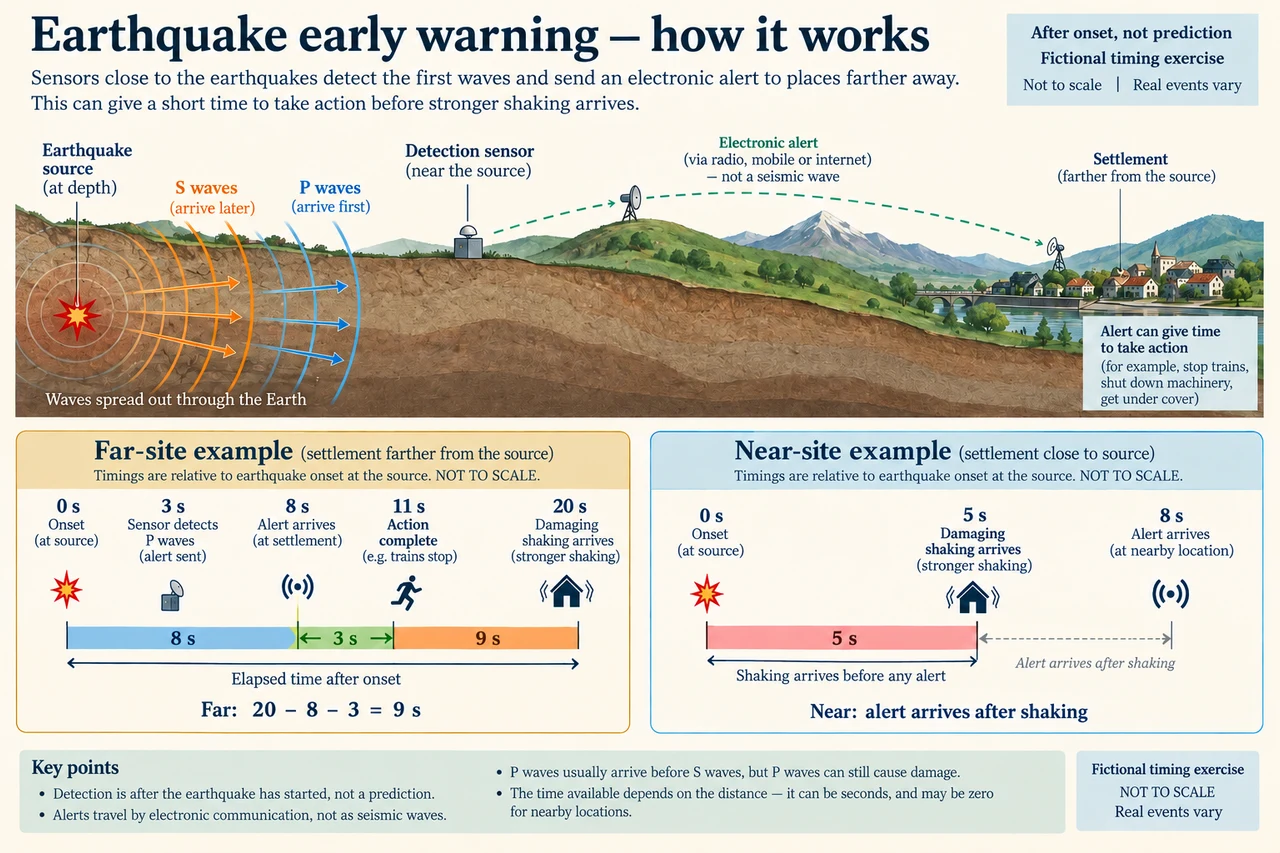
myAudience original generated educational illustration · Original commissioned illustration
A warning is useful only if action fits the remaining time
An early-warning system has several clocks, not just one. The earthquake starts, waves reach sensors, processing estimates the event, an alert is delivered, and a recipient must recognise it and act. Useful time is the interval left after all necessary delays, before the particular shaking being considered arrives. asks how monitoring and planning reduce risk; the demanding part is explaining why a working detector may still provide little useful time at a particular place.
USGS describes ShakeAlert as detection of an earthquake already underway, followed by estimates and partner-delivered alerts. Faster P waves can be recorded before later S and surface waves, while telecommunications move information much faster than seismic energy. This creates a possible advantage at some distant sites. It is not exact advance prediction, and it does not mean that every P wave is harmless or that every damaging motion waits for a single idealised S-wave arrival.
Keep the source, sensor and person separate. A sensor near the rupture may start the detection process before waves reach a farther settlement. A person very near the rupture can feel shaking before sufficient observations and message delivery are complete. Increasing the number of sensors can help coverage and estimation, but it cannot abolish physical travel time or guarantee a reliable message from every damaged or overloaded communication network.
In the plate, both timelines are invented and not proportional drawings of time. At the farther site the selected damaging shaking arrives 20 seconds after onset, the delivered alert arrives at 8 seconds, and the stipulated action needs 3 seconds. Action completes at 11 seconds, leaving 9 seconds. At the nearer site the selected shaking arrives at 5 seconds, before the 8-second alert. Clipping a negative lead-time estimate to zero means no advance warning; it does not imply that an alert after onset has no later informational value.
The calculation distinguishes available lead time from usable action time. The far-site lead time is 20 − 8 = 12 seconds; subtracting the 3-second action leaves 9. Saying “there are 20 seconds to act” would erase detection and delivery. Saying “the warning predicts the quake 11 seconds beforehand” reverses the chronology. These numbers are stipulated teaching data, not measured ShakeAlert performance, operating specifications or an instruction to complete a particular protective movement in 3 seconds.
Uncertainty can consume a narrow margin. Suppose the relevant shaking could arrive between 17 and 23 seconds, delivered alert between 7 and 9, and action between 3 and 5. The conservative remaining margin is 17 − 9 − 5 = 3 seconds; the optimistic one is 23 − 7 − 3 = 13. These are bounded combinations, not confidence probabilities. If delays are correlated, the combinations may not be equally plausible. A decision-maker should know how estimates were obtained rather than announce an unsupported average guarantee.
Planning connects a message to an achievable action. Accessible audible and visual delivery, comprehensible wording, practised arrangements and support for people who cannot respond alone can matter as much as a rapid algorithm. Automatic actions can sometimes be faster, but they have engineering and failure-mode requirements. A geographic evaluation should identify which people or services receive useful warning and which remain outside effective coverage; national income alone cannot provide that answer.
Transfer the reasoning to a new situation. If the far-site alert is delayed to 15 seconds and the same action takes 6, it finishes at 21: the 20-second deadline is missed by 1. Reducing the action to 4 gives a 1-second remaining margin, still vulnerable to timing error. A strong explanation states the assumptions, calculates the margin, distinguishes detection from prediction and evaluates residual risk. Actual emergency actions must follow current official local guidance, not these model timelines.
Worked example: A fictional settlement expects damaging shaking at 28 s after onset. Detection takes 5 s from onset, processing and delivery together 4 s, and a stipulated action 7 s. Find delivered-alert time, initial lead time and remaining margin. Then test an extra 12 s delivery delay.
Delivered alert: 5 + 4 = 9 s after onset.
Initial lead time: 28 − 9 = 19 s; action completes 9 + 7 = 16 s, leaving 12 s.
With another 12 s delay the alert arrives 21 s and action completes 28 s: zero margin, not a robust guarantee.
Answer: The initial margin is 12 s; the delayed case has zero margin. Detection began after onset, so neither case is prediction. Timing uncertainty could make the zero-margin plan fail.
Check your understanding: A system issues the same message to two places. Does receiving it earlier than a neighbour prove that you have more useful warning time? Explain, then correct the claim that faster alerts eliminate earthquake vulnerability.
Answer: No. Compare each place’s shaking-arrival time with its delivery and action times. Earlier receipt can coexist with an even earlier hazard arrival. Alerts can support action but do not replace resilient buildings, maintenance and accessible plans.
Why: Credit a correctly ordered timeline and remaining-time calculation, a place-specific explanation and one implementation limitation. Comparing receipt times alone or promising earthquake-proof protection is not sufficient.