Tōhoku 2011: separate a tsunami mechanism from a local outcome
By UK GCSE Geography · independent study · myAudience
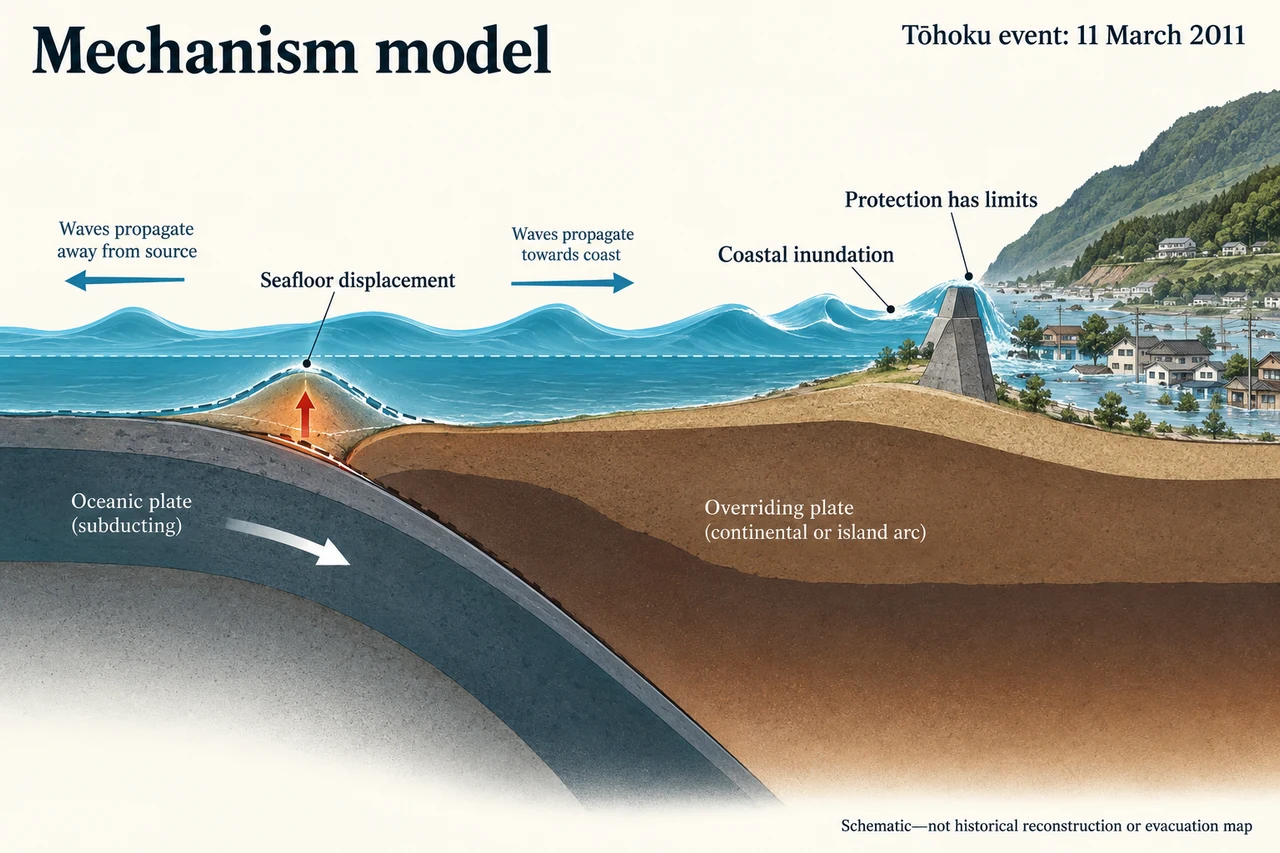
myAudience original generated educational illustration · Original commissioned illustration
Tōhoku 2011: separate a tsunami mechanism from a local outcome
The 11 March 2011 Tōhoku earthquake is a dated example of interacting hazards and protective limits. NOAA NCEI’s account, updated 9 March 2026, identifies a magnitude 9.1 earthquake off northeast Honshu and a tsunami generated by it. This lesson studies the chain from tectonic movement to coastal disruption. It does not replace the existing Chile–Nepal contrasting-wealth comparison or assign present-day income categories to historic events.
A sudden vertical displacement of a large part of the seafloor can displace the overlying water and start tsunami waves. The plate depicts one simplified subduction-thrust mechanism. An earthquake does not automatically generate a damaging tsunami: rupture geometry, depth and seabed displacement matter. The wave moves energy across the ocean; it is not a wall containing only the same parcel of water carried all the way from the fault to each coast.
As a tsunami approaches shallower coastal water, local bathymetry and the shape of bays or inlets alter its behaviour. Run-up is the vertical reach of water on land relative to a stated reference, not automatically offshore wave height or depth above a house floor. The large drawn wave is an explanatory exaggeration; the plate supplies no measured height, exact coastal profile or historical reconstruction. Neither earthquake magnitude nor this sketch determines the maximum inundation at a particular street.
NOAA’s dated account describes the tsunami overtopping seawalls and the loss of reactor power and cooling at Fukushima Daiichi. This supports a cascade: a protective barrier can be exceeded; inundation can interrupt critical services; service failure can create further hazards. A damaged reactor is not simply a second earthquake. The lesson does not explain plant operation or attribute the accident to a single simplified design detail; an actual engineering investigation requires the specific systems and sequence.
A seawall can reduce some exposure to smaller events without protecting against all possible water levels, debris impacts or overtopping. Its existence may also affect land-use choices and residents’ expectations. A comparison should therefore specify the event range, maintenance, access and residual risk. “A wall was overtopped, so all protection is useless” and “a wall exists, so no evacuation plan is needed” are equally unsound conclusions.
The imaginary map exercise uses travel times rather than this plate as navigation advice. If a stipulated hazardous arrival occurs at 24 minutes and an alert is understood at 6,18 minutes remain before action time is counted. A route taking 12 minutes leaves 6; an accessible alternative taking 20 does not fit. This identifies a planning gap under the exercise’s assumptions, not a reason to force someone onto an inaccessible route or infer a real Tōhoku evacuation duration.
Response effectiveness must be judged against an appropriate counterfactual. NOAA describes benefits of warning and mitigation systems while acknowledging severe losses. A large death toll alone does not show that every warning failed, and a claimed number of lives saved needs a method rather than a subtraction from an imagined perfect outcome. Fatality, damage and evacuation records also have different definitions and reporting dates. This lesson deliberately avoids adopting changing casualty totals or the source’s global magnitude-ranking statement.
Longer-term learning can combine mapping, building and service resilience, understandable warnings and inclusive rehearsed plans. Households may remain near the sea for work, family or affordability reasons; access to relocation is unequal. For an extended answer, connect a named 2011 impact to a mechanism and a response, explain the protection’s limit and identify what evidence would establish improvement. The generated higher ground is a conceptual contrast, never a certified safe destination or substitute for current official local instructions.
Worked example: A fictional coast expects hazardous water at 24 min after the event. Message comprehension takes 6 min from onset. Route A needs 12 min; accessible route B needs 20 min. Calculate each remaining margin. A planned transport service cuts B to 14 min but adds a 3 min wait; evaluate the revised margin.
Initial A margin: 24 − 6 − 12 = 6 min; B: 24 − 6 − 20 = − 2 min, so B does not finish before the stipulated arrival.
With service B the total action interval is 3 + 14 = 17 min; margin 24 − 6 − 17 = 1 min.
A 1 min margin is small relative to uncertain arrival, waiting and congestion; an accessible plan needs robust tested capacity, not merely a positive arithmetic result.
Answer: A leaves 6 min; original B misses by 2 min; revised B leaves 1 min under the fictional assumptions. This is an access-gap analysis, not historical data or route advice.
Check your understanding: Explain why a higher offshore earthquake magnitude cannot by itself tell you which of two houses has deeper tsunami inundation. Then write a balanced conclusion about an overtopped seawall.
Answer: Local seabed/coast geometry, ground/floor height and water movement matter. Overtopping shows a limit for that event; it does not prove no benefit for other events, but it prevents treating the barrier as complete protection.
Why: Credit a linked physical explanation, distinction between event magnitude and local water depth, and a bounded evaluation of residual risk. An unsupported claim that a wall guarantees safety or that all walls are useless is not justified.