Economic reasoning: claims, models and causal evidence
By UK A Level Economics · independent study · myAudience
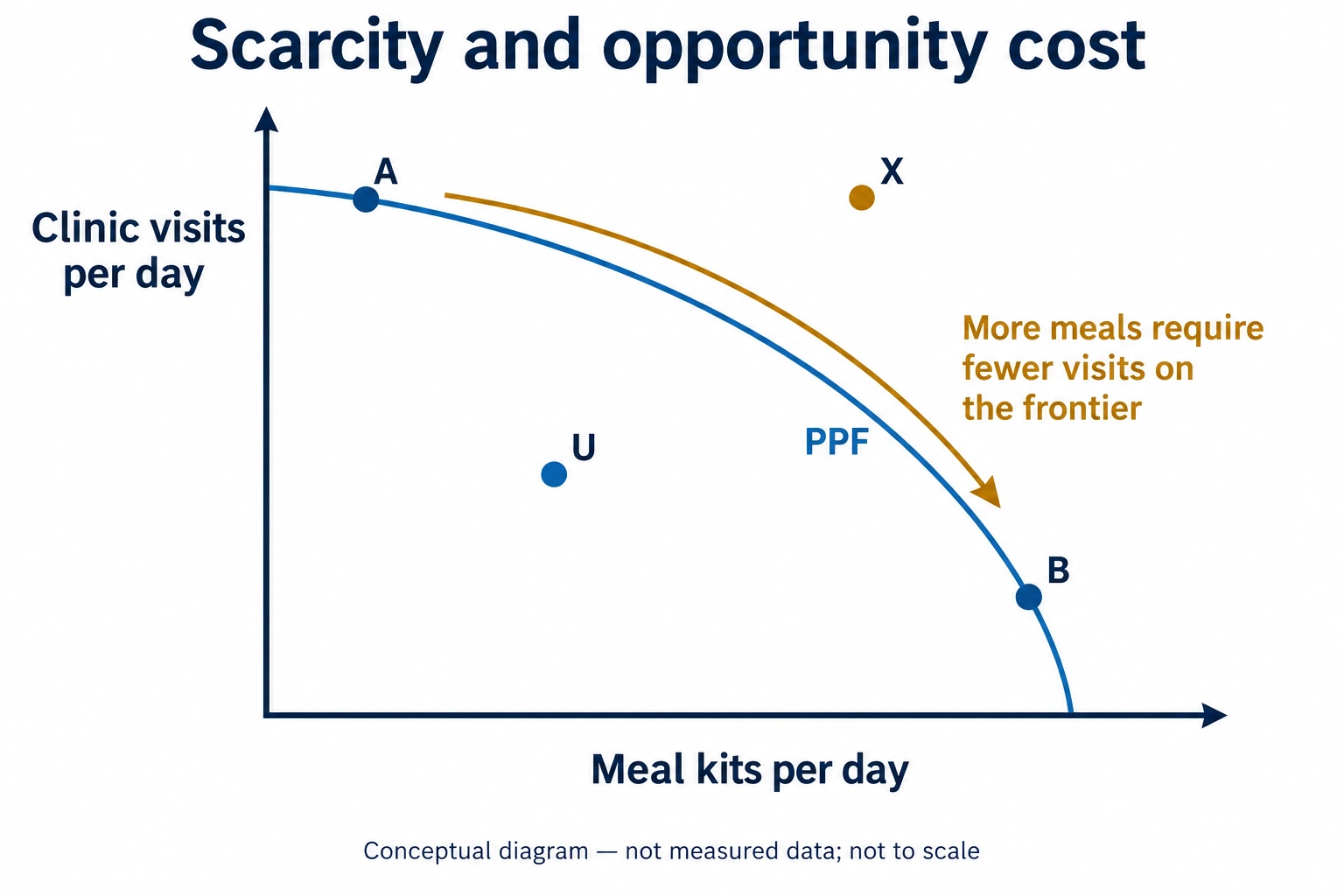
Original teaching plate generated using the built-in imagegen tool, 2026-10-04; conceptual or hypothetical, not empirical evidence. · Original generated artwork; provenance and rights acceptance pending independent review before public publication.
Economic reasoning: claims, models and causal evidence
Economics studies how people and institutions choose under constraints, and how those choices interact. A model deliberately leaves things out to isolate a mechanism. Suppose a clinic raises its appointment fee and attendance falls. The demand model offers a possible explanation: a higher opportunity cost discourages some visits. It does not establish that the fee caused the entire fall. Illness patterns, transport disruption and changing service quality might also matter. Begin with a precise question, identify the agents, state the proposed mechanism, and ask which observations would count against it. A useful model makes conditional predictions that can be confronted with evidence rather than explaining every outcome after it happens.
A positive statement is a claim about what happens or would happen; it can in principle be tested, even when false or difficult to measure. A normative statement depends on a value judgement about what ought to happen. "A fee reduces attendance" is positive. "A fee is unfair" is normative unless fairness is explicitly operationalised as a measurable criterion. "Fees should be abolished because they reduce attendance" combines both. The consequence can be investigated, but choosing to prioritise access over budgets requires a value judgement. Evidence can inform a moral decision without mechanically settling it. Do not use positive to mean desirable, or normative to mean unsupported nonsense.
Ceteris paribus means holding relevant other influences constant, not pretending they never change. Demand is a conditional relationship between price and quantity for a specified good, population and period. A dataset of successive market prices and sales need not trace that relationship because both demand and supply may shift. Reverse causation is also possible: a crowded service may raise its fee. A common cause such as an income rise can affect both variables. Correlation describes co-movement; causation asks what would change under an intervention, relative to a credible counterfactual. Two observations cannot identify a whole causal mechanism merely because a graph slopes the expected way.
Random assignment can make comparison groups similar on average before an intervention, but compliance, attrition and spillovers still threaten interpretation. A natural experiment uses a plausibly external change in exposure; its credibility rests on a defended design, not the word natural. For a before-and-after comparison with a control, one assumption is that outcomes would have followed parallel trends without the intervention. Differences in underlying trends or a second policy affecting only one group can break that assumption. The 2021 Nobel scientific background explains how economists study causal effects using such designs; this lesson uses an original hypothetical arithmetic example, not a reported study or an estimate of any real policy effect.
The PPF plate illustrates the distinction between a model and a measurement. Its boundary says that, given resources and technology, more of one output may require less of another. It has units but no calibrated ticks: you cannot read a numerical opportunity cost by measuring the raster. To test a real capacity claim you would need comparable output definitions, information about staffing and technology, and evidence of feasible combinations. Controlled laboratory methods are sometimes possible in economics, yet large-scale choices involve institutions, incentives and expectations that change when people learn. Methodological difficulty calls for explicit assumptions and triangulation, not exemption from evidence.
Build an extended response in a connected chain: define the claim; explain how a named agent responds; apply supplied evidence; identify a serious alternative explanation; state what further evidence would discriminate; give a conditional judgement. An objection earns its place when it changes the inference. If a service reduces its fee while extending opening hours, both mechanisms predict more attendance. Comparing attendance alone does not separate them. A persuasive judgement might favour a fee effect provisionally while specifying that stable hours, population and eligibility are needed. This method will recur in every market and macroeconomic lesson. Statistical precision, causal confidence and moral approval are three different judgements.
Original model essay — part 1. The claim combines two questions that require different warrants. Whether higher fees caused lower attendance is a positive, potentially testable claim. Whether abolition is the best policy is normative: best might mean improving health, protecting low-income access or using a fixed budget efficiently. A fall after a rise establishes sequence, not the attendance that would have occurred without that rise. The price mechanism is plausible because a visit becomes more costly, but plausibility does not identify the size of the effect or prove that all forgone appointments were beneficial. The hypothetical fee-reduction example illustrates a counterfactual strategy. Attendance rises from 200 to 240 in the treated clinic and from 100 to 110 in the comparison. Subtracting the changes gives 30 visits per week. This level estimate differs from the ten-percentage-point difference between the clinics' growth rates. Its interpretation requires the comparison's ten-visit change to represent the treated clinic's counterfactual change. Different clinic sizes make that a substantive assumption, rather than an automatic result of doing the subtraction correctly. Evidence about earlier trends, eligibility and comparable health needs would help defend it. A concurrent extension of opening hours could increase attendance independently of fees. Conversely, an influenza outbreak or transport closure could conceal an effect of cheaper access. I would collect repeated observations before and after the change, check differential changes in hours and staffing, and compare services exposed to similar background shocks. A fee change determined for reasons unrelated to local attendance may offer a stronger design than a clinic choosing its own fee in response to crowding. Even then, uncertain estimates and changes in the population must be reported rather than treated as negligible.
Original model essay — part 2. Patient switching creates a particularly important threat. If the treated clinic attracts people from the comparison, the comparison's attendance is no longer an untreated outcome. The estimated effect on one clinic could exceed the increase in total healthcare use. Measuring attendance across the whole switching network would identify whether visits were redistributed or additional. A comparison outside that network might avoid direct contamination, but geographical differences could make its counterfactual less credible. Both checks are preferable to simply declaring the control valid because its fee stayed unchanged. Abolition also has a financing opportunity cost. Replacing fee revenue through taxation or reducing another service may improve access while transferring costs elsewhere. More demand without more appointment capacity can produce queues and reduce consultation time. Targeted exemptions could protect vulnerable patients at lower fiscal cost, although eligibility checks may discourage take-up and exclude people incorrectly. These consequences require evidence about health outcomes and distribution, not attendance alone. My judgement is therefore conditional: abolishing fees is defensible where credible evidence shows harmful barriers to valuable care and a feasible funding and capacity plan exists. The original observation cannot establish that conclusion by itself, and a well-funded targeted alternative could be preferable under a different welfare criterion.
Worked example: Hypothetical weekly clinic attendance: treated clinic 200 before and 240 after a fee reduction; comparison clinic 100 before and 110 after. Calculate each change and a difference-in-differences estimate in visits, then explain why it is not proof.
Treated change = 240 − 200 = 40 visits per week; its percentage rise is 40/200 × 100 = 20%.
Comparison change = 110 − 100 = 10 visits per week; its percentage rise is 10/100 × 100 = 10%.
In levels, the difference of changes is 40 − 10 = 30 visits per week. This is not the difference of percentage growth rates.
The level calculation assumes the comparison would capture the treated clinic's counterfactual level change. Unequal sizes do not automatically make that assumption reasonable.
A treated-only extension of opening hours could account for some or all of the extra 30; stable pre-trends and unchanged eligibility would strengthen the design.
Answer: 30 extra visits per week is the hypothetical level-based estimate under the stated counterfactual assumption. A 10-percentage-point growth gap answers a different question. Neither number by itself establishes causation or fairness.
Check your understanding: Write 450–600 words evaluating: "A fall in clinic attendance after fees rise proves that abolishing fees is the best policy." Use the example, propose a counterfactual design, and separate positive and normative parts. Transfer: explain how your design would change if patients could switch between clinics.
Answer: A defensible response rejects proof from sequence alone. Price may reduce use, but hours, quality, health needs and income may also change. A comparison design could estimate an effect if untreated trends approximate treated counterfactual trends and no differential shock occurs. Switching contaminates the control because its attendance becomes an outcome of the fee change; use wider system totals or a comparison outside the switching network, while checking comparability. Even a causal reduction in attendance does not identify unnecessary versus beneficial visits. Abolition may improve access but requires funding and may increase congestion. Best depends on welfare, distribution and feasible alternatives such as targeted exemptions. A justified judgement is conditional, not neutral by default.
Why: Indicative criteria, not an official mark scheme: accurate positive/normative distinction establishes the question; an agent-level price mechanism explains rather than merely asserts causation; correct units and arithmetic ground application; a credible counterfactual with assumptions tests AO3 reasoning; switching and simultaneous changes make the critique specific; a funded alternative and explicit welfare criterion support AO4 judgement. Reward another conclusion if its causal and ethical warrants are defended. Unsupported "correlation is not causation" earns less than a concrete mechanism and a discriminating test.