Scarcity and opportunity cost: choosing the next-best alternative
By UK A Level Economics · independent study · myAudience
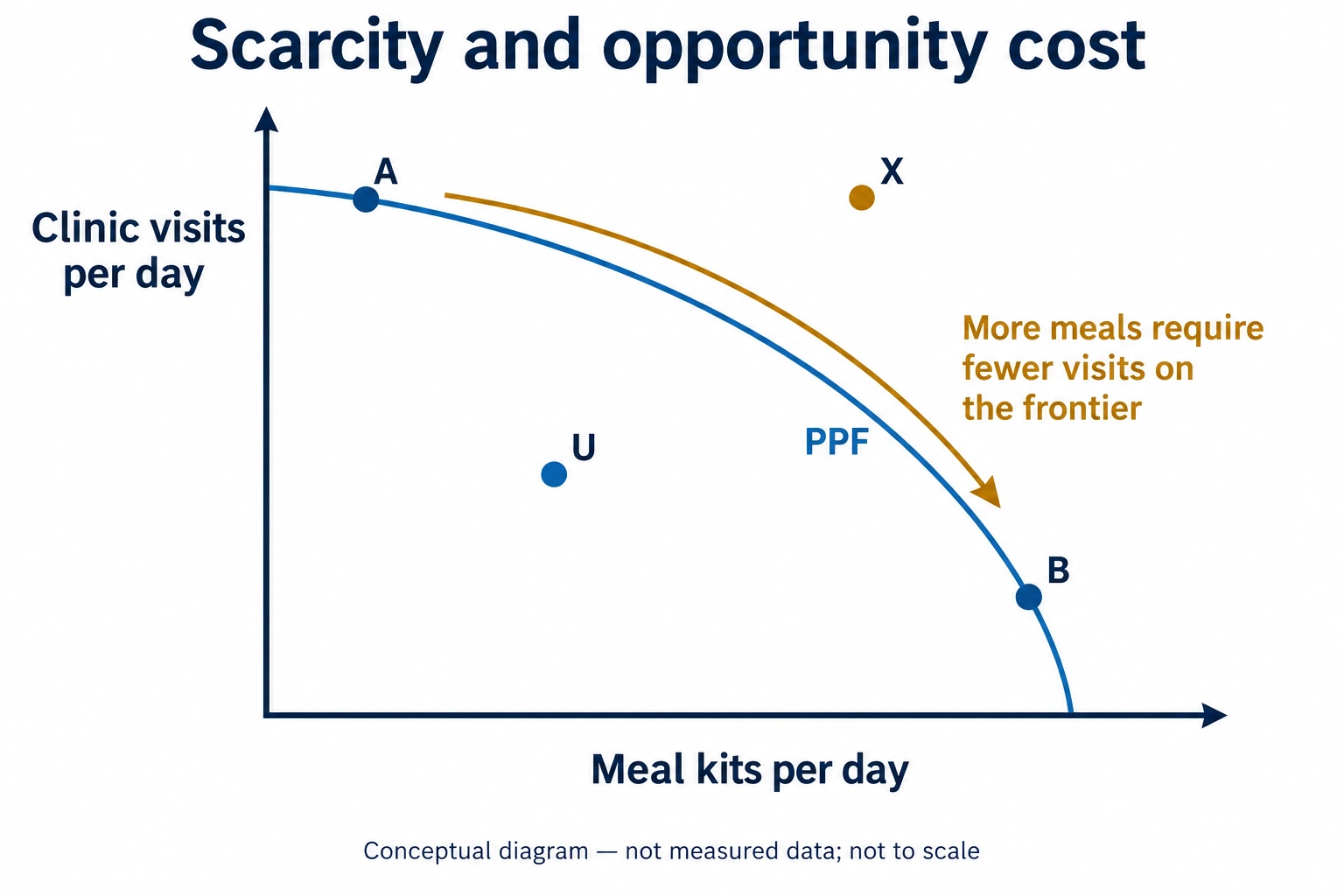
Original teaching plate generated using the built-in imagegen tool, 2026-10-04; conceptual or hypothetical, not empirical evidence. · Original generated artwork; provenance and rights acceptance pending independent review before public publication.
Scarcity and opportunity cost: choosing the next-best alternative
Scarcity means resources cannot satisfy every competing use at once. It applies even in a wealthy economy: time, skilled staff, land, materials and environmental capacity have alternative uses. A shortage is different: at a particular price, buyers want more than sellers offer. Prices may remove a shortage while scarcity remains. A council choosing between clinic visits and meal kits must decide what to produce, how to produce it, and who receives the output. Those questions combine feasibility with distribution. A production total alone does not show whose needs are met or which allocation is fair.
Economists classify inputs as land, labour, capital and enterprise. Land includes natural resources; labour is human effort; capital means produced assets used in further production, such as equipment; enterprise coordinates resources and bears business risk. Money can buy equipment but is not itself the machine's productive service. A qualification may raise human capital, but the worker remains a labour input. Categories are analytical tools, not an exhaustive moral description of a person. The environment is scarce because one activity may use clean air, water or habitat capacity that another activity also values, including future generations.
Opportunity cost is the value of the next-best feasible alternative forgone. It is not the sum of all rejected possibilities, and it is not automatically the cash price. If a hall can host tutoring worth an estimated £600 or a concert worth £450 on the same evening, choosing a meeting sacrifices the best alternative, tutoring, provided those estimates use a comparable decision criterion. Adding £600 and £450 would pretend both alternatives could have occurred together. If the hall could host both sequentially, the feasible alternative set changes. State whose valuation is used and whether benefits beyond revenue are included.
Sunk costs have already been incurred and cannot be recovered by the current choice. They may explain past decisions but should not determine the marginal comparison now. A prepaid non-refundable course fee does not make attending an extra session costless: the student still forgoes work, care or leisure. Conversely, a ticket that can be resold has a recoverable value and belongs in the current comparison. The relevant decision compares future incremental benefits with future incremental opportunity costs. Average accounting cost can therefore differ from the economic cost of one additional action.
The plate shows A and B on a conceptual capacity boundary. Moving towards more meal kits uses resources that could produce clinic visits. U is inside the frontier, so some resources are idle or inefficiently organised; output may rise without reducing the other output. X is outside the present feasible set. These meanings depend on holding the resource base, technology and period fixed. The plate does not prove that every real council can transfer medical staff into catering at will. Skills, safeguarding rules and indivisible equipment can constrain transfers and make adjustment costly.
Allocation by prices, queues, need, ballots or planning all answers the same scarce-resource questions through different institutions. Prices can reveal willingness and ability to pay, but income differences mean willingness to pay does not measure need directly. A queue may avoid a cash fee while imposing a large time cost on workers and carers. A needs assessment can prioritise severe cases but requires information and administrative resources. An extended judgement should compare feasible institutions on an explicit criterion, trace behavioural responses and consider who bears the opportunity cost. Calling an output free merely says the recipient pays no posted price; it does not erase resources used.
Original model essay — part 1. A council's apparently spare room is not necessarily a free resource. Scarcity concerns the limited resources available relative to competing wants; a shortage concerns excess demand at a particular price or allocation rule. A room can be unoccupied today while maintenance, staff time and its future availability have valuable alternative uses. Allocating it changes who gains access and which possibilities are forgone. The appropriate decision therefore depends on feasible uses and the council's objective, rather than the visual impression that empty space must be wasted. An auction directs the room towards the highest monetary bid and generates revenue that could support other services. Bids reveal willingness and ability to pay, however, not an income-independent measure of social benefit. A wealthy club may outbid a low-income advice group even if the latter advances the council's access objective more effectively. An auction also requires clear booking rights, enforceable terms and administration. Revenue should be compared with the costs of administering the scheme and with the net benefit of alternative uses, not mistaken for an additional benefit independent of what the winning bidder receives. A queue offers an apparently simple equal rule, but waiting and applying early consume time. People with flexible work or better information may secure the room more easily than carers or shift workers. A need-based allocation can address this disadvantage, yet needs must be defined and verified. That introduces administrative costs, judgement errors and opportunities to exaggerate claims. Neither procedure abolishes scarcity: each selects beneficiaries while excluding or delaying other users. A shortage under a zero booking price may require a non-price allocation mechanism even when charging would clear demand.
Original model essay — part 2. Opportunity cost is the value of the best feasible alternative forgone, not the sum of every rejected option. Two relevant examples are the net value of another group's meeting and the value of keeping the room available for emergency use. If a room requires a staff member, that person's best alternative task also matters. The Saturday example shows why the accounting frame must be consistent: revision is valued at 60, work at 48 and the concert at 55, but a recoverable ticket changes total wealth across the choices. A sunk, non-refundable payment should not independently determine the current allocation. Similarly, the council should separate past construction expenditure from recoverable costs that a present booking actually changes. Legal restrictions make some apparent alternatives infeasible. If the room cannot safely support catering or legally provide care, their imagined benefits cannot be used as its current opportunity cost. The council may instead assess whether adapting the room is worthwhile, comparing the adaptation cost with the additional feasible benefits. Temporary vacancy during such planning does not prove irrational allocation. I would favour a transparent need-based minimum allocation for essential support, with remaining slots allocated through a clearly advertised mechanism that reflects the council's priorities. This is a conditional recommendation, not a claim that need assessment always dominates auctions. Where uses are similar, bids credible and administrative budgets tight, an auction may perform better. The decisive comparison is between feasible net benefits, distribution and implementation costs; calling the room free or counting every rejected proposal as an opportunity cost obscures that choice.
Worked example: A hypothetical student has one four-hour Saturday block. Option A earns £48 in a shift; B provides revision valued by the student at £60; C is a concert valued at £55 with a refundable £20 ticket already purchased. Values are gross benefit equivalents. Assume mutually exclusive options and ignore travel. Find the best choice and opportunity cost; reconsider if the ticket becomes non-refundable.
With refund available, A yields £48 plus the £20 refund = £68; B yields £60 plus £20 = £80; C yields £55 with no refund.
The ranking is B, A, C. Choosing B forgoes next-best A, a £68 total benefit equivalent. The common refundable asset can instead be stripped out: B is £60 versus A £48 versus C £35 net; the current-action opportunity cost is £48.
The two descriptions are consistent if the refund is treated consistently. Comparing B £60 with A £68 mixes accounting frames.
If the ticket is non-refundable and has no resale value, the £20 is sunk. Compare A £48, B £60, C £55; B remains best, and the next-best action is now C at £55.
These valuations are the student's hypothetical preferences, not market observations or a claim that revision has an objective £60 benefit.
Answer: B in both cases. With a common refundable asset separated out, the forgone action is A at £48 when refunding is possible; with no refund/resale it is C at £55. Frame total wealth and action values consistently.
Check your understanding: Write 450–600 words advising a council with one spare room whether to allocate it by auction, queue or assessed need. Explain at least two opportunity costs, distinguish scarcity from a shortage, and challenge the assertion "a free room has no economic cost". Transfer: an empty room cannot legally be used for either care or catering; does its vacancy prove avoidable waste?
Answer: An empty room still has alternative uses, maintenance costs and staff requirements. Auction may allocate to high private value while excluding low-income users; a queue consumes time and favours those who can wait; need assessment uses information/admin resources but may better target social benefit. Scarcity persists under all systems, while a shortage refers to excess demand at a given price. Vacancy alone does not show an available feasible use: legal or skill constraints can place the room outside the relevant immediate production set. One could evaluate changing those constraints, but adaptation also costs resources. Prefer an institution conditional on need, funding, capacity and information, rather than treating price or public provision as automatically optimal.
Why: Indicative criteria: identify a feasible next-best use, not every imaginable use; use the four factors accurately; account for time and administrative costs; explain distribution and incentives in each allocation system; make the legal constraint part of feasibility; state a criterion for the recommendation. Reward reasoned auction or mixed-system answers as well as need allocation. A list of virtues without a mechanism or opportunity-cost comparison does not provide extended economic reasoning.