Production possibility frontiers: capacity, efficiency and growth
By UK A Level Economics · independent study · myAudience
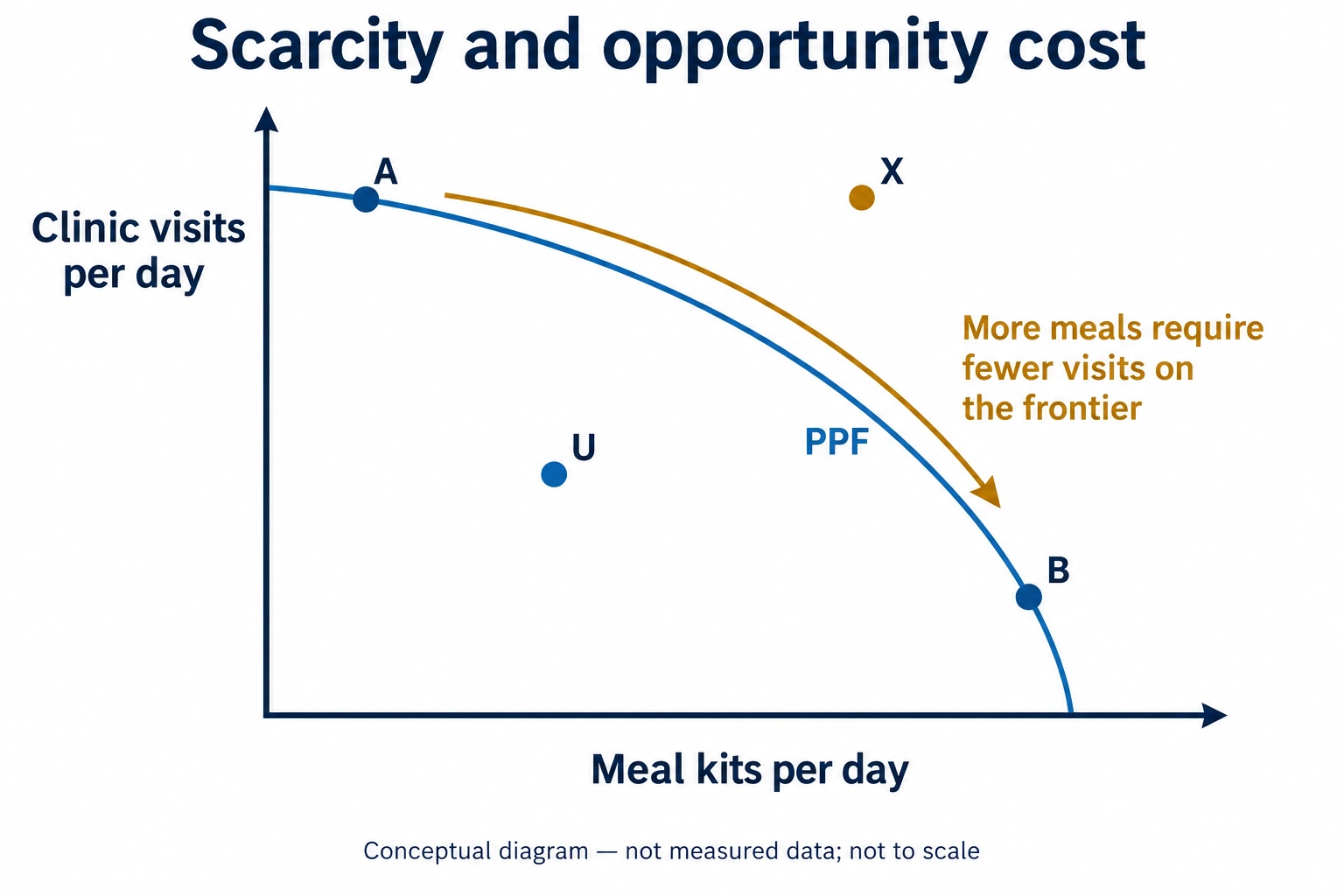
Original teaching plate generated using the built-in imagegen tool, 2026-10-04; conceptual or hypothetical, not empirical evidence. · Original generated artwork; provenance and rights acceptance pending independent review before public publication.
Production possibility frontiers: capacity, efficiency and growth
A production possibility frontier summarises maximum feasible combinations of two output groups during a specified period, given resources and technology. Put one output on each axis with units and time. The boundary is not a demand curve: it shows capacity, not willingness to buy. Points inside are feasible but leave room to increase at least one output without sacrificing the other under the model. Points outside are currently infeasible. The generated plate uses meal kits per day and clinic visits per day; it is deliberately uncalibrated, so the original numerical table below, not pixel distances, determines opportunity costs.
A movement along a fixed frontier reallocates existing productive resources. An outward shift changes productive capacity, perhaps through technology, training or additional equipment. Moving from idle resources to the frontier raises actual output but need not raise potential output. A recession may move actual production inward while capacity remains; prolonged unemployment may later damage skills and investment and shift capacity too. These are separate mechanisms. A new process affecting only meal production can rotate the frontier outwards rather than moving both intercepts equally. Explain which resources or technologies change before drawing a generic growth arrow.
Productive efficiency on a PPF means no more of one output can be produced without reducing the other, given the stated technology. Allocative efficiency asks whether the chosen combination matches the relevant social valuation of marginal benefits and costs. Every point on a standard frontier is productively efficient, but not every point is socially preferred. A council can produce many meal kits efficiently while leaving urgent clinic needs unmet. Preferences, distribution and external effects affect that judgement. The later firm-cost meaning of productive efficiency concerns minimum average costs; do not interchange that diagram with a two-output frontier without explaining the level of analysis.
A bowed-out frontier is consistent with increasing opportunity cost as resources less suited to meals are transferred out of care. It does not arise merely because all resources are limited: perfectly adaptable inputs could generate a straight line and constant opportunity cost. A staircase may be more realistic where equipment and staff are indivisible. The magnitude of a trade-off is a ratio: clinic visits lost per extra meal kit. Reversing axes reverses the units of that ratio. Read local trade-offs from adjacent feasible combinations rather than treating the whole frontier as having one constant gradient.
Investment can require present consumption to be forgone while increasing future capacity. That is a conditional mechanism, not a guarantee: unused equipment, poor maintenance, harmful environmental depletion or failed training may produce little gain. Capacity can also contract through resource damage. Treat an environmental constraint as part of the feasible set rather than a costless background. A society may knowingly accept less measured current output for cleaner air or leisure. The frontier does not rank those values if its axes omit them; a two-good model is useful precisely when its omissions are made explicit.
For extended analysis, connect a capacity diagram to agents and time. An extra clinic shift requires trained labour, not just funding; raising pay may attract labour from another clinic rather than add total capacity. Better scheduling can increase use of existing resources, while training takes time. Distinguish a short-run improvement in utilisation from an outward shift and ask whether the change affects both sectors. A statement that growth resolves scarcity is too strong: even a larger feasible set leaves alternative uses competing. The next-best forgone benefit can change as capacity expands, but the need to choose remains.
Original model essay — part 1. Movement to a production possibility frontier can increase output through better use of existing resources, but movement along it changes the output mix. Neither statement implies that every move is socially desirable. A frontier is a conditional description of feasible production with specified resources and technology. It does not rank the value of meals against clinic visits or determine who receives either service. Productive efficiency and allocative desirability therefore answer different questions. More measured output can reflect reduced slack without indicating an increase in productive capacity. The hypothetical combinations make opportunity cost concrete. Moving from 20 meals and 55 visits to 40 meals and 45 visits gains 20 meals while sacrificing ten visits: the local cost is half a visit per meal. Moving from 60 meals and 30 visits to 80 meals and no visits instead costs 1.5 visits per meal. This increasing cost can reflect resources that are progressively less suited to meal production. It is not established merely by saying resources are scarce, and a straight frontier would be appropriate under a different, constant-cost production model. A point such as 40 meals and 30 visits lies inside the stated possibilities. Moving to 40 meals and 45 visits increases one output without reducing the other, so improving utilisation is potentially beneficial. However, the classification presumes the outputs are comparable and that omitted constraints have not changed. If extra visits are rushed, or staff exhaustion reduces future service quality, the recorded increase may overstate the gain. Evidence about quality, staffing and sustainability would distinguish genuine removal of slack from changing what the output measure counts.
Original model essay — part 2. Along the frontier, the lost visits are a real trade-off. An increase in meals may serve urgent nutritional needs, but reducing visits could harm people requiring treatment. Calling any such movement good silently assumes a value judgement about relative marginal benefits. The desirable mix depends on those benefits, their distribution and available substitutes. A society could choose a different mix without becoming more productively efficient or expanding its feasible set. Equally, a point outside today's frontier is not necessarily impossible forever; it is infeasible under the present assumptions. Staff training illustrates the distinction between current sacrifice and future capacity. Removing workers for six months may reduce today's meals or visits, while improved skills could expand future possibilities. That outcome is uncertain: skills must match actual tasks, trained employees must remain available, and complementary equipment may be needed. If meal productivity alone rises by 25%, the original maximum of 80 meals becomes 100 under the example's assumptions; the maximum of 60 clinic visits does not automatically become 75. An outward change need not be uniform in both directions. I would assess a training programme by its expected additional future benefits, current opportunity cost and risks, rather than reject it because output initially falls or endorse it because growth is promised. A measured output rise is useful evidence, but genuine growth in capacity needs a feasible-set argument. The strongest judgement identifies the mechanism, compares marginal benefits with sacrifices, and checks whether the output measure captures what users actually value.
Worked example: Hypothetical feasible frontier combinations (meal kits/day, clinic visits/day): (0,60), (20,55), (40,45), (60,30), (80,0). Compute opportunity costs for the four 20-kit increases and assess (40,30), (40,50). Assume listed segments approximate the frontier.
From 0 to 20 kits, 5 visits are lost: 5/20 = 0.25 visit per kit.
From 20 to 40, 10 visits are lost: 0.5 visit per kit. From 40 to 60, 15 are lost: 0.75 visit per kit.
From 60 to 80, 30 visits are lost: 1.5 visits per kit. These rising ratios support increasing opportunity cost.
At 40 kits the frontier allows 45 visits. (40,30) is inside; (40,50) is outside under the assumptions.
A 25% productivity increase in meals alone changes meal-axis capacity from 80 to 100 if all other constraints permit, not clinic-axis capacity from 60 to 75.
Answer: Opportunity costs: 0.25, 0.5, 0.75, 1.5 visits per extra kit. The two test points are respectively feasible but below capacity, and currently infeasible. A meal-specific improvement need not expand the clinic intercept.
Check your understanding: Write 450–600 words evaluating "Any move to the PPF is good, and any rise in output is economic growth." Use the table and plate; distinguish productive/allocative efficiency and actual/potential growth. Transfer: training removes staff from present production for six months but increases later productivity. Explain both periods.
Answer: Moving inside-to-frontier increases feasible output utilisation, but whether it is good depends on the output mix and omitted effects such as fatigue or environmental harm. A rise in actual output does not establish capacity growth. Reallocation along the frontier increases one output while reducing another; compare the marginal social values of those changes. Training can reduce current feasible production or available staffing, yet expand future capacity if learning is effective and workers remain. The initial reduction does not show training failure, and the later expansion is not certain. A defensible judgement welcomes removal of genuine inefficiency while requiring evidence of social value, sustainability and future benefits.
Why: Indicative criteria: accurate axis units and point classifications; all four opportunity-cost ratios with local denominators; a distinction between movement and shift tied to resources; a productive/allocative comparison; two-period training mechanism; a qualified welfare judgement. Reward a straight-line alternative if constant trade-offs are explicitly assumed. Do not reward measuring the uncalibrated raster or automatically treating maximum measured output as maximum social welfare.