Competitive equilibrium: shortages, surpluses and price adjustment
By UK A Level Economics · independent study · myAudience
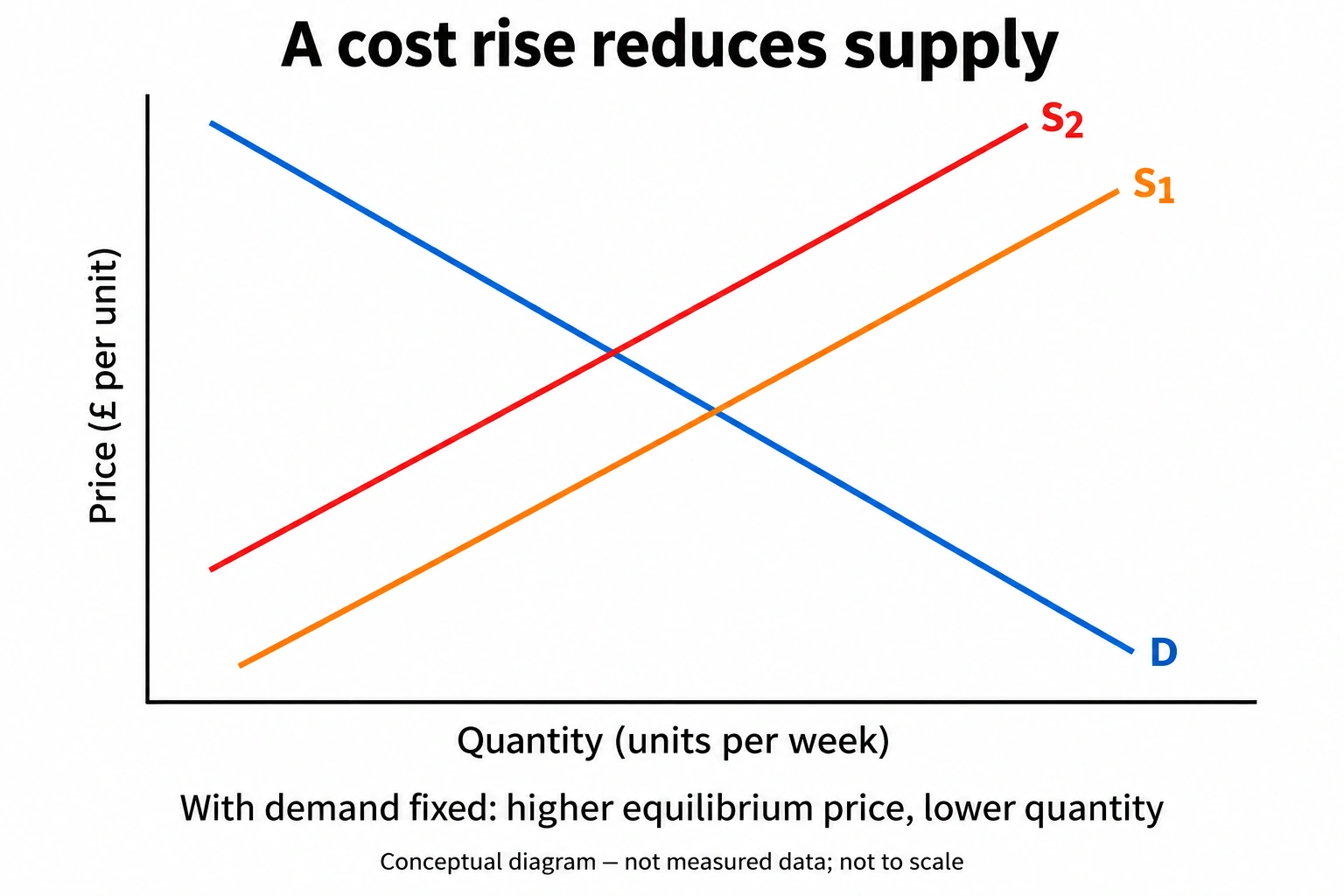
Original teaching plate generated using the built-in imagegen tool, 2026-10-04; conceptual or hypothetical, not empirical evidence. · Original generated artwork; provenance and rights acceptance pending independent review before public publication.
Competitive equilibrium: shortages, surpluses and price adjustment
Equilibrium in the competitive demand–supply model is a price at which quantity demanded equals quantity supplied. It is an absence of an internal pressure for price to change under the stated conditions, not a claim that the outcome is fair or permanent. Buyers still face budgets and producers still face scarce resources. If an outside event shifts a curve, the old price is no longer clearing. A diagram should name the initial curves, mark their intersection and project the same point onto both axes. The supply plate shows two clearing intersections, D/S1 and D/S2; an equilibrium must be at an actual intersection, not merely somewhere on demand.
At a price below equilibrium, desired purchases exceed offers, creating excess demand. Buyers may bid up prices or sellers may revise posted prices; rationing can also occur through queues or allocation rules. At a price above equilibrium, offers exceed desired purchases and unsold output creates pressure for a price cut. These are mechanisms rather than automatic instantaneous laws. Contracts, menu costs, regulation and expectations can delay adjustment. A shortage figure is a difference between desired quantities at one specified price, not a measured quantity missing from all possible allocations.
An increase in demand with unchanged upward supply normally raises both equilibrium price and quantity. A decrease in supply with unchanged downward demand raises price but lowers quantity. In each case the new own price causes a movement along the curve that did not shift. Calling the induced response a second shift double-counts the same adjustment. Read the supply plate: a cost shock shifts S, then higher price reduces quantity demanded along D. The hypothetical equations below give exact coordinates; the plate gives qualitative relationships and is not calibrated to those equations.
The model assumes sufficiently competitive exchange, a stable product definition, conditional schedules and prices capable of adjusting. It abstracts from strategic price setting, many search frictions and macro feedbacks. If producers set a common capacity ceiling or buyers face eligibility rules, the mechanism can differ. Actual transactions at a non-clearing price are limited by available offers or willing buyers and the allocation rules. They need not equal the larger desired quantity. A queue tells us something about non-price rationing but not whether the service ought to be allocated by money instead.
Equilibrium is not automatically socially efficient. Demand reflects private willingness and ability to pay; supply reflects private production incentives. External harms, public goods, imperfect information and unequal purchasing power may make private clearing differ from a social objective. At this stage, treat the clearing calculation as a positive result within a model. Later lessons introduce criteria for evaluating it. Nor does the existence of a unique solution to two invented linear equations prove that every real market has a unique stable equilibrium. The algebra is a transparent learning device.
In an extended response, trace adjustment with named agents rather than saying "the market fixes it". A demand increase first creates excess demand at the old price. A higher price discourages some buyers and encourages some sellers until quantities match, if adjustment is feasible. Evaluate speed using time horizons and information; evaluate access using distribution; evaluate efficiency using effects omitted from private decisions. These are separate questions. A reasoned policy conclusion could tolerate gradual adjustment, protect vulnerable users or expand capacity, but it should acknowledge implementation costs and not equate a desirable goal with a successful intervention.
Original model essay — part 1. A ceiling of three pounds in the hypothetical market creates an excess of desired purchases over intended offers, but the consequences depend on allocation and subsequent adjustment. Equilibrium is a condition in which quantity demanded equals quantity supplied under specified schedules. It does not imply that everyone has their preferred amount or that the distribution is fair. A price ceiling can improve access for successful buyers while making it harder for others to obtain the good. Assessing it requires examining both the price and the mechanism used when not every intended purchase can be fulfilled. With Qd = 100 − 10P and Qs = 20 + 10P, the unregulated equilibrium is four pounds and 60 units. At three pounds, buyers demand 70 units while suppliers offer 50. The shortage is therefore 20 units for the stated period. Seventy units are not automatically sold: realised transactions are constrained by available supply and the allocation process. It would also be wrong to assume that all 50 supplied units reach the people whose welfare benefit is greatest. The model contains monetary demand, not a complete measure of need. Queues, booking systems or allocation by sellers can replace some of the price mechanism. A queue uses time as well as money, disadvantaging people unable to wait. Preferential access may favour informed or connected customers. An explicit needs-based system can address some inequities but introduces verification costs and possible errors. These arrangements change the effective cost of obtaining the good even when the posted price remains three pounds. A judgement that the ceiling benefits low-income users needs evidence about who actually receives units, not just the lower price charged to those who succeed.
Original model essay — part 2. Over time, the response may extend beyond the fixed supply schedule. Lower returns can discourage maintenance, new entry or additional production if suppliers cannot cover relevant costs. On the other hand, an unusually high pre-ceiling price might reflect market power rather than the competitive conditions assumed here. Evidence about production costs, contracts and competitive constraints would determine how far this classroom model applies. It would be inconsistent to use the numerical schedules as a precise prediction while simultaneously invoking an unmodelled market structure without explaining the change in assumptions. Releasing 25 stored units supplies a useful transfer case. If the stored goods are usable substitutes and distributed during this period, they could cover the calculated 20-unit gap. That does not mean productive capacity has increased permanently. Stocks can be exhausted, and replenishment has a cost. Storage losses, quality differences or a poorly targeted release could also prevent the extra units from reaching the intended users. The policy may bridge a temporary disruption, but a continuing shortage needs a sustainable flow response or a change in desired demand. My recommendation would depend on the objective and duration. A temporary ceiling accompanied by a funded, transparent allocation and stock-release plan might protect vulnerable users during a short shock. For a persistent problem, targeted support combined with measures addressing supply constraints may avoid some rationing costs, although subsidies can themselves raise demand and prices. The three-pound ceiling has identifiable benefits and risks; neither the equation showing a shortage nor the lower posted price establishes the whole welfare judgement.
Worked example: Hypothetical market Qd=100−10P and Qs=20+10P, quantities in units/week, P in £/unit. Find equilibrium, excess demand at £3 and excess supply at £5. If a cost rise changes Qs to 10P, find the new clearing outcome.
Set 100−10P=20+10P: 80=20P, so P=4 and Q=60 units/week.
At £3: demand=70 and supply=50, so excess demand=20 units/week. Actual sales cannot exceed 50 here without stocks/imports or other sources.
At £5: demand=50 and supply=70, so excess supply=20 units/week. Actual sales need not be 70.
With new Qs=10P: 100−10P=10P gives P=5 and Q=50.
The cost shift raises price £4→£5, a 25% rise, and reduces quantity 60→50, a 16.7% fall using initial values. Demand has not shifted.
Answer: Initial equilibrium £4 and 60 units/week; 20-unit shortage at £3 and 20-unit surplus at £5. After the supply decrease: £5 and 50. Clearing is conditional and does not establish fairness or social efficiency.
Check your understanding: Write 450–600 words evaluating a £3 price ceiling in this hypothetical market. Explain the 20-unit gap, possible allocation rules and effects over time. Transfer: if suppliers can release 25 stored units once, does that remove scarcity or permanently solve the shortage?
Answer: The ceiling below the £4 clearing price creates desired demand of 70 against weekly supply of 50, so rationing is needed. Queues, eligibility priorities or resale can allocate scarce output; lower price may help those who obtain it while excluding others through time costs or availability. A one-off release of 25 stored units can cover the current 20-unit gap, but stocks are depleted and a recurring weekly gap can return. It does not remove scarcity. Maintenance/investment incentives may weaken over time, though the exact supply response requires evidence. Targeted support or expanded capacity may protect access differently but uses funding. The judgement should distinguish protecting recipients from ensuring all desired purchases occur.
Why: Indicative criteria: equality solved with correct units; shortage measured at the ceiling; distinguish desired quantities, sales and stocks; explain queues/resale and intertemporal incentives; compare a feasible policy alternative; weigh distribution and capacity. Avoid an automatic "ceilings are always bad" conclusion: welfare depends on beneficiaries, enforcement and alternatives. Unsupported claims that cheap prices increase supply contradict the specified schedule.