Supply elasticity and tax incidence: who can adjust?
By UK A Level Economics · independent study · myAudience
Original teaching plate generated using the built-in imagegen tool, 2026-10-04; conceptual or hypothetical, not empirical evidence. · Original generated artwork; provenance and rights acceptance pending independent review before public publication.
Supply elasticity and tax incidence: who can adjust?
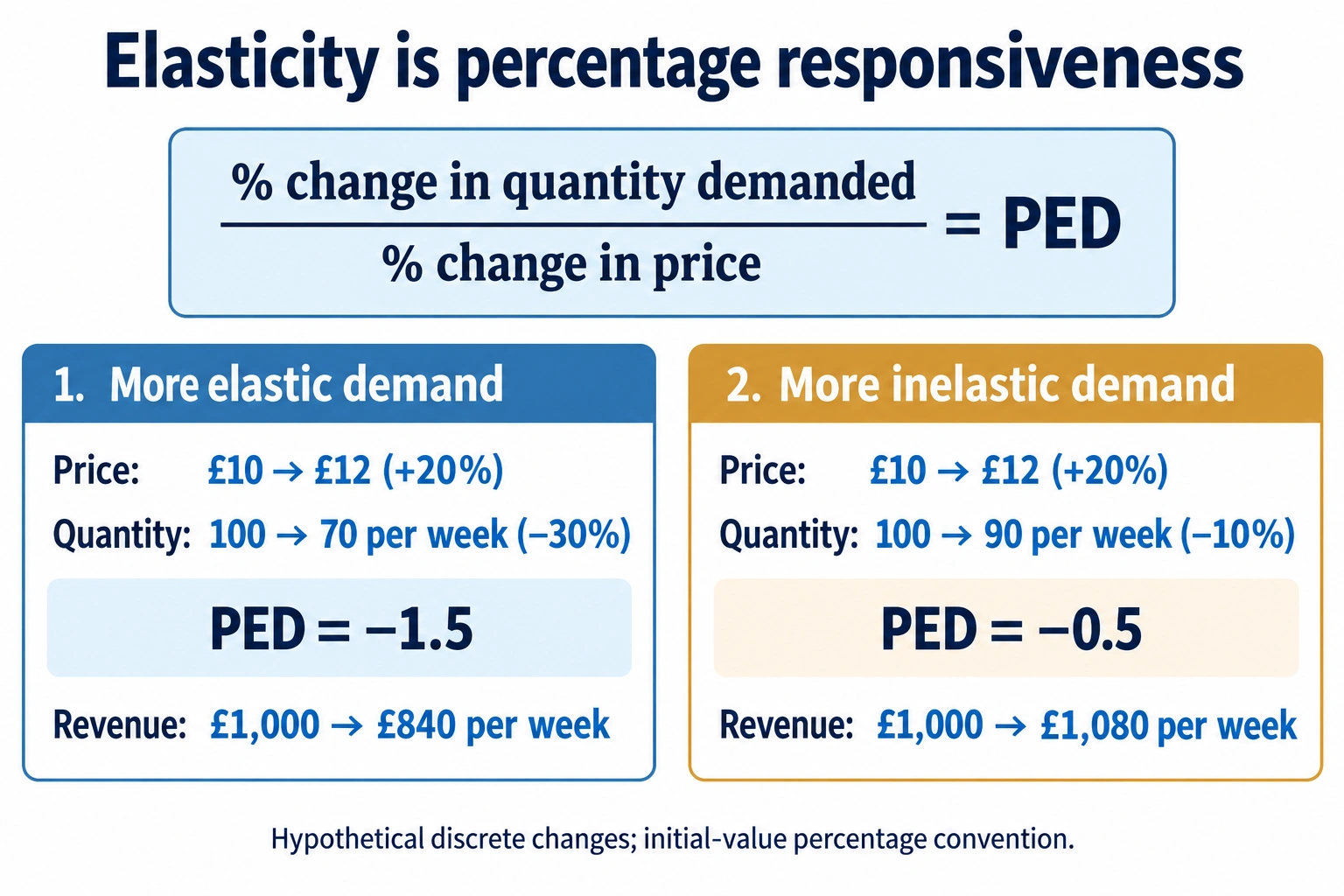
Price elasticity of supply (PES) divides percentage change in quantity supplied by percentage change in own price. In the usual schedule it is non-negative. Values above one indicate a proportionately larger quantity response; below one indicate a smaller response. Zero describes fixed quantity over the relevant horizon. The PED plate illustrates the percentage-ratio method but its negative figures are demand examples: they must not be called PES. Both measures are unit-free, while curve slopes depend on axis units. A steeply drawn line cannot be declared inelastic without considering coordinates and scale.
Spare capacity, inventories, production time, input mobility and the ability to expand determine the response. A fixed seating capacity can imply PES near zero tonight, while new venues can increase supply over years. Fresh crops may be difficult to expand quickly; stored goods can be released faster, though stock depletion limits repeated releases. A longer horizon often permits a larger response but does not guarantee it when land, regulation or skills remain binding. State the relevant period before comparing industries. A fixed short-run quantity is not evidence that producers ignore incentives.
A per-unit tax creates a wedge between the price buyers pay and the net price sellers receive. Legal responsibility for remitting the tax does not by itself determine the economic burden. Buyers can reduce purchases; sellers can contract output or leave. The less responsive side generally bears more of the price burden in a competitive model. If demand is very inelastic, buyers have limited alternatives, so more of the wedge may appear as a higher buyer price. If supply is very inelastic, sellers have fewer adjustment options and more may appear as a lower net receipt. These are relative elasticities, not moral assignments of blame.
Use algebra to distinguish the two prices. With buyer price Pc and seller receipt Ps, Pc−Ps equals the tax per unit. Demand depends on Pc; supply depends on Ps. Substituting Pc into both schedules would erase the wedge and produce a wrong quantity. Tax receipts equal tax times units traded, measured as money per period. That receipt is a transfer to government, not automatically a net social loss. Administrative costs, behavioural distortions and externality changes matter for welfare. We have not yet introduced the surplus areas needed to measure a welfare loss; the next lesson does.
An incidence prediction is conditional on market structure, enforcement, timing and response curves. Firms with market power, contracts or strategic pricing can pass through taxes differently. Informal trade, changes in quality and tax avoidance can complicate observed prices. A correlation between a tax increase and retail-price increase need not identify full pass-through if input costs change too. Policy evaluation needs credible comparisons and evidence about who ultimately pays, including wages, profits or suppliers beyond the immediate transaction.
A reasoned extended response connects elasticity to options. A rural commuter may face fewer transport substitutes than an urban one, while a producer with specialised equipment may find exit costly. Compare short and long run, not just consumers and firms in the abstract. A tax designed to reduce harmful use may raise revenue but have a modest quantity effect when demand is inelastic; that does not mean it has no welfare justification, nor that it is automatically fair. Specify the external harm, distributional protections and use of revenue. Incidence and desirability answer different questions.
Original model essay — part 1. A tax legally paid by sellers can harm buyers because legal responsibility and economic incidence are different. Sellers respond to the net price they retain, while buyers respond to the gross price they pay. In a competitive model, a per-unit tax creates a wedge between those prices. How the burden is divided depends on the relative responsiveness of demand and supply, not on which side sends the payment to the government. This mechanism makes the original claim false under the stated model, although its quantitative application requires evidence. The hypothetical market starts with Qd = 100 − 10Pc and Qs = 20 + 10Ps. Without a tax, the prices coincide at four pounds and quantity is 60. A two-pound tax requires Pc = Ps + 2. Solving gives a buyer price of five, seller net price of three and quantity 50. Buyers pay one pound more per unit and sellers retain one pound less. Equal slopes produce equal per-unit incidence here; that is a feature of this example, not a general rule that all taxes are shared equally. Revenue is two pounds multiplied by 50 units, or 100 pounds. Buyers' total expenditure is 250 pounds, while sellers receive 150 pounds after tax. These flows must not be confused with the entire welfare cost of the tax. Quantity falls, some mutually beneficial transactions may be lost, and collecting and spending revenue involves additional choices. Conversely, an external cost or a funded public service could justify intervention. Identifying an incidence on buyers therefore does not settle whether the tax is desirable; it disproves the claim that legal remittance prevents that incidence.
Original model essay — part 2. Demand for an essential good with few practical substitutes may be relatively unresponsive over the relevant range, leaving buyers bearing a larger share than when substitutes are plentiful. Supply responsiveness also matters. A seller unable to redeploy fixed capacity may initially absorb more of a tax, whereas adjustment or exit over time can change the outcome. The separate supply-elasticity example, where price rises from four to five and offers increase from 60 to 75, gives PES of one using initial values. It describes that schedule and interval rather than the whole market's incidence under every tax. If energy costs rise when the tax begins, an observed retail price increase combines two possible mechanisms. Attributing all of it to the tax would overstate pass-through unless the cost change is accounted for. Comparing otherwise similar untaxed products or firms with different tax exposure may help, but substitution and shared inputs can contaminate those comparisons. Evidence should also distinguish the posted price from discounts, product quality and package size, since buyers may bear part of a burden through changes other than the headline price. My judgement is that a seller-remitted tax can clearly affect buyers, but its size and welfare significance are conditional. Policymakers should examine relative elasticities over an appropriate horizon, distribution across customer groups and the purpose of the revenue. If a vulnerable group faces a substantial burden, a targeted offset may be considered, with its own financing and administrative costs. The relevant analysis follows the price wedge and feasible responses; naming the legal taxpayer is not an incidence argument.
Worked example: Hypothetical Qd=100−10Pc, Qs=20+10Ps (units/week). Introduce a £2/unit tax, so Pc=Ps+2. Solve prices, quantity, burdens and receipts. Separately compute PES if price rises £4→£5 and quantity supplied 60→75.
Before tax Pc=Ps=4 and Q=60. After tax: 100−10(Ps+2)=20+10Ps; 60=20Ps, so Ps=3 and Pc=5.
New Q=50. Buyers pay £1 more/unit and sellers receive £1 less: the £2 wedge is split equally in this example.
Receipts = £2×50 = £100/week. Buyer spending = £5×50=£250; seller receipts = £3×50=£150; their difference is £100.
PES example: price rises 25%; quantity supplied rises 25%; PES=1.
The equal incidence comes from the specified slopes at this equilibrium, not from a rule that every tax is shared half-and-half.
Answer: Pc £5, Ps £3, Q 50/week; £1 per-unit burden on each side and £100 weekly receipts. The separate initial-value PES is +1. Legal remittance is not economic incidence.
Check your understanding: Write 450–600 words assessing "A tax collected from sellers cannot harm buyers." Use the wedge calculation, compare an essential good with many-substitute demand, and discuss short/long-run supply. Transfer: a tax and an input-cost rise occur together; design an evidence check.
Answer: Buyers pay £1 more in the hypothetical example despite collection from sellers. More inelastic demand tends to place more burden on buyers relative to a responsive supply, while many substitutes can shift burden towards sellers. Adjustment over time may change relative elasticities as firms and buyers find alternatives. A simultaneous input-cost rise also tends to raise prices, so attributing the entire observed rise to the tax exaggerates pass-through. Compare untreated but similar products or markets, pre-trends and cost data, and examine net seller receipts as well as retail prices. Welfare and fairness depend on harms reduced, access and revenue use, not merely who remits the tax.
Why: Indicative criteria: correct two-price algebra, quantity and receipts; correct PES percentage denominators; relative-elasticity mechanism; horizon-specific constraints; concrete cost confounding/evidence design; separate incidence from welfare. Reward a justified asymmetric case. Do not accept adding the whole tax to buyer price while keeping quantity and seller price fixed unless perfectly inelastic demand is explicitly assumed.