Public goods and common resources: institutions and free riding
By UK A Level Economics · independent study · myAudience
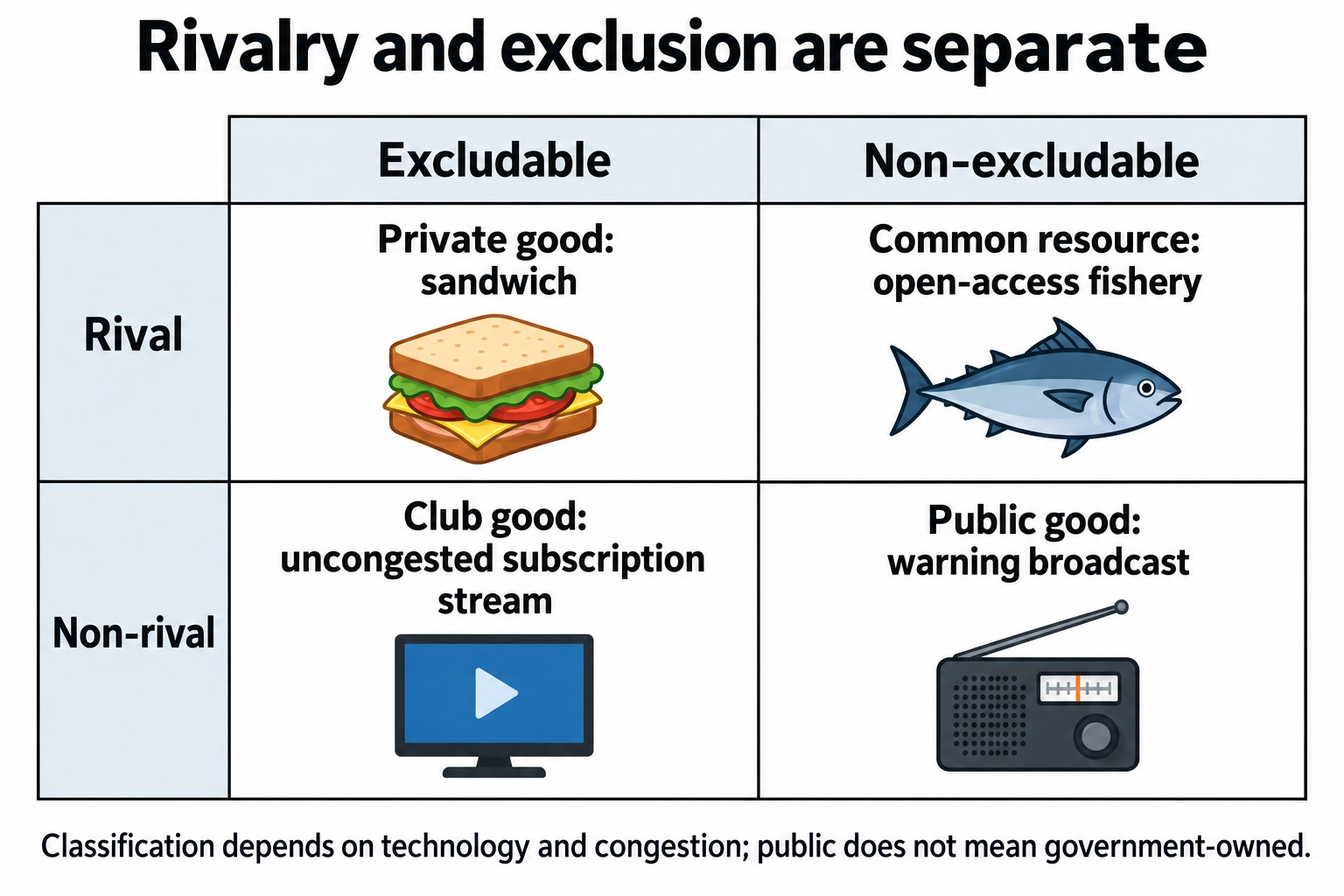
Original teaching plate generated using the built-in imagegen tool, 2026-10-04; conceptual or hypothetical, not empirical evidence. · Original generated artwork; provenance and rights acceptance pending independent review before public publication.
Public goods and common resources: institutions and free riding
Rivalry means one person's use reduces what is available to others. Excludability means users can feasibly be prevented from benefiting without permission or payment. A pure public good is non-rival and non-excludable over the relevant range. Government ownership is not the definition: a publicly operated sandwich stall still sells rival, excludable food. The plate separates the two dimensions. A private good sits in the rival/excludable cell; a common resource in rival/non-excludable; a club good in non-rival/excludable when uncongested; a pure public good in non-rival/non-excludable.
A warning broadcast can benefit another listener without reducing the warning available to existing listeners, and excluding all unpaid beneficiaries may be difficult. A supplier reliant on voluntary payments faces free riding: a person may prefer others to finance provision while still enjoying it. This can lead to under-provision or a missing market. It does not imply that every user values the warning equally or that zero provision must always occur. Donations, institutions or a bundled service may provide some output. The problem is aligning contributions with benefits when exclusion is impractical.
A fishery open to all is different. Fish caught by one boat are no longer available to another: it is rival. If access cannot be controlled, each boat may ignore the depletion cost imposed on other users and future stocks. The tragedy of the commons is a risk under those incentives, not a claim that every community-managed resource inevitably collapses. Rules governing access, monitoring and sanctions can change the incentives. Ostrom's research, presented in her Nobel lecture, examines institutions beyond a simple choice between unfettered markets and central state control. We do not infer success for any specific fishery from the plate.
Technology and congestion can change classification. Encryption may make a broadcast excludable. A road may be largely non-rival when empty but rival when congested; toll equipment changes exclusion costs. A club service can become congested if too many users share capacity. A label such as quasi-public therefore requires explanation of which characteristic holds imperfectly and in what conditions. The examples in the plate are conditional: "uncongested subscription stream" states a range, and "warning broadcast" assumes beneficiaries cannot all be charged individually. Classify the service actually described, not its name alone.
A public-good decision compares benefits across all beneficiaries with resource costs. If one more warning benefits several listeners without rivalry, social marginal benefit includes all their marginal valuations, assuming those valuations use a defensible common money measure. Private individual payment decisions may not reveal those values honestly because users can conceal willingness to pay. Aggregating estimated benefits is therefore not the same as observing a revenue forecast. Distribution, uncertainty and the opportunity cost of funding remain relevant. A central provider can also misestimate demand, overspend or respond to political incentives.
Evaluate institutions by the particular coordination problem. A compulsory levy may fund a non-excludable warning but impose burdens on low-income households. A user club with defined rights may help conserve a common resource, yet monitoring and enforcement can be costly or exclude outsiders. Tradable rights, quotas and local rules create different incentives and require legitimate allocation. Connect stock and flow: a fish stock is measured at a date, while catch is a flow per period. Sustainable catch depends on regeneration, not merely current price. The original arithmetic below simplifies biology to reveal the stock accounting and institutional trade-off.
Original model essay — part 1. Compulsory funding for an open warning service and community rules for a fishery address different economic problems. The warning is potentially non-rival in use and difficult to exclude recipients from; fish are subtractable, so one fisher's catch leaves fewer for others. These characteristics concern the good and access technology, not whether its provider is public or private. A useful policy comparison begins with the specific mechanism that prevents voluntary arrangements from reaching a desirable outcome, rather than assuming government provision or community control is always superior. In the warning example, two recipients value the service at 60 and 50 while its cost is 90. Their combined willingness to pay is 110, yielding a possible net gain of 20 within the stipulated model. Neither person alone values it at the full cost. If each hopes that the other will pay while both receive the broadcast, voluntary funding may fail. This free-rider incentive supports collective finance, but does not prove that no voluntary arrangement is possible. Repeated interaction, charitable preferences or a coordinated agreement could change the outcome. The government still needs information about benefits and costs. Compulsory contributions can spread the cost, although a particular funding rule may impose a disproportionate burden on some recipients. The legitimacy of the decision, ability to pay and enforcement costs matter. Charging individual subscribers may be ineffective if non-subscribers can hear the signal indirectly, because payment does not fully exclude them. Conversely, a new access technology could make exclusion easier and change the feasible funding arrangements. The label public good should therefore be tied to the actual service design, not treated as a permanent property of every possible warning system.
Original model essay — part 2. The fishery illustrates a different problem. Starting with 1,000 fish and stipulated net regeneration of 200, four boats each catching 80 remove 320, leaving 880. A total catch cap of 200 leaves 1,000 under those assumptions; an equal division would allow 50 per boat. Those calculations demonstrate the accounting mechanism, not an actual sustainable biological recommendation. Regeneration can depend on stock size, environmental conditions and timing, so repeating the same fixed figure indefinitely would be unjustified. Distribution of rights and compliance also determine whether the theoretical cap works. Community governance can use local information and legitimate shared rules, but membership boundaries, monitoring and sanctions must be credible. A powerful participant may capture decisions or shift costs onto excluded users. Central regulation also faces information and enforcement limits. Ostrom's institutional analysis supports examining context and arrangements rather than declaring every common resource inevitably depleted or every local group effective. The appropriate comparison is between feasible institutions, including their costs, not between an imperfect real system and an imagined costless alternative. I would provisionally favour collective finance for a warning whose benefits genuinely spill over and a fishery regime with an enforceable total constraint and defensible allocation. Whether the latter is community-led, public or mixed depends on local legitimacy, monitoring capacity and ecological evidence. Both choices remain conditional. The warning decision must test whether total benefits justify resources used; the fishery decision must test both stock dynamics and governance. Treating them as the same market failure would obscure why finance is central in one and restraint on extraction in the other.
Worked example: Hypothetical lake has 1,000 fish at the start of a year. Natural net regeneration adds 200 before catch; four boats each plan to catch 80. Compute end stock. Compare a binding total catch limit of 200. Separately, two households value a warning service at £60 and £50/year; provision costs £90/year.
Unregulated planned catch=4×80=320 fish/year. End stock=1000+200−320=880 fish, assuming the net regeneration figure and timing are correct.
With a total limit of 200, end stock=1000+200−200=1000. A uniform division would allow 50 fish per boat/year, but that is a distribution rule, not a biological necessity.
The planned catch exceeds regeneration by 120. Repeating this numerical rule indefinitely is not a realistic population model because regeneration may depend on stock.
For the non-rival warning, summed hypothetical willingness to pay=60+50=£110/year, above £90 cost by £20.
Neither household alone values it at £90, and free riding can prevent voluntary joint finance. Positive net benefit does not itself supply an enforceable or fair payment mechanism.
Answer: Fish stock falls to 880 with 320 annual catch; a 200 limit holds it at 1,000 under the simplified regeneration assumption. Warning net benefit is £20/year, yet contributions can fail through free riding.
Check your understanding: Write 500–650 words comparing compulsory warning-service funding with community fishery rules. Explain why the two goods are different, propose a funding/access rule and address a serious competing institutional explanation. Transfer: a new technology can charge individual warning recipients but others still hear it.
Answer: The warning is non-rival/non-excludable, so voluntary finance can understate joint benefits; the fishery is rival/non-excludable, so private catch incentives can deplete a stock. A levy may fund the £20 net-benefit warning but must handle affordability and uncertain valuations. Community access rules with monitoring may keep catch near regeneration, though enforcement, outsider access and fairness can undermine them. Technological charging creates partial exclusion, but audible spillovers preserve some free riding; classification depends on the effective beneficiary boundary. Neither state nor community provision is automatically efficient. Prefer a conditional institutional design that matches the problem and compares resource/admin costs and legitimacy.
Why: Indicative criteria: accurate two-dimensional classifications; correct stock/flow arithmetic; distinguish free riding from rival depletion; explain how a proposed rule changes incentives; treat Ostrom as evidence for possible institutional alternatives, not universal success; evaluate charging spillovers and funding equity. A well-defended levy, rights system or community rule can meet the criteria. Name-dropping "commons" without a mechanism cannot.