Externalities and merit goods: the marginal social benchmark
By UK A Level Economics · independent study · myAudience
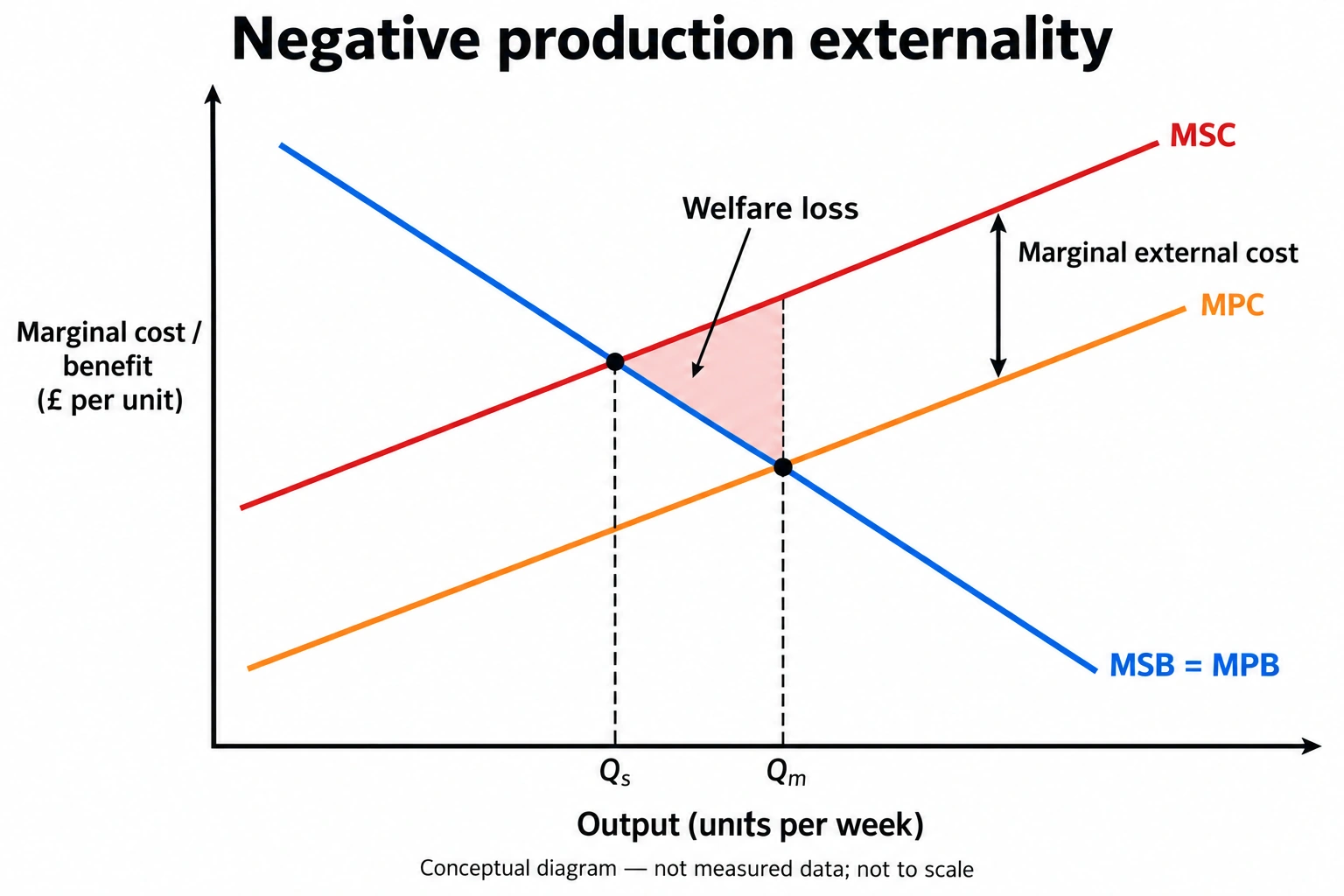
Original teaching plate generated using the built-in imagegen tool, 2026-10-04; conceptual or hypothetical, not empirical evidence. · Original generated artwork; provenance and rights acceptance pending independent review before public publication.
Externalities and merit goods: the marginal social benchmark
An externality is a cost or benefit affecting a third party that the decision maker does not fully take into account through the transaction. A factory's smoke can impose cleaning or health-related costs on neighbours without compensation. Social cost includes private cost plus external cost; social benefit includes private benefit plus external benefit. A price change transmitted through a normal market is not automatically an externality: it may be part of the price mechanism. Identify an uncompensated effect on others and explain why private choices omit it. We use hypothetical monetary harm estimates, not invented health data.
Marginal means the change associated with one additional unit. For a negative production externality, marginal social cost (MSC) lies above marginal private cost (MPC). Assuming no consumption spillover, marginal social benefit equals marginal private benefit (MSB=MPB). The private competitive outcome equates MPB and MPC at Qm; the social benchmark equates MSB and MSC at Qs. The plate accurately shows Qs left of Qm. Between them the additional units cost society more than their benefits, producing the shaded welfare-loss triangle. It is not the total external-damage area and cannot be measured from uncalibrated pixels.
For a negative consumption spillover one conventional diagram has MSB below MPB, with MSC=MPC, again making private quantity too high. A positive consumption spillover places MSB above MPB and tends to make private quantity too low. A positive production spillover can be represented by MSC below MPC. These are alternative diagram placements for different mechanisms, not labels to interchange. In every case locate private and social intersections and identify the forgone net gains. The A-level specification requires marginal cost/benefit diagrams; shared AS externality content does not require the same MSC/MSB diagram demand.
A merit good is judged to be beneficial enough that people may consume too little of it; a demerit good too much, relative to a defended judgement. Imperfect information or limited attention can make perceived private benefits differ from informed benefits. External effects may coexist, but merit status and positive externality are not synonyms. A service could benefit its user yet have no substantial spillover, and another could have a spillover without fitting a particular merit judgement. Explicitly distinguish paternalistic claims about the consumer's own interests from claims about benefits to other people.
An efficiency benchmark is conditional on estimates of harm and benefit, the relevant population, time horizon and uncertainty. Marginal damage may rise with concentration, depend on where production occurs or persist after the production period. Valuing harm in money can miss distribution or irreversible effects. Private bargaining can internalise some spillovers when rights are clear and transaction costs low, but large numbers of affected people, unequal bargaining power and information can obstruct agreement. A missing effective right or enforcement mechanism is one explanation, not proof that every externality can be eliminated by assigning ownership.
For policy evaluation compare instruments with the actual failure. A tax can make a producer face estimated marginal external cost; an output or emissions rule can constrain harm; a permit system can cap covered emissions and let firms trade reductions. Each needs measurement and enforcement. A flat output tax is less precise when emissions differ across producers. A subsidy for a positive spillover can increase provision but may pay for activity that would have occurred anyway. The next lesson develops these choices. Here the key achievement is identifying the social benchmark correctly, separating transfers from harm and not using private market clearing as a welfare conclusion.
Original model essay — part 1. A tax on a demerit good does not necessarily remove all pollution, and demerit status is not itself a numerical measure of external damage. An externality arises when a decision imposes costs or benefits on others that the decision-maker does not fully account for. A demerit classification concerns a judgement that consumption is excessive, perhaps because consumers underestimate private harm. The two can coincide but should be distinguished: an information problem about harm to the consumer calls for a different argument from an unpriced cost imposed on someone else. The hypothetical production example makes marginal accounting explicit. Marginal private and social benefits are 20 − Q, marginal private cost is 4 + Q, and marginal social cost is 8 + Q. The private equilibrium is Q = 8 at price 12. Equating social benefit with social cost gives Q = 6, where marginal benefit is 14 and private cost ten. The vertical cost gap is four, so a four-unit per-unit tax can align private incentives with the stipulated social cost. That tax is a marginal correction; it is not calculated by charging every producer the entire total damage bill on each unit. At the social quantity, six units are still produced. With the constant four-unit marginal external cost specified here, residual total external damage is 24. Tax revenue is also 24, but the equality is a numerical feature of the constant-rate example, not evidence that harm has disappeared or that receiving revenue reverses it. The gain from reducing excessive output from eight to six is the triangular area between social cost and benefit: one half times two times four, or four. Counting all revenue as an extra welfare gain without accounting for transfers would confuse fiscal flows with avoided resource harm.
Original model essay — part 2. Different emissions intensities make targeting important. If two firms produce the same product but impose different damage per unit, one uniform output tax may not align both incentives accurately. A charge tied to measurable emissions could better reward cleaner techniques, but measurement, enforcement and avoidance become relevant costs. A production restriction may provide a clearer quantity constraint where damages are uncertain or irreversible, while offering less flexibility across firms. No instrument is automatically best merely because its name appears next to a correctly drawn diagram. For a demerit consumption problem, better information may address underestimated private costs, although consumers can already know a risk and still make choices that policymakers dislike. That disagreement involves a normative judgement about autonomy and welfare. An external-cost tax may still be justified if consumption harms others, but the reasoning should identify those people and the causal mechanism. Distribution also matters: a tax can burden low-income users, and substitutes or targeted support may reduce hardship without removing the underlying incentive. Such support has its own financing and implementation costs. My judgement is that a corrective tax can improve welfare under a credible marginal-damage estimate and an enforceable incentive structure, but zero pollution is generally a separate objective. In this model, eliminating all output would forgo units whose social benefits exceed social costs. Different real damage relationships could change that conclusion, particularly with thresholds or catastrophic risks. The strongest recommendation therefore specifies the welfare criterion, distinguishes private information from external harm and explains how the instrument follows the actual source of damage rather than assuming every demerit good requires the same tax.
Worked example: Hypothetical weekly output Q: MPB=MSB=20−Q, MPC=4+Q, MSC=8+Q, all £/unit. Find Qm/Qs, the marginal external cost and welfare loss. Find an ideal constant per-unit corrective tax under these assumptions.
Private: 20−Q=4+Q gives Qm=8 units/week and private price £12/unit.
Social: 20−Q=8+Q gives Qs=6. At Qs, MSB=MSC=£14/unit while MPC=£10/unit.
Marginal external cost=MSC−MPC=£4/unit throughout this invented range.
Welfare loss from units 6 to 8 is 0.5×(8−6) units/week×£4/unit=£4/week; the height at Qm is MSC−MSB=4.
A £4/unit tax raises the private cost schedule to MSC and gives Q=6. Tax receipts=4×6=£24/week; residual external cost=4×6=£24/week, a different item with the same numerical value here.
Answer: Qm 8, Qs 6, constant marginal external cost £4/unit and welfare loss £4/week. A £4 tax decentralises Qs in this exact model; it does not eliminate all external harm or make receipts a welfare loss.
Check your understanding: Write 500–650 words evaluating "Every demerit good should be taxed at the full external damage, so that pollution disappears." Use the equations, distinguish total/marginal harm and private/social benefit, and transfer to producers with different emissions per unit.
Answer: The ideal tax matches marginal external cost at the desired outcome, not total damage. In the example £4/unit reduces output to 6 and removes the £4 welfare loss, yet £24 external damage remains because some production has benefits exceeding social costs. Demerit classification can also involve perceived private benefit and value judgements without a spillover. A tax on output may be poorly targeted when clean and dirty firms have different emissions; taxing measured emissions or regulating intensity may align incentives better if measurement is feasible. Uncertain harm, distribution and enforcement can justify a precautionary rule or a differentiated instrument. Elimination of pollution is a separate policy objective, not implied by marginal efficiency.
Why: Indicative criteria: correct intersections, triangle and units; explicitly separate marginal external cost, total damage, receipts and welfare loss; classify production/consumption and sign placements correctly; distinguish merit judgement from externality; explain heterogeneity and measurement limits; make a conditional instrument judgement. Reward justified precautionary objectives if their value basis and costs are clear. These are original indicative criteria, not marks.