Intervention and government failure: choosing a defensible instrument
By UK A Level Economics · independent study · myAudience
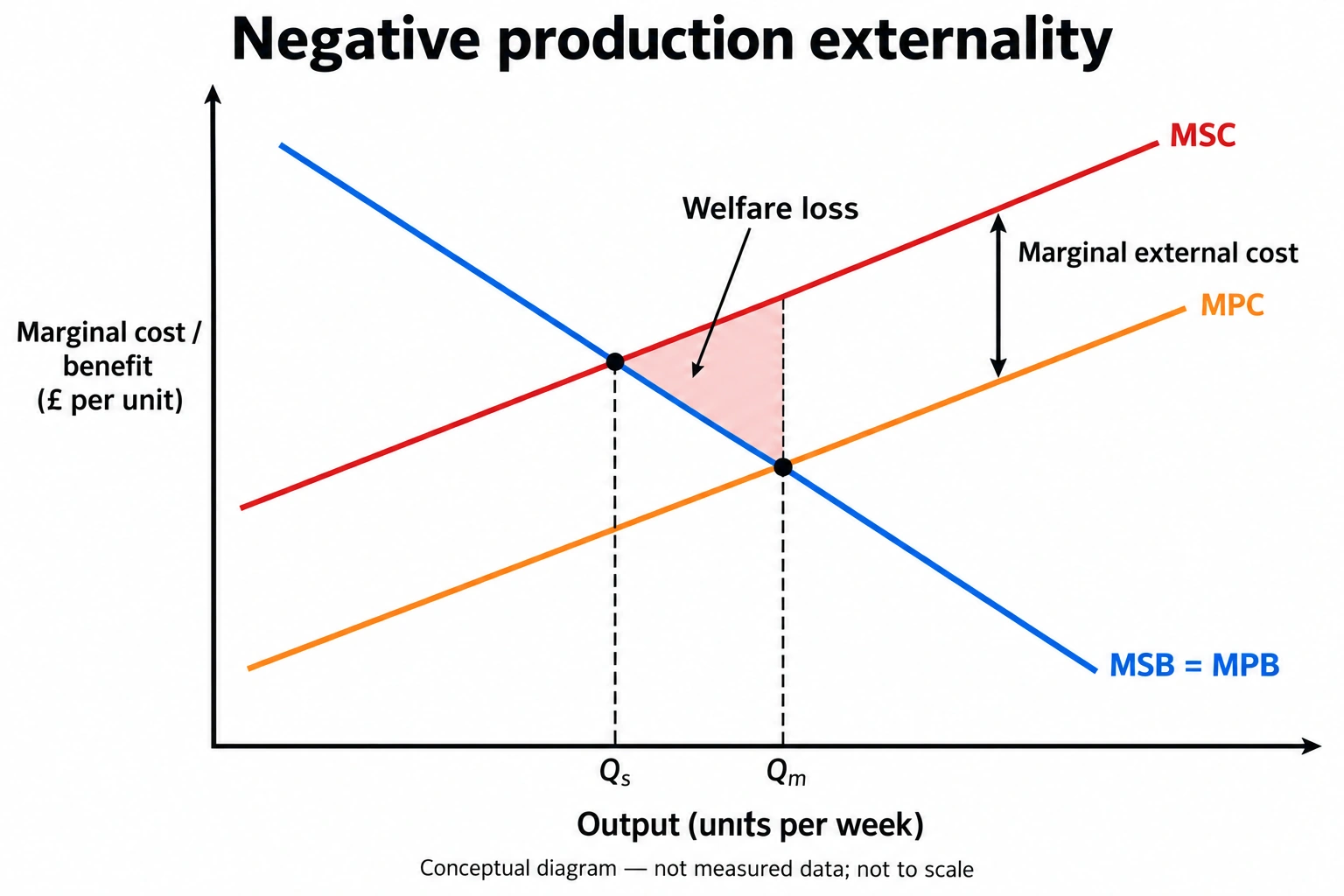
Original teaching plate generated using the built-in imagegen tool, 2026-10-04; conceptual or hypothetical, not empirical evidence. · Original generated artwork; provenance and rights acceptance pending independent review before public publication.
Intervention and government failure: choosing a defensible instrument
Market failure provides a possible reason to intervene, not proof that a particular intervention improves welfare. The relevant comparison is between feasible institutions, including their information and enforcement costs. Government failure occurs when intervention worsens resource allocation relative to the relevant alternative. Conflicting objectives, weak information, administration, capture and unintended responses can matter. A policy may still be worthwhile despite imperfections if the untreated failure is larger. Avoid comparing an ideal state with a real market, or an ideal market with a real state: both comparisons hide the actual decision.
A corrective tax changes the private incentive at the margin. In lesson 13, adding £4/unit to MPC made the producer face the modelled MSC. A subsidy can increase activity with positive spillovers but consumes funding and may reward existing activity without changing it. Price controls affect transactions and rationing rather than directly measuring external harm; a ceiling may create queues, a floor excess supply. State provision can solve a funding problem but still needs information about the appropriate output and quality. The externality plate identifies a benchmark; it does not show which instrument can actually achieve it.
Tradable permits set a total covered emissions allowance and allow exchanges. If firms face different abatement costs, trade can shift reductions towards lower-cost firms, potentially lowering the cost of meeting the cap. A tax instead sets a price for emissions while leaving the quantity response uncertain. Both need coverage, monitoring and credible enforcement; free allocation affects wealth distribution without necessarily changing the marginal opportunity cost of using a tradable permit. A permit used internally could have been sold, so its opportunity cost is not zero merely because it was allocated free. Distinguish the cap, permit stock and annual emissions flow.
Property rights can enable bargaining over an external effect, but enforcement, transaction costs and distribution constrain the outcome. A rule can be easier to verify than estimating a precise marginal damage function, especially for dangerous irreversible harm. Conversely, a uniform technology mandate can impose very different costs on heterogeneous firms and discourage better methods. Choice architecture or information may help some imperfect-information problems, but a nudge is not an adequate substitute for pricing an unrecognised harm in every case. Match the mechanism to the failure and compare the next-best instrument.
Policy evidence needs a counterfactual. A reduction in emissions after a tax may also reflect a recession, fuel substitution or changing measurement. Before-and-after totals do not isolate the policy effect. Assess durability, displacement to uncovered regions and changes in quality; a domestic reduction can coexist with higher imported emissions. Distribution matters too: a flat household charge may burden poorer households more as a share of income, while revenue recycling can alter the net impact. Claims about a current UK instrument require dated official evidence; this lesson teaches hypothetical mechanisms and asserts no current rate or enacted policy.
A final judgement should name the objective, horizon, key uncertainty and fallback. If measuring output is easy but emissions intensity varies sharply, a measured-emissions instrument could be preferable if its extra monitoring cost is justified. If irreversible damage is plausible, a cap may provide quantity assurance, though evasion can defeat it. Pilot and review arrangements can improve information but do not erase immediate costs. Demand an explicit welfare account: benefits from avoided harm minus real abatement/admin costs, plus separate discussion of transfers and distribution. Do not add tax receipts to environmental gains as though government receives new resources without anyone paying.
Original model essay — part 1. Choosing between a rule, tax and tradable permits requires comparing feasible incentives, information and implementation costs. A rule can specify a limit or technique; a tax changes the price of an activity; a permit system restricts authorised quantity while allowing trading. Each can reduce external harm, but none is costless or immune to enforcement failure. Government failure means that intervention worsens the relevant outcome compared with a feasible alternative, not simply that a policy has some administrative cost or fails to achieve perfection. The hypothetical abatement example shows why flexibility may matter. Firm A can remove its first four tonnes at ten pounds each and the next two at 50. Firm B can remove six tonnes at 30 each. Requiring each to remove three tonnes costs A 30 and B 90, a total of 120. Allowing the six-tonne target to be achieved by A removing four and B two costs 40 plus 60, or 100. The twenty-pound saving comes from reallocating the same total abatement towards lower marginal costs. It is not an additional environmental improvement because both arrangements remove six tonnes under the example's assumptions. The cost saving does not automatically justify a trading system. If its additional administration costs 25 relative to the equal-cut arrangement, the combined cost becomes 125 rather than 120. Monitoring, verification, registry operation and legal enforcement are real resources. They must be compared on a consistent basis: charging all ordinary enforcement costs to permits but none to the rule would bias the result. Repeated use, more participants or better information could alter the comparison, but those potential advantages require evidence rather than being assumed to erase the stipulated extra cost.
Original model essay — part 2. A saleable permit has an opportunity cost even when initially allocated free. Using it means forgoing the revenue from selling it, so free initial allocation need not remove the marginal incentive to reduce emissions. However, initial rights affect distribution and may generate windfall gains. Market power, inaccurate monitoring or insecure rights can undermine the theoretical mechanism. A permit system must also define the relevant emissions and period; trading an accounting unit is useful only if that unit represents the environmental constraint policymakers intend to impose. Uncertainty changes the instrument comparison. A tax gives a clearer charge but leaves the resulting emissions quantity dependent on firms' responses. A cap gives a clearer authorised quantity but can produce uncertain permit prices and adjustment costs. If uncertain additional emissions risk irreversible harm, controlling quantity may deserve greater weight than avoiding cost variation. If harm varies gently while abatement costs are highly uncertain, flexibility may be more valuable. These are conditional arguments about the relative slopes and consequences, not a universal ranking of taxes and permits. Capture and information problems are serious counterarguments, but they apply differently across instruments. A regulator might set lenient rules, mismeasure damages or allocate rights to politically influential firms. Transparent reporting and independent enforcement can mitigate these risks, with costs of their own. My judgement is to select the lowest total social-cost feasible arrangement that credibly meets the environmental objective, including distribution and irreversible-risk concerns. In the supplied arithmetic, the flexible allocation saves production resources but loses that advantage if the additional 25-pound administration cost is unavoidable. A sophisticated instrument is not automatically a better implemented policy.
Worked example: Hypothetical two firms must jointly cut emissions by 6 tonnes/year. A can cut its first 4 tonnes at £10/tonne then 2 at £50/tonne; B can cut 6 at £30/tonne. Compare an equal 3-tonne rule with a cost-minimising allocation. Assume each stated cost is marginal and monitoring is reliable.
Equal reductions: A cuts 3 at £10=£30/year; B cuts 3 at £30=£90/year; total £120/year.
Lower-cost allocation: A cuts 4 at £10=£40/year; B cuts 2 at £30=£60/year; total £100/year.
Any extra A reduction beyond 4 costs £50, above B's £30, so moving further reductions to A raises total cost.
The saving is £20/year, not an additional environmental gain: both allocations cut 6 tonnes.
A permit-trading arrangement could support this allocation under the assumptions, but an extra £25/year monitoring/trading cost would outweigh the £20 saving relative to the simple equal rule.
Answer: Equal rule costs £120/year; differentiated efficient reductions cost £100/year. The £20 saving depends on reliable costs and enforcement. With £25 extra administration, the differentiated approach costs £125 and is no longer cheaper.
Check your understanding: Write 500–650 words recommending a rule, tax or permits for this hypothetical industry. Explain marginal incentives, cost heterogeneity and a serious government-failure risk; state evidence that would change your recommendation. Transfer: free permits can be sold and damage is uncertain but possibly irreversible.
Answer: Cost heterogeneity supports shifting reductions to A's first four tonnes and B's next two, saving £20 relative to equal quotas. Trading can achieve this if monitoring/enforcement and transaction costs are sufficiently low; the £25 extra-cost scenario favours the simpler rule on cost. A tax allows flexible reduction but does not ensure exactly six tonnes when responses are uncertain. A cap provides covered-quantity control, subject to evasion, and may be preferred for irreversible harm. Free tradable permits still have an opportunity cost equal to forgone sale value. Distribution of initial permits and revenue requires a separate fairness judgement. Recommend conditionally, using verified emissions/cost/admin evidence and an explicit review trigger.
Why: Indicative criteria: correct marginal-cost allocation and costs; do not count identical emissions gains twice; tax-price versus cap-quantity distinction; explain permit opportunity cost; specific capture/evasion/information risk and realistic evidence; defend a welfare/distribution judgement. Reward a simpler rule when the admin comparison is applied correctly, rather than treating trading as universally superior.