Persistent storage: magnetic, solid-state and remote
By UK GCSE Computer Science · independent study · myAudience
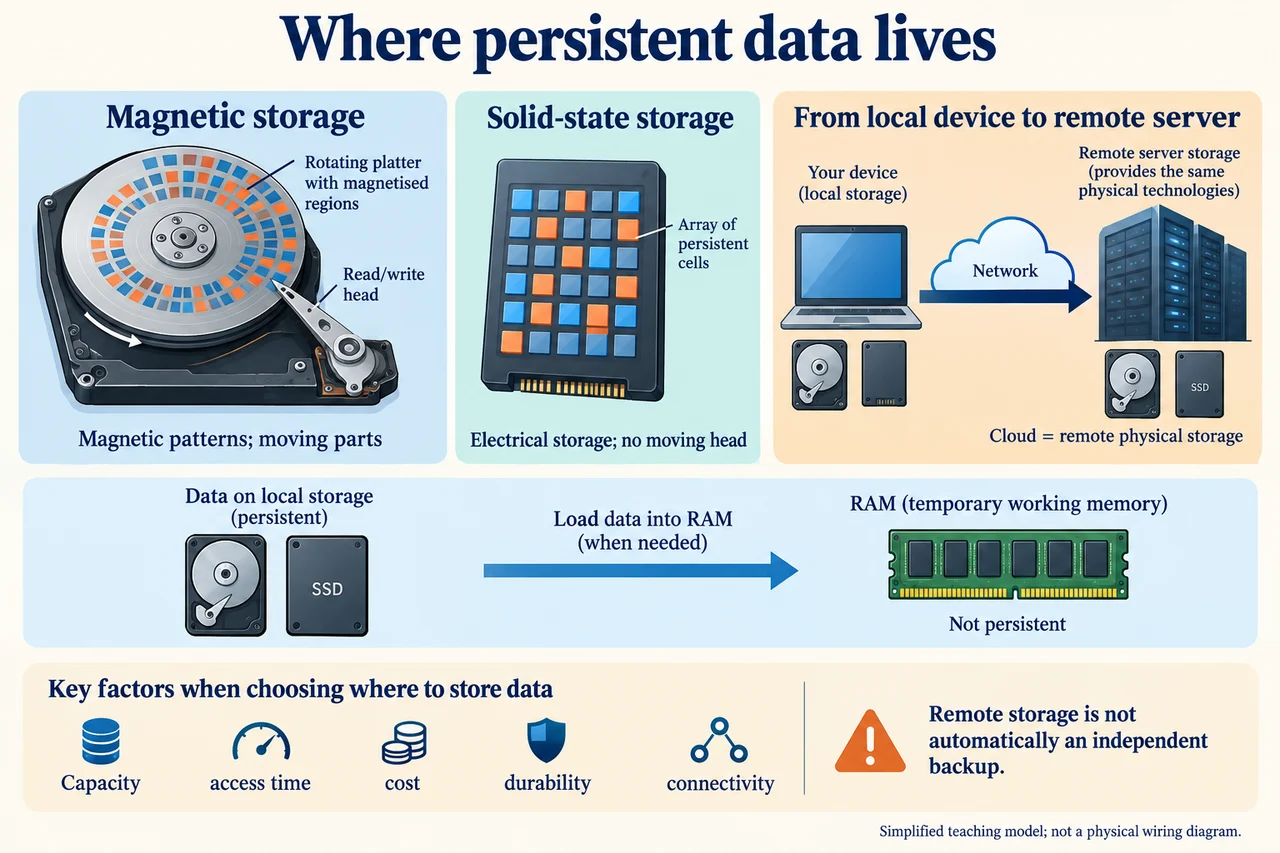
Original AI-generated teaching illustration via built-in image_gen; author inspected 2026-10-04. · Generated project artwork; no copied exam/publisher figure. Independent publication review pending.
Persistent storage: magnetic, solid-state and remote
Secondary storage retains data when ordinary working memory loses its contents. It holds programs and user files that are loaded into main memory when needed, and it can receive successfully saved results. GCSE model distinguishes it from directly CPU-accessible main memory. A hard disk, SSD and remote storage service can all provide persistence, but their mechanisms and access conditions differ. None is an automatic guarantee of permanent retention, confidentiality or an independent recovery copy.
A magnetic hard disk uses magnetic patterns on surfaces to represent stored information. A moving head accesses locations while the platter rotates. Seeking a region and waiting for it to rotate into position can contribute to access delay, particularly for scattered requests. A large sequential transfer may behave differently because subsequent data is located in an ordered run. This qualitative explanation links physical movement to a workload, without requiring a maintenance procedure or assuming every real disk has identical timing. The plate's magnetised regions are schematic representations, not visible domains at physical scale.
A solid-state drive retains information electronically without a moving read/write head. Common devices use nonvolatile flash memory, but precise NAND implementation is outside this GCSE requirement. Avoid the false inference that electronic means ordinary volatile RAM or that no moving parts means no failure. Controllers, electrical faults, wear, data corruption and other causes remain possible. The absence of mechanical movement helps explain some access characteristics and resistance to some physical stresses, but a real comparison must use the relevant device evidence rather than an absolute claim.
A decision matrix asks about capacity, acquisition and ongoing cost, access behavior, durability, portability and the user's task. A fictional archive needs 6 TB that is infrequently read; a classroom editing machine needs responsive scattered access to a 500 GB working collection. The same choice need not fit both. Capacity and cost constraints can outweigh response-time benefits for one role, while interactive access can matter strongly for another. Justification should name the requirement and connect it to a mechanism or supplied observation, not simply label one technology best.
Cloud storage places stored data on remote physical systems accessed through a network. The word cloud does not mean information floats without drives, electricity or operators. The remote service may use magnetic or solid-state hardware, replication and access-control software. Users gain convenient remote access but become dependent on connectivity, service availability, permissions and the provider's arrangements. A local cached copy can allow some offline access, yet its freshness and scope depend on the software. A link to a remote file does not itself contain the file's bytes.
Remote storage and backup are not synonyms. A synchronisation service may propagate an accidental deletion or unwanted change to other copies. An independent recovery plan needs retention/versioning and a tested restoration process suited to the risk. Likewise local storage is not automatically private: unauthorised physical or software access can expose it. Security and data-loss risks depend on authentication, permissions, encryption where appropriate, recovery design and the actual threat. These distinctions support a grounded cloud-versus-local evaluation without promising invulnerability.
A fictional local copy of a 600 MB file transfers over an otherwise idle connection delivering a sustained 20 MB per second of useful file data. The ideal data-transfer time is 30 seconds. If the sustained useful rate falls to 5 MB per second, it becomes 120 seconds. These given MB/s values are bytes per second, not megabits per second. The model excludes setup, retransmission and additional delays, so measured completion can take longer. No network product benchmark is claimed. Physical storage capacity and transfer rate answer different questions.
Transfer: a school wants students to edit project files without reliable home internet, retain a recoverable history and share final work with teachers. A justified design could keep local working copies with clear synchronisation status, controlled remote sharing when connected and independently retained/versioned backups. It must account for conflicting offline edits and access permissions, rather than assuming automatic agreement. The generated plate separates local storage, loaded RAM and a remote server so these distinctions can be explained. The answer should also identify missing evidence, such as acceptable recovery delay, storage capacity and tested restoration behavior.
Worked example: Find the ideal transfer times for the600MB file at the two supplied useful rates.
600MB/(20MB/s)=30s.
600MB/(5MB/s)=120s.
The rate reduction multiplies ideal time by4; capacity has not changed.
Answer: 30s and120s before omitted overheads; useful byte-rate units are explicitly stipulated.
Check your understanding: A cloud sync service immediately mirrors a deletion. Is having two synchronised locations enough to guarantee recovery? Propose evidence and a remedy.
Answer: No: both may now lack the file. Check retained versions, retention period and actual restoration capability. Use suitable independent/versioned recovery copies and test restoring, while controlling access. A remote physical location alone does not establish independence from deletion propagation.
Why: The causal failure is propagated state change, not the word cloud; the remedy must preserve recoverable prior state.