Embedded and general-purpose systems: classify by role
By UK GCSE Computer Science · independent study · myAudience
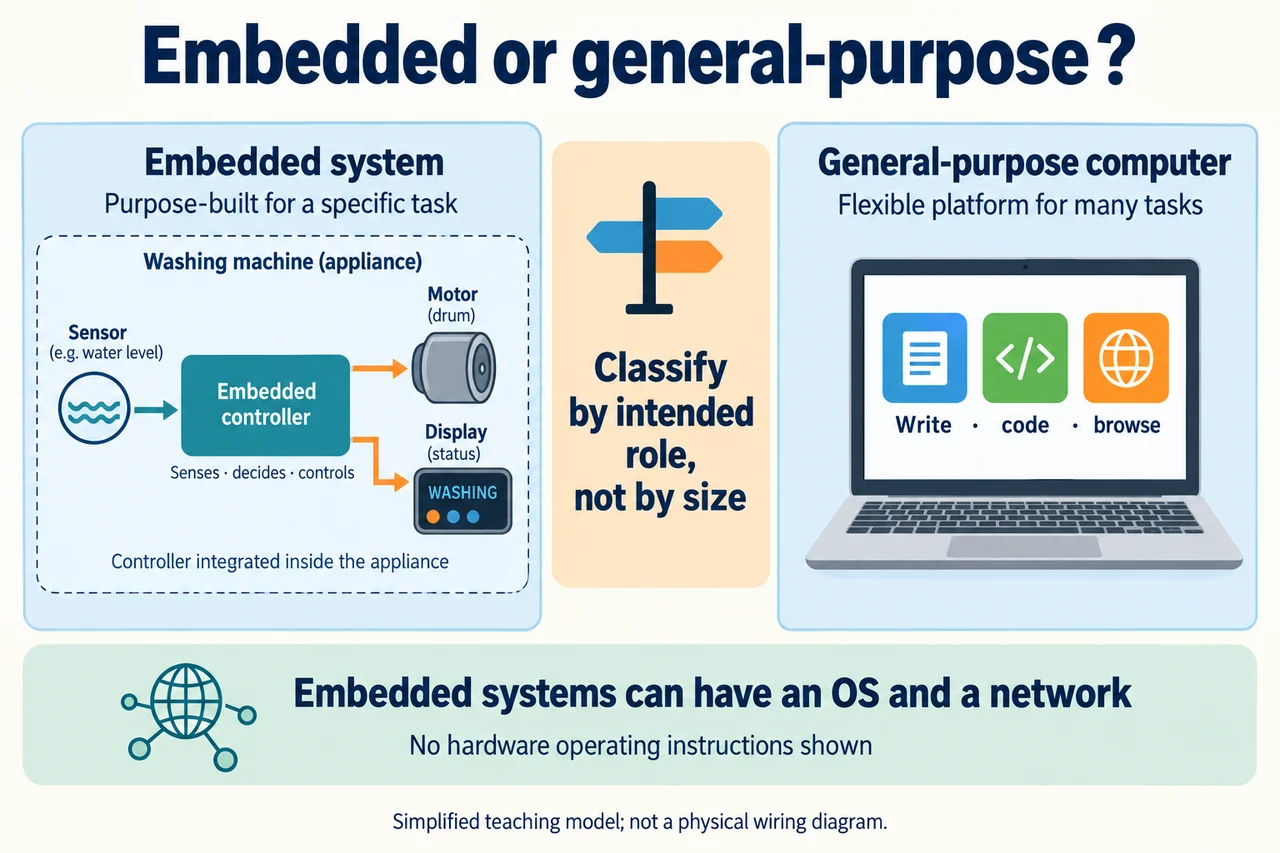
Original AI-generated teaching illustration via built-in image_gen; author inspected 2026-10-04. · Generated project artwork; no copied exam/publisher figure. Independent publication review pending.
Embedded and general-purpose systems: classify by role
An embedded system performs a particular computing role within a wider device or system. A washing-machine controller, for example, can read sensor information and coordinate appliance outputs according to its program. A general-purpose computer is intended to support a broad range of user-selected tasks. The distinction concerns purpose and integration, not merely screen size or processing power. A small laptop can be general-purpose and a powerful controller can be embedded. Neither category implies a particular brand or a single required hardware layout.
The generated illustration shows a controller inside a conceptual appliance boundary, with sensor information entering and output commands leaving. The appliance is the wider system; the controller contributes computation to its operation. The arrows explain information flow, not physical electrical wiring or instructions for operating hardware. Real appliance safety and interlocks require engineering evidence not supplied here. To classify a device, first identify the system and its intended role instead of inferring purpose from the shape of the box.
An embedded controller can repeatedly receive an input, apply a rule and produce a response. A fictional classroom model reads an integer reported level, compares it with a threshold and emits a symbolic status. The example is designed to illustrate computing behavior only; it is not a water-level control recipe or safe threshold for an appliance. Its supplied numbers have no operating significance. A result is meaningful only if the input contract, rule and output interpretation are defined, just as in the earlier algorithm lessons.
General-purpose machines still contain embedded components. A laptop may include controllers performing specialised internal roles while the overall device supports writing, browsing and programming. This is why the classification depends on the chosen boundary. Calling the whole laptop embedded merely because it contains a dedicated controller confuses a component with the wider system. Conversely, connecting an appliance to a network does not transform its intended primary role into an unrestricted general-purpose workstation.
Embedded systems can use operating systems and network connections. A complex controller may need scheduling, communication and resource management, while a simple controller may run a compact program without a general-purpose OS. No-OS and no-network are therefore not definitions of embedded. The appropriate software depends on requirements such as response timing, resources, reliability and maintainability. This lesson does not claim that every embedded task is safety-critical or that using an OS guarantees a response deadline.
A fictional status display has input values0–9. Its rule returns LOW for0–2, MID for3–6 and HIGH for7–9. An input outside the stated range gives INVALID rather than pretending to represent a known measured state. For inputs2,3,6 and7, the outcomes are LOW,MID,MID,HIGH. Boundary traces show why exact comparisons matter. If the value3 incorrectly gives LOW, inspect the programmed condition before declaring a hardware fault. Program errors, sensor errors and communication errors need different evidence to distinguish them.
An original Python3 expression of that bounded rule is `if not 0 <= level <= 9: return "INVALID"`, followed by thresholds `level <= 2` and `level <= 6`, otherwise HIGH. This assumes an integer input already established by the caller; input-type validation belongs to the earlier validation lesson. The rule does not command motors, heating or a physical device. Its purpose is to connect an embedded-system scenario to a testable algorithm while retaining the Python route and avoiding hazardous real operating instructions.
Transfer: a connected camera is dedicated to capturing and processing images, while a desktop runs user-installed tools for many tasks. Connectivity and image processing alone do not settle the classification; intended role, integration and supported uses matter. A strong answer can classify the dedicated camera subsystem as embedded while recognising that some devices blur the boundary or support extensive applications. It explains its chosen system boundary and avoids the absolute claim that all cameras or all small devices belong to one category. Evidence-based classification is better than a memorised list detached from purpose.
Worked example: Trace the symbolic status model at its boundaries.
2<=2 soLOW;3 passes the first threshold and<=6 soMID.
6 remainsMID;7 exceeds6 soHIGH.
10 lies outside the0–9 contract soINVALID.
Answer: 2→LOW,3→MID,6→MID,7→HIGH,10→INVALID; these are fictional information labels, not appliance actions.
Check your understanding: A networked appliance controller runs an OS. Does either feature disprove that it is embedded? Explain and identify the classification boundary.
Answer: No. Its dedicated computing role within the appliance can still make it embedded. Networking and an OS describe capabilities, not a general-purpose intended role. Specify whether classifying the controller or the whole device, and use its supported purposes as evidence.
Why: This rejects definition-by-size/connectivity/OS and uses purpose plus system integration without promising real-time or safety behavior.