Family, household and the dimensions of diversity
By UK GCSE Sociology · independent study · myAudience
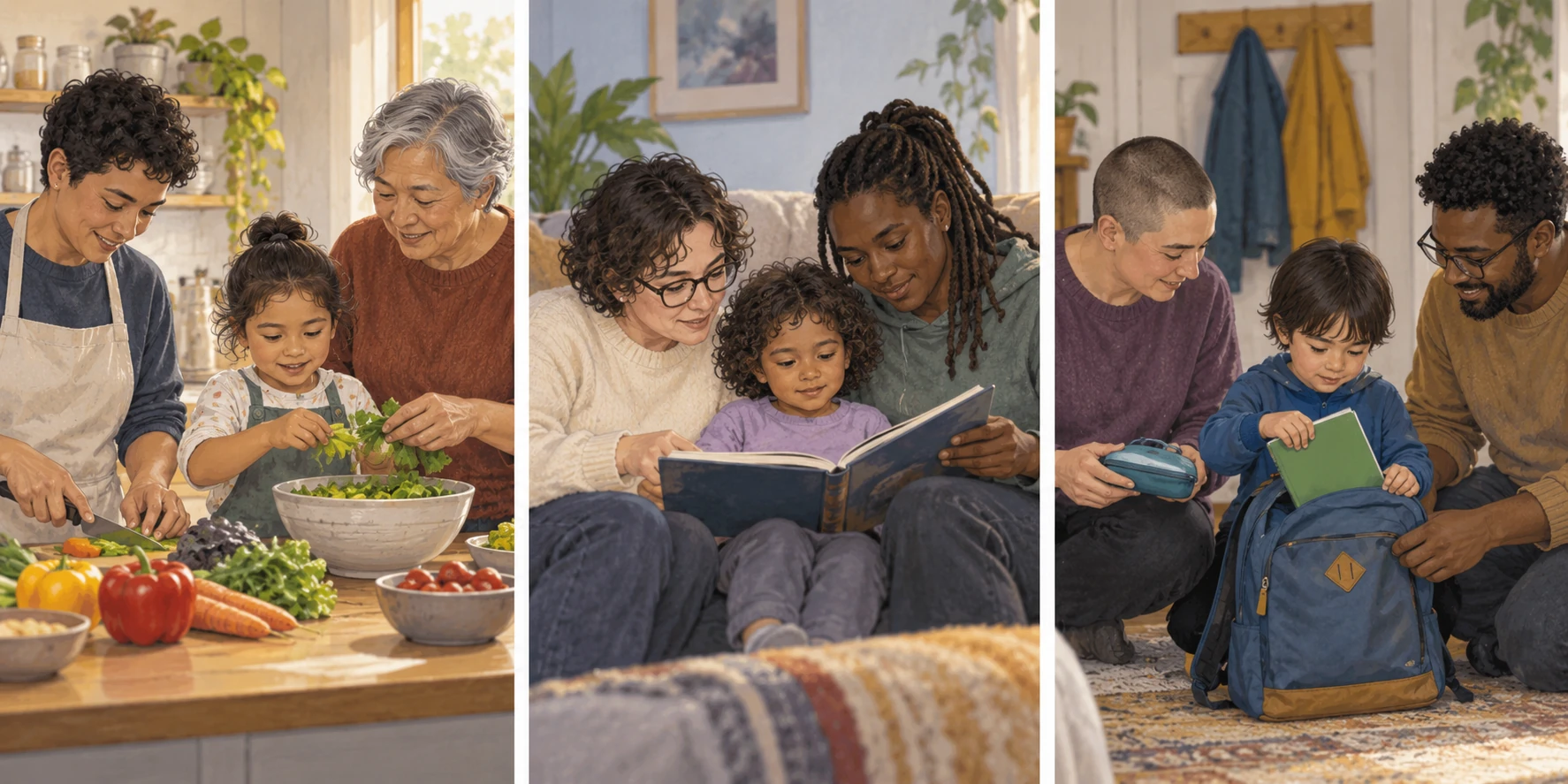
Original OpenAI imagegen conceptual teaching illustration, generated 4 October 2026; not observational evidence. · AI-generated original asset for this independent guide; no third-party artwork intentionally reproduced.
Family, household and the dimensions of diversity
A household concerns a living arrangement, while family concerns relationships organised through kinship, partnership, care and socially recognised ties. Operational definitions vary with the purpose of a study. One household can contain unrelated people or more than one family; family relationships can extend across households. A nuclear family is commonly described as a couple and children, while an extended family includes wider kin relationships. A lone-parent family has one parent living with children; a reconstituted family brings relationships from previous partnerships into a new family arrangement. These labels describe selected features, not quality of care or a family's moral worth.
family-forms requirement uses the term 'single sex'; this guide uses same-sex family when discussing that form. Family form, gender, sexuality and parenting practices are different questions. A picture of two adults and a child cannot establish kinship, legal status, sexual orientation or the history of a household. Likewise, a person living alone may remain embedded in family care across several homes. Define what the research needs to know and ask appropriate questions rather than infer relationships from appearance. The family illustration presents equally valued scenes of care; it is not a visual classification exercise or demographic distribution.
The Rapoports' prescribed account identifies organisational, cultural, class, life-course and cohort dimensions of diversity. Organisational diversity concerns arrangements such as divisions of domestic labour. Cultural diversity concerns beliefs and practices; it should not be reduced to uniform assumptions about an ethnic group. Class diversity concerns resources and location in social stratification. Life-course diversity concerns stages and transitions in people's lives. Cohort diversity concerns the historical experiences of people born in different periods. A cohort is not just an age category observed once: age and historical period can be difficult to separate without appropriate evidence.
The dimensions overlap but are not interchangeable. Two households with the same form can divide work differently, have unequal resources and be at different life-course stages. The same person can move between forms while continuing relationships across households. A finding about one form should therefore be examined for composition and context before a causal interpretation is made. If a fictional survey records different homework support between forms, resources, working hours, children's ages and the meaning of support may explain some differences. Family form alone is not a mechanism. Nor does a group average describe every member of either category.
The Rapoports' work is contextualised in the early 1980s and in British and American family research as summarised by an awarding body. Its framework helps resist treating one arrangement as universal, but the summary is not evidence that those five categories capture every contemporary relationship. The specification notes the historical context of recognition of gay and lesbian households. Later comparisons need current definitions and careful language. In UK and global comparisons, legal categories, residence, kinship and welfare institutions can differ; translating a label without checking its meaning can create a false comparison. We make no unsupported claim about national prevalence or global superiority.
Official family and household statistics are useful precisely because their definitions and scope can be checked. The current ONS methods guide illustrates that estimates cover a defined survey population and statistical family categories. A qualitative study of transnational care could answer a different question from a household-count survey. Neither should be forced to represent the other's unit of analysis. When building an argument, state the unit, the dimensions and the evidence, then explain limitations. Respectful description and sociological criticism are compatible: analysing institutions and inequalities does not require stereotyping those who live within them.
Worked example: Original fictional cases: Household A contains a parent, a child and the parent's adult sibling; another parent lives elsewhere and shares care. Household B contains two partners and a child, with grandparents providing daily help from another home. Compare form and two Rapoport dimensions without assigning identities or ranking care.
State that residence and wider family networks differ. A household label alone cannot capture shared care or kin support across addresses.
Describe organisational diversity through who provides care and how duties are allocated. The cases do not reveal whether work is equally shared.
Describe life-course diversity through dependent-child care and possible transitions, while acknowledging that the ages and histories needed for a detailed account are absent.
Ask what additional evidence would establish resources or cultural practices; do not infer these from household composition or imagined appearances.
Answer: Both cases show family relationships extending beyond one home. Household A includes wider kin in residence and shared care from an adult elsewhere; Household B may fit a nuclear residential form while depending on an extended kin network. Organisational diversity is visible in the arrangements for care, but equality of work cannot be established from the descriptions. Life-course questions could explore transitions and changing care needs. Class or cultural diversity would require evidence about resources and practices. There is no basis for deciding which family provides better care solely from form.
Check your understanding: Transfer task: a fictional agency reports that 'nuclear families are identical and extended families belong to a single culture'. Use three diversity dimensions to challenge the claims, explain a household/family distinction and propose one ethical research question. Indicative rubric: 12 points: dimensions 6, unit distinction 2, critique 2, research question 2.
Answer: Families sharing a nuclear form can differ organisationally, in class resources and in life-course stage. Extended relationships can be organised across many cultural settings and households. A household is not the whole family network. A neutral question could ask how care is coordinated across homes, using hypothetical cases or a properly overseen voluntary study. The claims confuse a form with an internally uniform group and treat culture as fixed.
Why: Award each dimension only when explained through a possible difference rather than named. The question should investigate arrangements without assuming deficiency or demanding sensitive disclosures. A strong answer rejects the universal claims while recognising that some patterns might still be investigated with appropriate definitions and evidence. No real prevalence claims are supplied.