Crime, deviance and competing explanations
By UK GCSE Sociology · independent study · myAudience
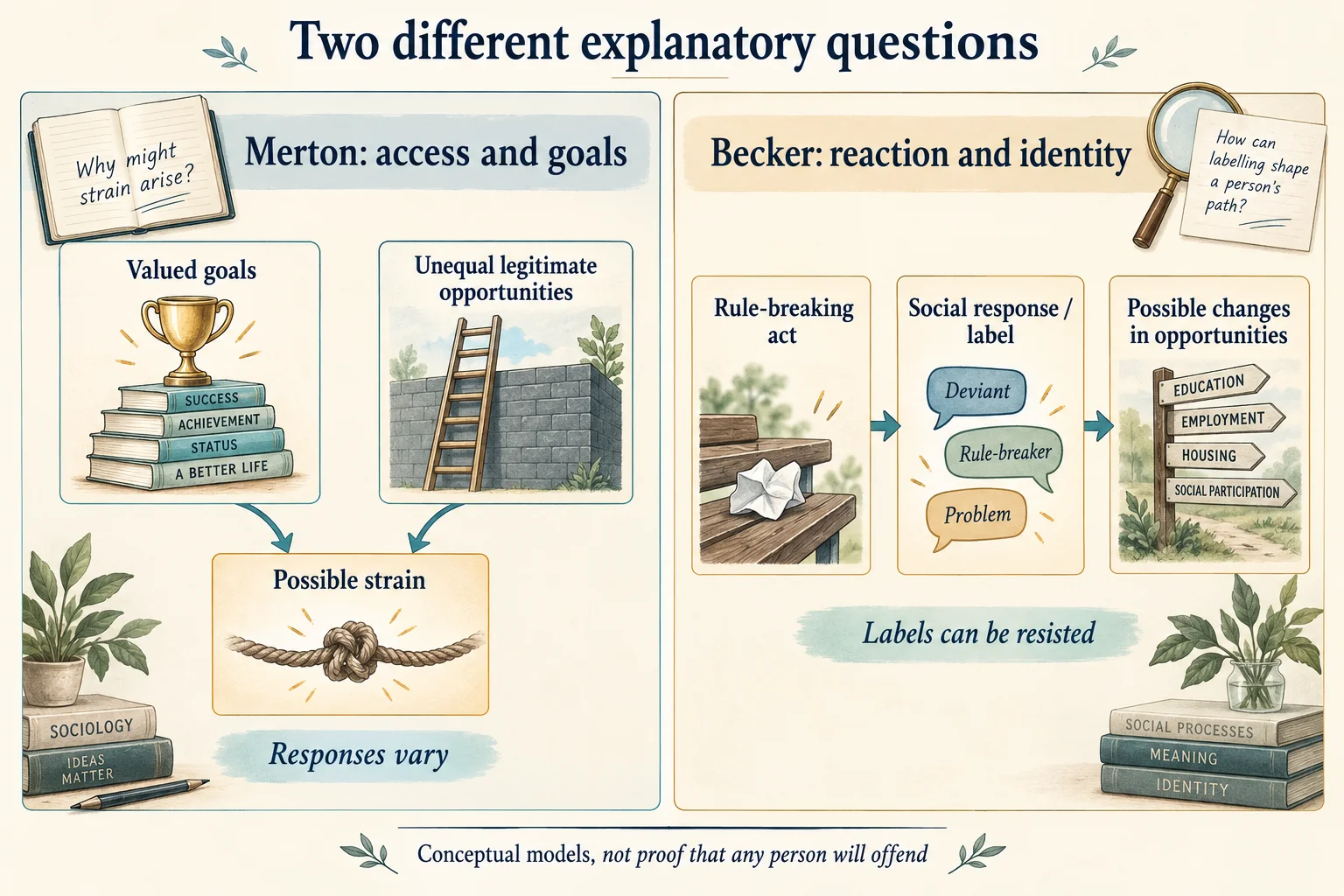
Original built-in OpenAI imagegen teaching illustration, generated 4 October 2026; conceptual model, not documentary evidence. · Original generated illustration; no third-party artwork intentionally reproduced.
Crime, deviance and competing explanations
Crime refers to conduct prohibited by criminal law in a specified jurisdiction and period; deviance concerns departures from social expectations. Their boundaries can overlap without being identical. A fictional club may disapprove of interrupting a meeting even though no criminal offence has occurred. Conversely, an offence could be normalised within a particular group without becoming lawful. Social construction asks how rules and categories are established, interpreted and enforced. It does not mean injuries are imaginary or that every legal finding is merely an opinion. Keep an act, its legal classification, its social reception and its consequences analytically distinct.
Begin comparison by asking what each explanation tries to explain. One question is why a person initially breaks a rule; another is why one person's conduct receives an official label while similar conduct does not; a third concerns what happens after a label. A mechanism that addresses one question does not automatically answer the others. In an original fictional scholarship programme, every applicant encounters the same advertised goal, but access to recognised qualifications differs. That scenario can support an opportunity question. It supplies no observation of offending, discrimination or identity change until those processes are separately investigated.
Merton's strain approach connects strongly valued success goals with unequal access to socially approved means. The analytical tension lies between what is demanded and what can legitimately be achieved, rather than a claim that low income biologically produces crime. In Merton's usage, anomie concerns pressure towards success that can weaken the authority of legitimate rules; it is not simply any individual's stress. Within this account, conformity accepts goals and means; innovation accepts the goal while using disallowed means; ritualism retains prescribed means while scaling down the goal; retreatism rejects both; rebellion seeks replacement goals and means. These are ideal-type responses, not diagnoses or a reliable classification of every individual. Innovation here does not mean every creative or entrepreneurial activity is deviant.
A structural explanation becomes testable when its proposed links are specified. What goal is actually valued by these participants? Which means are available, and who experiences a barrier? Does that barrier precede a particular response? The fact that many people facing difficulty continue to conform is an important contrary case, not an inconvenience to discard. Accessible lawful alternatives, relationships and competing values may help explain variation. Likewise, a well-resourced person's wrongdoing challenges any crude equation of deprivation with offending. Evidence should examine opportunities and responses together rather than presume the first from a social-class label.
Becker's interactionist account foregrounds rule-making, selective reactions and the consequences of being defined as deviant. A potential chain runs from an act through a social response to altered treatment, opportunities or self-understanding. A label may become particularly influential when others interpret unrelated behaviour through it. Yet the chain remains conditional: people can contest labels, institutions can correct decisions and supportive relationships can preserve alternative identities. Explaining reactions does not establish that an initial harmful act was caused by the reaction. Nor does unequal treatment prove that every officially recorded incident is false. Examine evidence for each stage.
Consider two fictional participants who each interrupt an assessed discussion once. One receives a private reminder; the other is publicly described as habitually disruptive and later receives fewer invitations. This is a designed illustration of different reactions, not proof about any school. To investigate it, compare equivalent conduct, earlier records, decision rules, later invitations and participants' interpretations. If treatment differed before the interruption, the label may be one expression of an existing process rather than its origin. If later opportunities remain equal, the proposed consequence is unsupported. Chronology helps, but by itself it does not eliminate alternative explanations.
Different perspectives extend the comparison. A functionalist reading asks how shared expectations coordinate conduct, while a Marxist reading asks whose interests influence rules and whose resources enable them to challenge decisions. A feminist reading asks whether power and unequal expectations shape treatment or opportunities. These questions are compatible with examining interaction, but a list of perspectives is not an explanation. Connect each to the same specified outcome and identify observations that would support or challenge it. Neither agreement among powerful decision-makers nor strong public disapproval proves that a rule is fair, effective or universally accepted.
The image deliberately separates access-and-goals from reaction-and-identity. Arrows represent proposed connections to investigate; they do not depict measured effects or inevitable pathways into crime. The boxes also omit real-world variation and feedback, which the written explanation restores. The prescribed summaries were checked alongside bounded reference material; full original books and participants' records have not been inspected. Use the original model answer below to see how a judgment can compare explanatory reach, evidence and limits without inventing classic-study results. This lesson supports construction and theory requirements; it does not establish complete crime teaching or examination readiness.
Original extended model response, part 1:
The fictional programme's evidence permits a more precise judgment than saying that failure or labelling inevitably causes crime. Merton's approach helps explain why a strongly advertised achievement goal might create pressure when legitimate routes are unequally available. If applicants want the same award but some cannot access required training, the gap between goal and means is relevant. However, wanting an award and lacking training are not evidence of offending. The programme must establish what participants do next, including those who continue through lawful alternatives.
Becker's approach addresses a different part of the scenario. Suppose decision-makers label one applicant dishonest after an equivalent minor breach, while another receives a private warning. The important questions concern how that distinction arose and whether it changed subsequent opportunities or identity. If the labelled applicant later loses invitations, an opportunity mechanism is plausible. The timing is consistent with it, but earlier decisions, different conduct or other constraints could also account for the change. A participant who contests the label and continues successfully would refine, rather than automatically disprove, the explanation.
Original extended model response, part 2:
The theories can therefore be combined without treating them as interchangeable. Restricted legitimate opportunities may precede a breach, while the institutional response may further restrict opportunities afterwards. To test that account, compare similarly situated applicants, document rules and access over time, and seek voluntary accounts from people with contrasting outcomes. Do not create unfair labels experimentally. Information should be minimised and protected, and participants must be able to refuse without affecting their award chances.
A Marxist question about who controls recognised routes and a feminist question about unequal expectations could identify additional sources of power. Neither perspective earns support merely by being named. Investigate which actors make decisions and whether equivalent evidence receives equivalent treatment.
My provisional conclusion is that strain has greater relevance to the initial access problem and labelling to differential reaction and later exclusion. The available scenario does not establish a causal effect on offending or identify one universally strongest theory. A stronger judgment would require evidence linking opportunities, responses and outcomes, including lawful persistence and successful resistance as contrary cases.
Worked example: A fictional award programme has 100 applicants:60 lack access to its required training;12 of those 60 and 4 of the other 40 breach an administrative rule. Calculate the two observed proportions and evaluate whether they prove strain causes crime. Administrative breach is not stipulated to be a criminal offence.
12/60=20% and 4/40=10%; the observed difference is 10 percentage points and the first proportion is twice the second.
Keep the outcome administrative rule breach; neither denominator is all disadvantaged people or all offenders.
Access may relate to other circumstances or selection. An observational difference does not identify a causal effect.
Investigate participants' goals, available means, equivalent enforcement and contrary cases; compare reaction mechanisms separately.
Answer: The observed breach proportions are 20% and 10%, a 10-percentage-point difference. This constructed association is compatible with several mechanisms, including strain, but cannot demonstrate that strain caused the breaches. It cannot be relabelled a crime rate because no criminal offence is stipulated. Comparable enforcement, timing and relevant alternative explanations matter. The 48 applicants without training access who did not breach the rule also require explanation.
Check your understanding: Write 300–450 words evaluating the claim that strain and labelling are interchangeable explanations of the fictional award scenario. Include two explicit mechanisms, a contrary case for each, a feasible ethical evidence plan and a conditional comparative judgment. Indicative learning rubric:16 points—mechanisms 4, application 4, evidence and counterarguments 5, justified conclusion 3.
Answer: The extended original model response is one defensible answer. It distinguishes unequal legitimate access from differential reactions, explains how the mechanisms could interact, and avoids changing administrative breaches into crimes. An alternative answer can favour one account when its judgment follows the stipulated evidence and acknowledges its limits.
Why: Credit connected reasoning and observations that could change the judgment. Naming a theory, asserting that all poorer people offend, or treating every label as destiny earns no mechanism credit. A strong evaluation locates the outcome and time sequence, examines contrary cases and explains why the proposed evidence is ethically and methodologically suitable; the indicative points are not an official mark scheme or grade prediction.