Social control, gendered constraints and conditional conformity
By UK GCSE Sociology · independent study · myAudience
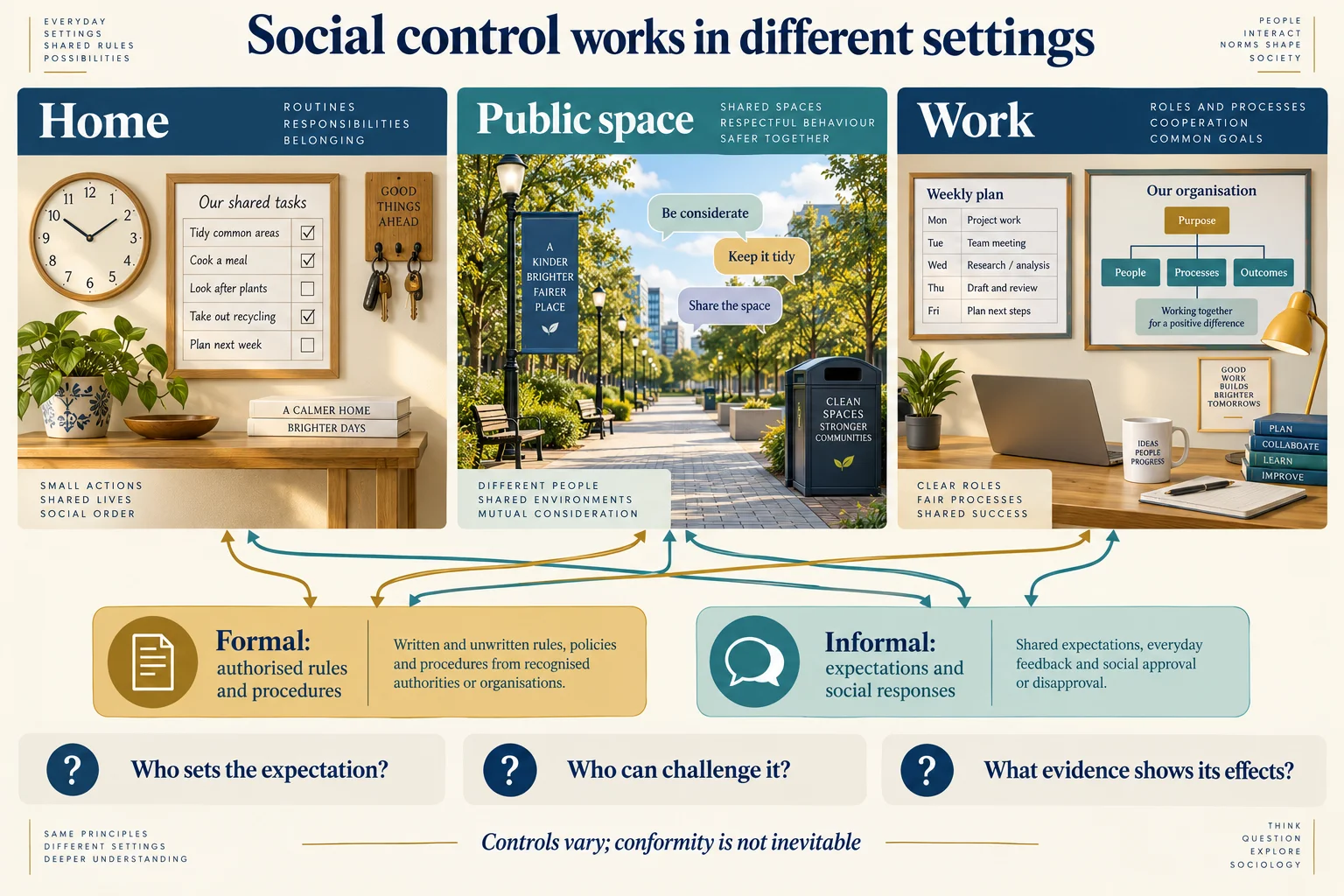
Original built-in OpenAI imagegen teaching illustration, generated 4 October 2026; conceptual model, not documentary evidence. · Original generated illustration; no third-party artwork intentionally reproduced.
Social control, gendered constraints and conditional conformity
Social control consists of processes through which conduct is encouraged, discouraged or regulated. A sanction can reward conformity as well as penalise a breach. Formal control relies on authorised institutions and explicit procedures; informal control operates through everyday expectations and social responses. The distinction concerns the process, not simply its location. A workplace can have a documented grievance procedure alongside informal ridicule, while a household may encounter formal legal responsibilities alongside unwritten expectations. Neither an official title nor public approval establishes that a particular practice is legitimate, proportionate or effective. Identify the rule, actor, response and opportunity to contest it.
In a fictional community workshop, the written booking rule reserves equal machine time for each participant. An administrator can cancel a booking under a stated procedure; peers may praise careful sharing or disapprove of monopolising equipment. These are analytically different forms of control even when they pursue a similar aim. Ask whether people understand the rule, whether it is applied consistently and whether participation is genuinely accessible. Conformity could reflect agreement, habit, lack of alternatives or fear of consequences. Observing that somebody obeys does not reveal which of those mechanisms matters, and disobedience is not necessarily criminal conduct.
A functionalist interpretation asks how expectations coordinate activity and maintain predictable relationships. A conflict or Marxist interpretation asks who controls resources and whether apparently neutral rules advantage particular interests. Interactionist analysis investigates how a breach is recognised, negotiated and labelled. Feminist analysis examines gendered power and expectations, including unpaid work and control of public or occupational opportunities. A defensible comparison applies these questions to the same case. Shared workshop rules could coordinate safe access and also be administered unequally. A rule's useful coordinating function does not settle the separate question of whose voice counts when it is revised.
Heidensohn's feminist account, as represented in the prescribed summary, investigates patriarchal controls in domestic, public and working life as an explanation of female conformity. The analytical claim concerns constraints and power, rather than an inherent tendency of women to obey. Treat it as a historically situated argument to examine: household expectations, reputational pressure or organisational hierarchies may limit opportunities and conduct. Their strength and form can vary across settings and over time. A lower recorded offending rate alone cannot demonstrate these mechanisms, because recording, opportunities and category definitions also matter. The complete original book has not been examined here.
To test a control mechanism, distinguish a restriction from the outcome it is supposed to explain. A participant's limited evening attendance might reflect care responsibilities, transport, paid work or preference. It is not automatically evidence that a partner imposed a restriction. Conversely, an apparently freely made decision can occur under unequal resources or credible pressure. A good study would examine decision processes, available alternatives and participants' own accounts, with safeguards appropriate to sensitive experiences. Group averages cannot establish every individual's circumstances. Gender categories must not be used as substitutes for investigating power, variation or resistance.
The original illustration places home, public space and work side by side, with both formal and informal processes potentially connecting to each. Its objects invite questions; no clock or timetable measures actual restrictions. The absence of people prevents appearance being used as evidence about gender or behaviour. Neither the well-lit path nor the organisational chart proves that a setting is fair. Learners should identify what observation, policy document or ethically gathered account would answer each question. The picture is a conceptual aid, not a diagram of an inevitable chain from gender to conformity or offending.
A numerical comparison must preserve its denominator and unit. In a fictional voluntary survey, 24 of 60 respondents report that the workshop's stated appeal procedure is accessible, compared with 45 of 75 in another workshop. Those proportions are 40% and 60%, a 20-percentage-point gap. They concern respondents' reported access to a procedure, not compliance, actual fairness or crime. Different invitation methods, non-response, interpretations of accessible or workshop demands could affect the result. Even perfect arithmetic does not identify why the gap exists. Reports should retain missing responses and explain whose experience the achieved sample represents.
Ethical inquiry into control must not reproduce the coercion it studies. Interviews should occur without someone who could punish the answer, refusal must not affect services, and researchers should not promise unlimited confidentiality where safeguarding duties could apply. Hypothetical designs need appropriate independent oversight before any real participation. The original extended answer below compares coordination, unequal voice and gendered constraints while keeping the conclusion conditional. It does not offer legal advice or diagnose anyone's relationship. Further evidence across groups, periods and contexts is needed before the social-control requirements can be considered adequately taught or assessed.
Original extended model response, part 1:
The fictional workshop's booking policy should be evaluated through both coordination and power. From a functionalist perspective, an equal-time rule may make shared resources predictable and reduce conflict. If participants understand the timetable and can obtain suitable slots, the rule could support cooperation. However, its wording alone does not show that it has that effect. Evidence about actual booking access, cancellations and participants' experience would be needed.
A feminist account would ask whether domestic expectations or organisational relationships affect who can use the nominally equal slots. A timetable concentrated in the evening may disadvantage people with care responsibilities, but those responsibilities cannot be inferred from gender or appearance. Heidensohn's account offers a mechanism concerning constraints in different settings. Applying it requires evidence about available alternatives, decision-making and pressure, alongside examples of resistance and change. It does not predict that every woman will conform or that every man controls others.
Original extended model response, part 2:
A Marxist or broader conflict account asks who decides the schedule and whose priorities it serves. If resource owners can override bookings while other participants cannot appeal, formal equality may coexist with unequal power. An interactionist account could examine how the same late arrival is described as understandable for one participant and irresponsible for another. That difference might influence later invitations, but its occurrence and consequences would need separate evidence.
The reported accessibility proportions,40% in one workshop and 60% in the other, identify a difference among respondents. They do not establish which mechanism caused it. The survey's wording, response patterns and populations may differ. I would compare the actual written procedures, anonymised booking patterns and voluntary interviews with contrasting experiences. A clear common period and definition of accessible would improve the comparison, while missing responses and contrary cases must remain visible.
Sensitive accounts should be sought privately, with meaningful refusal and clear limits on confidentiality. No experiment should deliberately deny appeal rights or expose personal relationships. My judgment is therefore provisional: coordination is a plausible function, but equitable access and voice must be investigated rather than assumed. The best explanation may combine resource conditions and interaction with shared expectations. Its strength depends on evidence showing which process operates for which participants, not on selecting a perspective by name.
Worked example: In two fictional voluntary surveys,24 of 60 and 45 of 75 respondents report accessible appeal procedures. Calculate the proportions, difference in percentage points and relative difference using the first workshop as the base. Evaluate the statement 'the second workshop is 50% fairer'.
24/60=40% and 45/75=60%.
60%-40%=20 percentage points;20/40=50% relative increase in the reported proportion.
The outcome is reported procedure access among respondents, not an overall measure of fairness.
Check common definitions, invitation and response patterns before generalising or explaining the difference.
Answer: The observed proportions are 40% and 60%. The second is 20 percentage points higher, or 50% higher relative to 40%. Calling the workshop 50% fairer substitutes an unmeasured evaluative concept for the actual survey item. Fairness could involve consistency, meaningful appeal and suitable access, which require separate evidence. The constructed surveys establish neither causation nor population estimates.
Check your understanding: Write 300–450 words evaluating whether a formally equal booking rule necessarily provides equal access and effective social control. Compare two perspectives, use the fictional evidence, specify a contrary case and an ethical research plan, and make a justified conditional judgment. Indicative learning rubric:16 points—concepts 3, mechanisms/application 5, evidence/ethics 5, conclusion 3.
Answer: The extended original model is one justified response. It explains coordination without equating it with fairness, investigates gendered or material constraints without assuming them, and treats reported access as a bounded outcome. Alternative perspectives and conclusions are acceptable when supported by the same case and its evidential limits.
Why: Reward specifying who exercises control, through what process and with which contestable effects. Do not reward treating official procedures as necessarily fair, gender as destiny, survey agreement as causation or conformity as proof of free consent. The indicative rubric is a learning aid, not an official examination mark scheme or assurance of a grade.