Subcultures, material opportunities and limits of generalisation
By UK GCSE Sociology · independent study · myAudience
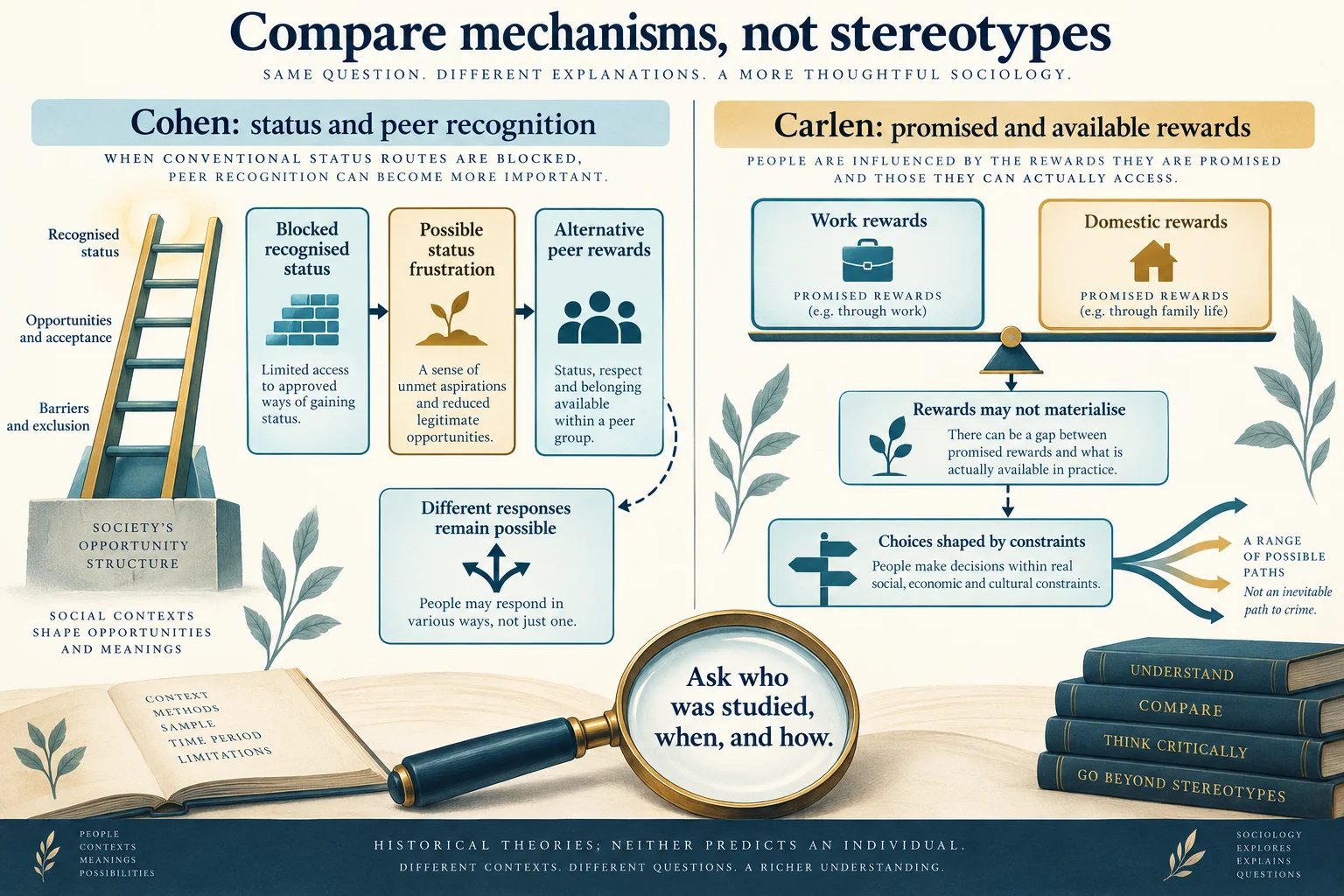
Original built-in OpenAI imagegen teaching illustration, generated 4 October 2026; conceptual model, not documentary evidence. · Original generated illustration; no third-party artwork intentionally reproduced.
Subcultures, material opportunities and limits of generalisation
A subculture is a group-associated pattern of meanings and practices within a wider society; it is not automatically criminal or harmful. A club that rewards unusual music or specialist skill can differ from mainstream expectations while remaining lawful. To explain a delinquent subculture, specify which acts count as offences, which rewards the group offers and how participation develops. Describing a neighbourhood, class or friendship group does not establish shared values. Group membership can change, individuals can disagree, and public labels may exaggerate cohesion. Begin with evidence about actual relationships rather than treating a category as an explanation.
Cohen's account links difficulty obtaining recognised status to possible status frustration and alternative peer rewards. In this mechanism, activities rejected by a dominant institution may gain prestige within a group. Its explanatory focus is the collective meaning of participation, not simply individual financial gain. prescribed summary situates the account in historically specific arguments about boys, schooling and opportunities. Those premises must be evaluated rather than adopted as timeless facts about working-class learners. Recognised success goals may vary, and educational difficulty does not demonstrate that a person accepts a delinquent alternative or belongs to such a group.
An original fictional design makes the proposed mechanism more concrete. Suppose interviews describe repeated exclusion from a school award, while a small friendship group later praises deliberately missing lessons. The pattern is consistent with alternative status rewards, but it does not establish the whole causal chain. The group may have valued attendance differently before the award decision, exclusion may reflect earlier conduct, or friendships may have formed for unrelated reasons. Compare timing, participants' meanings and contrary cases, such as excluded learners who form a lawful study group. Neither truancy nor a peer group's approval should be silently reclassified as evidence of criminal offending.
Carlen's feminist account examines how promised rewards associated with paid work and domestic roles can fail to materialise. The proposed class and gender deals connect conformity with expected material or relational returns; their breakdown may alter the attractiveness of alternatives under constrained circumstances. This differs from saying that women are naturally compliant or that poverty inevitably causes crime. summary describes in-depth interviews with a small selected group of convicted women. Such accounts can reveal meanings and mechanisms, but a conviction-selected sample cannot estimate how often all women offend or compare convicted and non-convicted women on equal terms. Full original records have not been inspected.
A strong comparison separates similarities from differences. Cohen highlights status and collective peer recognition; Carlen foregrounds material and relational rewards within gendered and class-based constraints. Both invite investigation of what mainstream promises mean to the people concerned, but their historical populations and central outcomes differ. A sample selected because participants were convicted cannot explain why most people facing hardship do not offend without additional comparison. Conversely, a study of peer identity does not automatically measure domestic control. The accounts may complement one another, but joining them requires evidence connecting the mechanisms in a specific case rather than substituting one vocabulary for the other.
Suppose an original fictional interview exercise selects 20 people because they have breached a programme rule;14 describe unavailable promised training. That is 14/20=70% of this selected group reporting an experience. It is not a 70% breach rate among people without training, because the exercise contains no denominator for that population. Reverse the conditional carefully: how many selected rule-breakers mention a barrier differs from how many people facing a barrier break a rule. The earlier survey and administrative-breach examples use different outcomes and samples. They cannot be pooled into a national statistic or treated as one classic study.
The concept diagram contrasts peer recognition with promised and available rewards, using objects rather than demographic scenes. The open branches signify possible variation; they are not a probability tree. The image supplies no observations about poverty, gender, school performance or offending. Its question about who was studied points learners towards sampling, context and method. Source criticism should also examine the researcher's categories and interpretations, whether contradictory accounts were included, and whether an argument is being applied beyond its historical setting. A limited case can illuminate a process without establishing its prevalence or universality.
Research on sensitive experiences requires privacy, meaningful consent and safeguarding; this lesson authorises no investigation of classmates' offending. For learning, work with the stipulated fictional accounts and original questions below. A justified conclusion should explain which observations distinguish status frustration from failed reward expectations and which would challenge both. Other aspects remain open: ethnicity, age, public debates, sentencing, the prison system and media evidence require separate substantive teaching. Mapping a requirement to this reading marks support for a bounded concept, not completion of the crime topic, the 209-requirement pathway, a grade or mastery.
Original extended model response, part 1:
The fictional accounts offer possible evidence for a status mechanism, but they cannot establish that educational exclusion inevitably causes crime. Cohen's approach asks whether participants seek recognised success and whether exclusion leads them to value alternative peer recognition. If the group praises absence after an award decision, that sequence is consistent with the account. However, absence is not stipulated to be a criminal offence, and timing alone does not show why its meaning changed. Earlier peer values and prior conduct could affect both the award decision and later behaviour.
A convincing study would therefore examine how participants interpret status and compare contrary cases. Learners who were excluded but formed a lawful study group show that alternative responses are possible. They do not automatically refute the theory, but they require an explanation of variation. Voluntary accounts, documented selection rules and a common time period could help, without researchers creating exclusion or rewarding harmful conduct.
Original extended model response, part 2:
Carlen's account addresses a related but distinct problem: promised material and relational rewards may be unavailable under constrained circumstances. The fictional training barrier could be relevant if participants expected a credible reward for conformity and experienced its failure. Yet no information about domestic rewards or gendered power has been supplied. Those elements cannot be inferred from the word disadvantaged, and the account should not be applied merely because some participants are women.
The interview figure,14 of 20 selected rule-breakers reporting unavailable training, describes the achieved selected group. It does not show that 70% of people lacking training break rules. People who experienced the same barrier and continued to conform are missing from that denominator. A broader comparison would need a clearly defined eligible population and ethical recruitment of contrasting experiences; qualitative accounts would then illuminate meanings rather than supply prevalence automatically.
My judgment is that status frustration has more direct relevance to the stated peer-reward scenario, while failed reward expectations identify another mechanism worth investigating. Neither is established as a general cause. The strongest next step is to examine participants' goals, timing, available alternatives and contrary cases, while distinguishing administrative breaches, deviance and criminal offences. Historical arguments can guide questions, but their usefulness here depends on evidence about this setting rather than presumed similarity to the original studied population.
Worked example: A fictional interview exercise intentionally selects 20 programme rule-breakers;14 mention unavailable training. A headline says '70% of people without training break the rule'. Explain the denominator error and specify the missing comparison. No criminal offence is stipulated.
14/20=70% describes reports of unavailable training among the selected rule-breakers.
The proposed headline needs all relevant people without training as its denominator, which is not supplied.
Rule-breakers with training and conforming participants with and without training are needed to examine the proposed association in a defined population.
Selection, wording, timing and missing responses still limit interpretation; qualitative meanings and population proportions answer different questions.
Answer: The exercise supports a bounded descriptive claim about its 20 selected accounts, not the headline. It contains no count of all people without training, so the claimed rule-breach proportion cannot be calculated. Selection on the outcome also limits causal inference. The 14 accounts could illuminate expectations, but they do not demonstrate that unavailable training caused a breach, that all groups share the mechanism or that a crime occurred.
Check your understanding: Write 300–450 words assessing whether Cohen and Carlen together fully explain the fictional peer-reward and training-barrier cases. Distinguish mechanisms and populations, correct the 70% denominator claim, include a contrary case and an ethical comparison, and justify a bounded judgment. Indicative learning rubric:16 points—concepts 3, connected application 5, evidence/limits 5, comparative conclusion 3.
Answer: The extended original model shows one defensible comparative judgment. It gives Cohen greater immediate relevance to the specified peer-status case while identifying conditions under which Carlen's reward mechanism might matter. Other conclusions are legitimate if they address the actual observations and omissions rather than infer identities, relationships or crime from categories.
Why: Reward precise conditional reasoning and comparison across the same outcome. Do not reward treating any youth subculture as criminal, a convicted sample as a population survey, deprivation as individual destiny, or a 70% selected-group report as the inverse conditional. The rubric is an original learning guide, not an official examiner's scheme or a grade guarantee.