Non-fiction: viewpoint, bias and the quality of evidence
By UK GCSE English Language · independent study · myAudience
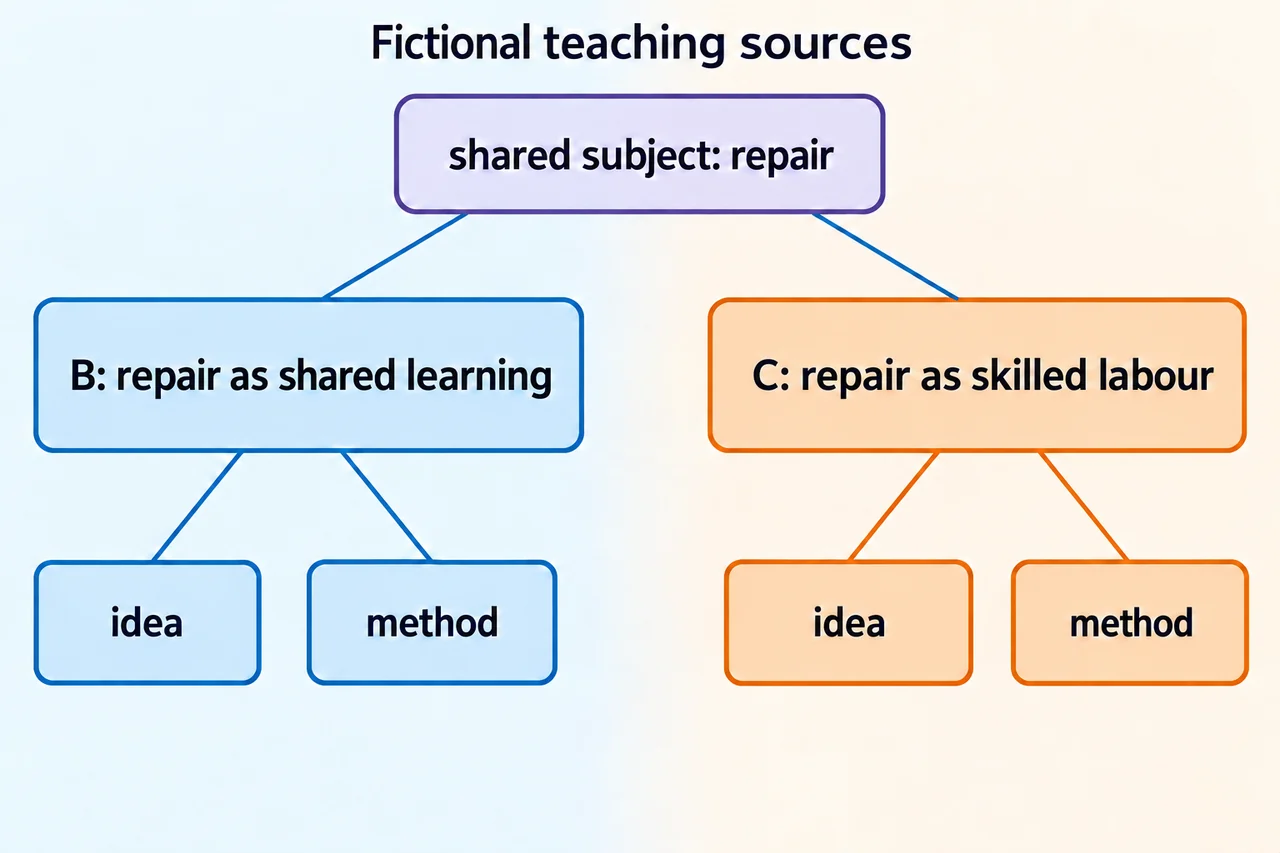
Image: illustration, not a documentary photograph. Original teaching model created for myAudience. · Original generated teaching illustration; no source textbook artwork reproduced.
Non-fiction: viewpoint, bias and the quality of evidence
Non-fiction presents ideas about the world, but its form does not guarantee that every claim is true. A viewpoint is a position on an issue; bias is a leaning that shapes selection or presentation. Evidence may be relevant yet too limited for the conclusion drawn. The prerequisites are close reading and cautious inference. Use the terms claim, evidence, sample and qualification when checking what a passage can reasonably establish.
Read this invented newsletter report: “At our repair day, eighteen of the twenty people who completed a feedback card said they would return. The organiser called the event a success. Since everyone in town loves repairing things, the council should fund a weekly workshop.” The feedback supports a claim about those twenty respondents. It does not show what every resident thinks, or even what people who attended but did not complete a card think.
Eighteen out of twenty is ninety per cent, because 18 divided by 20 is 0.9. A percentage describes this specified sample, not an automatic population result. The sentence about everyone in town misuses the limited evidence. The organiser may also have an interest in continued funding. That interest is context for evaluating selection, but it does not prove dishonesty or make every claim false. Distinguish a justified limitation from an attack on the writer.
Purpose changes the standard of usefulness. A resident deciding whether to attend might find opening hours and accessibility more relevant than a satisfaction figure. A council considering funding would need costs, demand and alternatives alongside feedback. An article that places the percentage in a large heading and hides the sample size in small print may create an impression stronger than the evidence warrants. Assess presentation as well as content.
In the original essay B, A Place to Learn, supplied below, separate the writer's proposal, illustrative experiences and acknowledged limitations. All its events are invented for teaching, so they cannot establish actual community outcomes. Analyse how the essay constructs a viewpoint and check whether its own reasoning follows from its premises. An effective critical reader can recognise a persuasive technique and still ask what further evidence would be needed for a real decision.
Original passage B: A Place to Learn. Original imagined community essay; not a factual report. Authored 3 October 2026; all events and data are fictional.
This is not historical testimony or an source.
B1. A repair table gives neighbours a place to learn together; even an unsuccessful mend can begin a conversation. In the imagined community session described here, a woman arrives with a coat she has stopped wearing because one pocket hangs loose. She leaves with uneven stitches and a reason to use it again. The stitches are not evidence that every repair succeeds. They show the modest kind of result a small workshop could aim for: an ordinary object returned to use by someone who understands it a little better.
B2. The appeal of such a session is not simply that somebody else will fix a problem. Watching the work can turn a mysterious fastening into a process with a beginning, a difficulty and a possible solution. A volunteer might explain why a zip catches or why a seam pulls apart. The explanation matters because it makes the next decision more informed. Sometimes that decision will be to stop, admit that a repair is beyond the group and seek qualified help.
B3. There is a social reason for making room around the table as well. An object gives people something concrete to discuss before they have to talk about themselves. A cup may carry a story; a sleeve may reveal years of work. This is a possibility, not a measurable promise that workshops cure loneliness or improve mental health. A community event can invite conversation while respecting a visitor who would rather concentrate on the practical task and go home quietly.
B4. Enthusiasm should still be tested. In this fictional teaching scenario, eighteen of twenty people who completed a feedback card said they would return. That is encouraging feedback from respondents, but it tells us little about residents who did not attend or visitors who left without a card. It also says nothing about the cost of a second session. A headline celebrating universal demand would go further than this imagined evidence allows.
B5. The sensible next step would be a limited pilot with a published budget and a clear boundary around the repairs offered. Organisers could collect bookings, record how long tasks take and ask what specialist help is needed. Skilled workers should not be expected to donate unlimited time because the event sounds kind. A workshop that depends on exhaustion is unlikely to provide a dependable place to learn.
B6. I would therefore support one further trial rather than promise a weekly service.
The aim should be a shared table with honest limits: enough time to learn, enough expertise to work responsibly, and enough information to judge whether another session is worthwhile. Success would not mean that every object leaves looking new. It would mean that participants understand their choices and that the people giving help can afford to offer it again.
Original passage C: The Cost of a Skilled Hour. Original imagined opinion article; alternative perspective on repair. Authored 3 October 2026; all events and data are fictional. This is not historical testimony or an source.
C1. Applause will not pay the trained repairer. A useful service must protect skilled time as carefully as it saves damaged objects. In the imagined town used for this teaching exercise, the committee praises volunteers for their generosity while quietly assuming that generosity will appear whenever a room is booked. That is an uncertain foundation for any service. Praise can express gratitude, but it cannot guarantee that the person with the necessary tools will be free next Tuesday.
C2. The word volunteer can also hide differences between tasks. Welcoming visitors, making tea, supervising a simple stitch and repairing a complicated mechanism are not interchangeable forms of help. Some work requires specialist training, equipment or responsibility that the committee has not budgeted for. Calling the whole event friendly does not remove those differences. Before advertising repairs, organisers should say what help will actually be available and what requests must go elsewhere.
C3. I do not object to a shared table or to people learning from one another. A visitor who understands a simple repair may make better choices next time, and a skilled worker may enjoy explaining a process. But enjoyment is not an unlimited resource. A programme that becomes successful can demand more hours than the original volunteers intended to give. If those hours are treated as free by definition, the programme may grow by transferring its costs to the helpers.
C4. A trial could still be useful if it measures work rather than just applause. Alongside visitor feedback, record the time spent on tasks, the cost of materials and the requests that could not be completed. Pay for specialist hours where they are needed. Such records would make a later decision less dependent on the charm of one afternoon. They could also reveal that a monthly event is practical even when a weekly service is not.
C5. Repair deserves a place in community life, but the people who make it possible deserve one too. I would support a modest service with clear limits before a grand promise built on invisible labour. A good plan should survive the day when the most enthusiastic volunteer cannot attend. If it cannot, the committee has designed an occasion, not a dependable service.
Extended study R5. Original teaching and practice, not an paper or awarded response. Passage A is The Last Repair in Lesson 1; B is A Place to Learn and C is The Cost of a Skilled Hour in Lesson 6. A1/B1/C1 identify their numbered paragraphs. All people, events, prices and survey data are invented; quoted phrases refer to these original teaching texts. Practice word ranges are editorial guidance, not examination limits.
R5 — Comparison of perspectives, methods and evidence quality
Source-criticism answer: 18 divided by 20 is 0.9, or 90 percent, but the denominator is returned cards, not the whole town. If thirty visitors attended and ten supplied no card, the rate of positive responses among all visitors could range from 18/30 = 60 percent to 28/30, about 93.3 percent, depending on the missing ten. Thirty is an additional fictional counterexample, not a fact in B. Even the upper bound would not establish demand among non-attenders, recurring attendance, affordability or repair safety. The original essay's careful limitation makes its argument more credible as writing; invented evidence cannot validate a real service. C's recommended records are a proposal to obtain evidence, not records already collected.
Revision workshop: weak draft — 'B is positive because 90% of residents love repairs. C hates volunteers and uses a short sentence to make people angry.' Correct the population first; then correct the viewpoint by using C's concession in paragraph 3; then replace the compulsory reader emotion with the opening's financial criterion. A reasoned revision is: 'B qualifies positive feedback from respondents, while C accepts shared learning but tests the service against the cost of skilled time. The blunt opening makes praise an inadequate substitute for provision.' Add a paired quotation and explain its contribution. Transfer: reverse the order of B's first and fourth paragraphs. Explain how starting with the feedback limitation could make the essay sound more cautious before its concrete benefit appears. Neither order changes the underlying sample size.
Full original evidence-criticism model. The report gives a positive response from eighteen of twenty people who returned a feedback card, so ninety per cent describes those respondents. It does not describe the whole town or necessarily every attendee. People who enjoyed the event may have been more willing to return a card, although that possibility alone does not prove bias actually occurred. If thirty attended, an additional fictional assumption, the ten nonrespondents could make the positive proportion among all attendees anywhere from eighteen out of thirty to twenty-eight out of thirty. These bounds still tell us nothing directly about residents who stayed away. The organiser's interest in continued funding is relevant context, not proof of dishonesty. A council would need information about staffing, costs, repeat demand and alternatives before treating satisfaction as sufficient reason for a weekly workshop. The report can support a limited account of respondent experience while leaving the larger funding question unresolved. All figures here are original invented teaching data, not observations of a real service.
Worked example: Original invented report: 18 of 20 feedback respondents would return. The writer claims that everyone in town supports weekly funding. Evaluate the inference.
Calculate 18 ÷ 20 × 100 = 90 percent for respondents only.
Notice that attendance, responding and town residence are different populations.
Identify the funding conclusion as requiring additional information about cost and demand.
Answer: The figure shows that 90 percent of the twenty respondents said they would return. It cannot establish universal support in the town or justify a weekly funding decision by itself.
Check your understanding: Would replacing everyone with many residents solve all the reasoning problems?
Answer: No. The source still identifies respondents rather than residents generally, and it gives no evidence about weekly cost or demand.
Why: Softening a quantifier helps avoid universality but does not make an unrepresentative or unspecified sample sufficient for a broader conclusion.