Compare and synthesise: shared subject, different perspectives
By UK GCSE English Language · independent study · myAudience
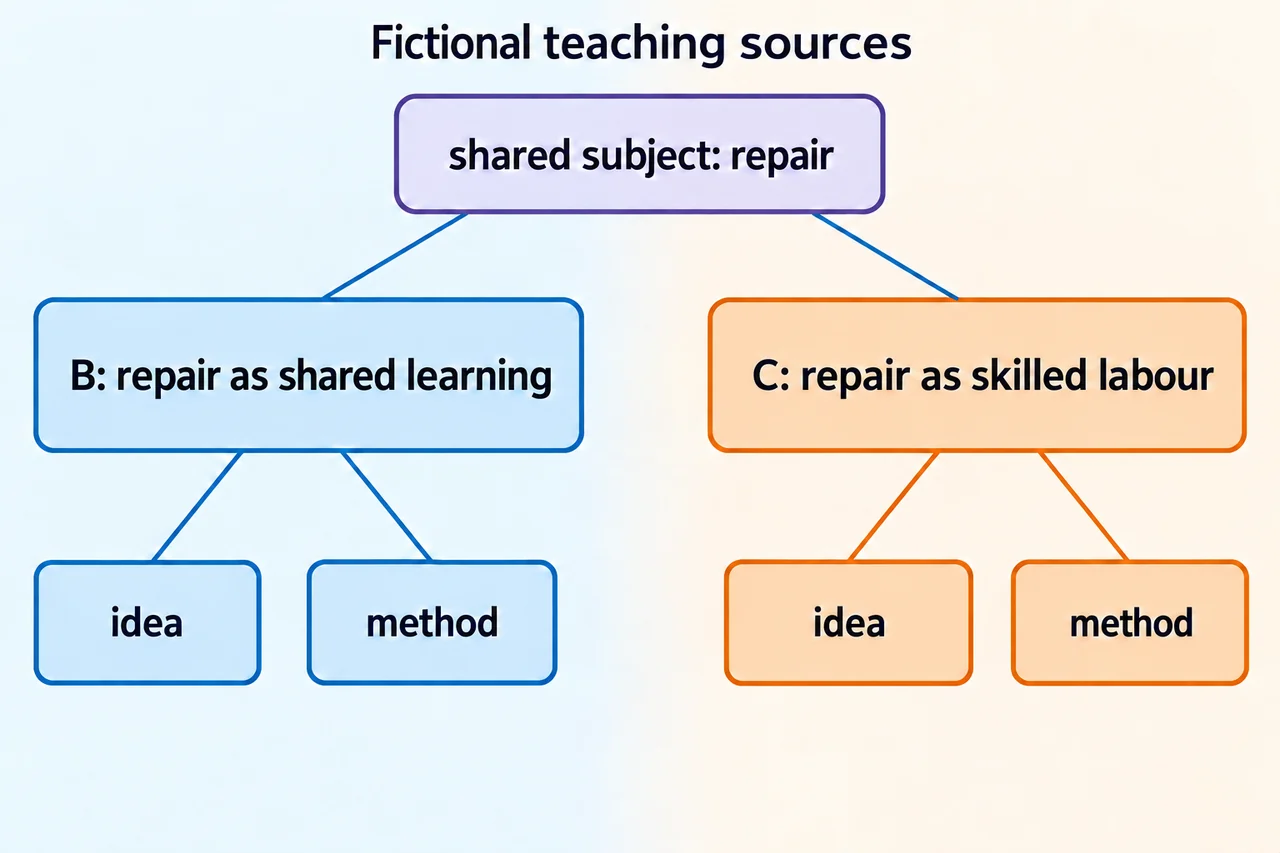
Image: illustration, not a documentary photograph. Original teaching model created for myAudience. · Original generated teaching illustration; no source textbook artwork reproduced.
Compare and synthesise: shared subject, different perspectives
Two texts can share a subject and still organise it around different concerns. Synthesis selects and combines relevant information into a new account; comparison examines similarities and differences in ideas and in how those ideas are conveyed. You need accurate single-text summaries before attempting either. Paired evidence, perspective and method are useful terms. A shared topic such as repair is a starting point, not itself a developed comparison.
Consider two original short sources. Extract B says, “A repair table gives neighbours a place to learn together; even an unsuccessful mend can begin a conversation.” Extract C says, “Applause will not pay the trained repairer. A useful service must protect skilled time as carefully as it saves damaged objects.” Both value repair, but B emphasises shared learning whereas C stresses labour and financial sustainability. Neither explicitly rejects the other's concern.
For a synthesis about the conditions needed for a useful workshop, combine B's emphasis on learning with C's emphasis on protecting expertise. Do not assert that both writers demand free weekly workshops, since neither says that. For comparison, develop the paired difference: B's welcoming phrase learn together presents repair as a social opportunity, while C's firm negative statement about applause makes unpaid labour a problem. The explanation connects an idea with a method in each text.
Keep the task distinction clear. A comparison of perspectives needs more than an alternating list of quotations. A synthesis of information need not catalogue every rhetorical feature. Use connecting language that expresses the actual relation, such as both value, whereas or qualifies, and avoid automatic oppositions. Sources may agree on a goal but disagree on means. A nuanced comparison should preserve that shared ground while explaining the important difference.
study strand uses linked sources across time, including a nineteenth-century source and another modern-century source. These invented 2026 examples teach comparison mechanics but cannot fulfil that historical reading requirement. The period-voice exercise D supplied below is clearly labelled contemporary invention. Before using real dates or contexts in interpretation, verify provenance. For this cohort, compare the ideas and wording you can actually see, and leave authentic cross-period transfer as an open next step.
Original passage D: A Period Voice Is Not a Period Source.
Original 2026 invented diary-style voice; NOT nineteenth-century evidence. Authored 3 October 2026; all events and data are fictional. This is not historical testimony or an source.
D1. This evening I carried the cracked cup to the room behind the shop, where a gentleman had set out his tools upon a narrow table. He asked whether I wished the line in its side to disappear. I told him that the line was the very reason I had kept it. At this he laid aside the glue and offered me a chair. The room was poorly lit, yet I found I could see the cup more clearly when no one was trying to make it new.
Extended study R5. Original teaching and practice, not an paper or awarded response. Passage A is The Last Repair in Lesson 1; B is A Place to Learn and C is The Cost of a Skilled Hour in Lesson 6. A1/B1/C1 identify their numbered paragraphs. All people, events, prices and survey data are invented; quoted phrases refer to these original teaching texts. Practice word ranges are editorial guidance, not examination limits.
R5 — Comparison of perspectives, methods and evidence quality
Extends lessons 6–7. Prerequisites: R1–R2 and original lessons 6–7. Vocabulary: concession, antithesis, representativeness, sustainability. Viewpoint is a position on the subject; method is how the text develops that position. A source can use welcoming language and still make a restrictive recommendation. Read the ending before calling a writer wholly optimistic. Both fictional essays favour limits, specialist help and a trial. The difference is the order and emphasis of their reasons, not a simple contest between kindness and hostility.
Visual explanation: the final comparison plate groups both perspectives under 'shared subject: repair'. Its equal source cards prevent an invented hierarchy. Under each, 'idea' and 'method' are separate prompts, not separate texts. For the shared-learning card, fill idea with 'support a bounded trial that helps participants understand choices'; fill method with the uneven-stitches example, qualification and limited recommendation. For the skilled-labour card, fill idea with 'protect skilled time before promising a dependable service'; fill method with the blunt financial opening, task distinctions and concession. The lines show grouping only. They do not measure influence, prove author intention or establish a historical relationship.
Original extended task: compare how extracts B and C make a limited repair service seem preferable to a grand promise. Write 500–700 words, integrating ideas and methods rather than writing two unrelated mini-essays. Then add a 150-word source-criticism note explaining what neither fictional essay can establish about a real town.
Model paragraph 1: Both writers support repair while resisting unlimited promises, but they lead readers towards that limit through different priorities. B begins with neighbours learning together and gives the coat's uneven stitches as a modest useful outcome. The imperfection of the result makes the positive case compatible with limits from the start: returning an object to use matters more than making it look new. C begins instead with 'Applause will not pay', a blunt contrast between public approval and the resources a worker needs. This opening asks readers to test an attractive proposal against its material cost before celebrating it. B makes restraint seem part of a worthwhile shared experience; C makes restraint a condition of dependable provision.
Model paragraph 2: Their qualifications also reveal important agreement. B acknowledges that a repair may require 'qualified help', refusing to treat enthusiasm as sufficient expertise. C distinguishes welcoming visitors from repairing a complicated mechanism, so the broad category of volunteering cannot conceal unequal demands. B's examples make an informed decision to stop part of learning, whereas C's task distinctions expose the committee's budgeting problem. Neither dismisses skill. The difference is whose decision receives emphasis: B attends to what a participant can understand; C attends to what organisers must provide. Comparing these methods avoids the misleading conclusion that one writer cares about people and the other only about money.
Model paragraph 3: The writers finally differ in their preferred evidence while converging on a cautious trial. B describes eighteen positive feedback cards out of twenty, then immediately limits the inference to those respondents. The apparent success is therefore placed inside a paragraph that checks enthusiasm rather than licenses indefinite expansion. C's recommendation to record time, materials and uncompleted requests shifts attention to what approval leaves invisible.
'Work rather than just applause' sharpens that shift through contrast, without making visitor feedback worthless: 'just' criticises reliance on feedback alone. Together the essays present a stronger case for a bounded pilot than either a celebratory headline or a blanket rejection of community repair would provide. B shows a possible benefit worth testing; C specifies costs the test must expose.
Model paragraph 4: Their endings make this agreement explicit while retaining different standards of success. B returns to a shared table where participants understand their choices and helpers can afford to return. C asks whether the plan can survive the absence of its most enthusiastic volunteer, distinguishing an occasion from a service. B's balanced account of participants and helpers preserves its inclusive starting point. C's hypothetical absence tests the proposal against a future difficulty that an enjoyable afternoon cannot answer. Both persuade through a limited ambition, but B makes that limit part of the benefit offered, while C makes it a test of organisational resilience.
Model paragraph 5: Neither writer relies solely on a slogan. B moves from the participant’s imperfect stitches towards the pilot’s limits, making cautious support grow out of an ordinary example. C moves from the inadequacy of praise towards records and payment, making the practical alternative answer the opening challenge. These sequences matter because each supplies a workable next step after questioning an attractive promise. The reader is offered a way to preserve repair’s value without assuming unlimited provision. The shared recommendation is consequently developed through distinct routes, rather than reached by identical arguments.
Annotations: paragraph 1 pairs openings by a shared issue and explains the effects of the examples and contrast. Paragraph 2 selects agreement with differing emphasis, then compares how each develops it. Paragraph 3 joins evidence criticism to the recommendation. These are sustained comparisons of methods, not merely similarities in topic. Two concessions do not automatically have identical functions; explain what each concession permits the writer to argue next.
Source-criticism answer: 18 divided by 20 is 0.9, or 90 percent, but the denominator is returned cards, not the whole town.
If thirty visitors attended and ten supplied no card, the rate of positive responses among all visitors could range from 18/30 = 60 percent to 28/30, about 93.3 percent, depending on the missing ten. Thirty is an additional fictional counterexample, not a fact in B. Even the upper bound would not establish demand among non-attenders, recurring attendance, affordability or repair safety. The original essay's careful limitation makes its argument more credible as writing; invented evidence cannot validate a real service. C's recommended records are a proposal to obtain evidence, not records already collected.
Revision workshop: weak draft — 'B is positive because 90% of residents love repairs. C hates volunteers and uses a short sentence to make people angry.' Correct the population first; then correct the viewpoint by using C's concession in paragraph 3; then replace the compulsory reader emotion with the opening's financial criterion. A reasoned revision is: 'B qualifies positive feedback from respondents, while C accepts shared learning but tests the service against the cost of skilled time. The blunt opening makes praise an inadequate substitute for provision.' Add a paired quotation and explain its contribution. Transfer: reverse the order of B's first and fourth paragraphs. Explain how starting with the feedback limitation could make the essay sound more cautious before its concrete benefit appears. Neither order changes the underlying sample size.
Further annotations: comparison paragraphs 4–5 weigh endings and whole-argument sequences. R2’s third paragraph tests unsettled atmosphere against the absent destination. R3’s fourth paragraph distinguishes two kinds of resolution. Evaluation paragraphs 4–5 test the unchanged weather, then prioritise narrated conduct over an inferred inner state. These extensions add warrants and limits, not additional claims about real readers’ emotions.
Full original reverse-order comparative transfer model. Opening B with the feedback limitation from its fourth paragraph would make the argument's caution visible before the account of shared learning. Readers would first encounter the boundary between reported enthusiasm and established demand. The subsequent concrete example could then appear as an illustration of a possible benefit rather than an attempt to let one appealing afternoon stand for everyone. That might strengthen trust for a funding audience already concerned about overclaiming, but it could also delay the human experience that gives the existing opening its interest. A claim about effect needs both possibilities: sceptical and sympathetic readers do not necessarily respond alike.
The reversal would not make B identical to C. B would still explore learning together and propose a limited trial, whereas C evaluates provision through the time and costs of skilled labour. Bringing B's qualification forward changes the sequence in which its perspective reaches the reader, not the underlying sample, the facts or the writer's entire position. C's financial emphasis could therefore remain a useful comparison, even if the revised B initially sounds more cautious. A successful explanation links viewpoint and method without collapsing them: the position concerns what repair can offer, while paragraph order controls when that offer and its limitation become visible. Simply saying that the revision makes B 'negative' would miss its retained concrete benefit. Equally, claiming that the existing order is manipulative would exceed the evidence. Either organisation can be reasonable if the later qualification is clear and the conclusion remains proportionate to what the original fictional sources establish.
Worked example: Compare B’s “learn together” with C’s “Applause will not pay the trained repairer”, explaining perspective and method.
Find common ground: repair is worthwhile in both passages.
Pair the distinct concerns: social learning versus skilled labour.
Explain B’s inclusive wording and C’s blunt negative statement rather than just identifying quotations.
Answer: Both writers value repair, but B’s inclusive “learn together” presents it as a communal opportunity. C’s blunt “Applause will not pay” shifts attention to the practical cost of skilled labour, qualifying enthusiasm with a demand for sustainability.
Check your understanding: Is “B likes repair but C dislikes it” a supported comparison?
Answer: No. C criticises reliance on praise rather than rejecting repair itself.
Why: Comparison must distinguish the object of criticism. Misidentifying C’s position creates a false opposition and loses the shared value expressed by both sources.