Description: organise attention and build a coherent atmosphere
By UK GCSE English Language · independent study · myAudience
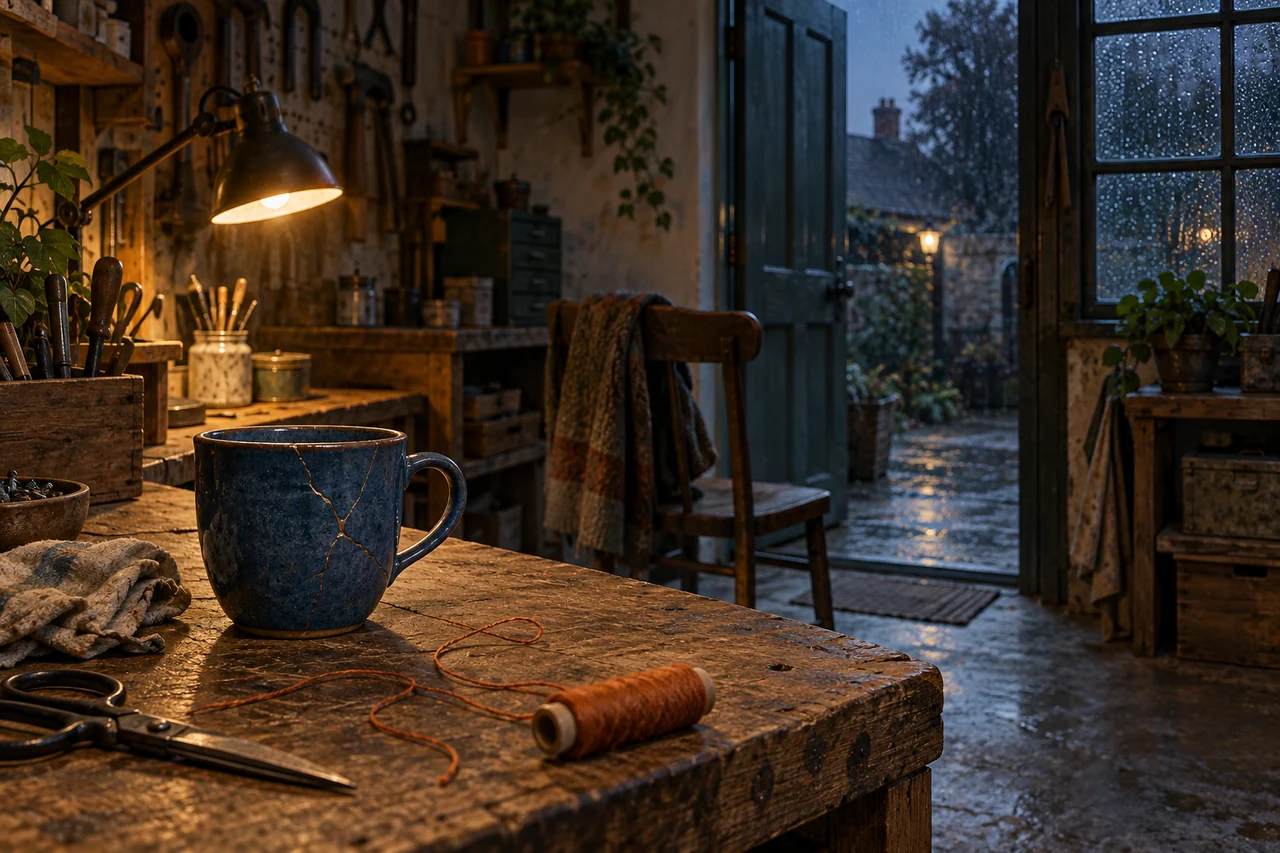
Image: illustration, not a documentary photograph. Original teaching model created for myAudience. · Original generated teaching illustration; no source textbook artwork reproduced.
Description: organise attention and build a coherent atmosphere
Description guides the reader's attention through a scene. It can include small actions, but its main work is to make a place, object or moment vivid and meaningful. Atmosphere is the impression created by related details; a motif is an element that recurs with significance. You need to understand contextual word choices and structural focus from Lessons 3 and 4. Choose an atmosphere as an intention, then test whether your details work together.
Use this lesson’s original workshop illustration, or its text alternative: a cracked blue cup and orange thread lie on a bench; an empty chair faces an open door; rain marks a dark window while a lamp warms the room. These details can support warmth, loneliness or anticipation. The picture is invented artwork, not evidence of an event. Your description may develop an imagined scene rather than reproduce every visible object.
Select two or three details with a common relationship. A warm lamp, worn bench and cup awaiting repair could suggest care despite damage. A cold doorway, abandoned chair and light confined to one corner could suggest absence. Listing every sense often gives a scattered inventory. Instead, place the reader somewhere and move attention deliberately: from the doorway towards the bench, or from a close detail to the wider room.
Compare “There was a very old, very nice bench” with “The bench shone where years of palms had pressed the grain smooth.” The second uses a concrete surface and implied use to suggest age and care. Precision need not mean rare vocabulary. A small number of well-chosen nouns and verbs usually conveys more than a cluster of incompatible adjectives. Do not force a metaphor where it confuses the physical scene.
Draft a short description with a stable observer and one planned change of focus. If the opening presents warmth, the ending might return to the lamp with a new emphasis on its limited reach. current description prompt allows imagination rather than exact picture copying. That freedom still requires a coherent response to the task. During revision, remove a detail that clashes with your intended atmosphere unless its contrast has a clear purpose.
Extended study W1. All model scenes, people, prices and survey examples are original fictional teaching inventions, not observed outcomes. Practice word ranges are editorial guidance, not examination requirements. No model is an awarded response.
W1 — Description organised by attention
Extends lesson 8.
Prerequisites: original lessons 3, 4 and 8. Vocabulary: focal point, spatial coherence, sensory selection, tonal modulation. Description has an organising intelligence even when little happens. A reader needs to know where attention is directed, how details relate and why one detail receives more space than another. A list of five senses can scatter attention rather than deepen it. Choose sensations that belong to the same viewpoint: someone at the bench might feel a rough rim and hear rain, but cannot also inspect the lane beyond a closed wall without moving or imagining it.
Original task: use this lesson’s workshop illustration as a starting point for a 400–600-word description in which a room seems initially unwelcoming but gradually offers a limited refuge. You may imagine beyond the image. Keep a coherent viewpoint and avoid turning the task into a complete rescue story. This practice length and mood trajectory are editorial choices, not official requirements. Plan three movements of attention: threshold and distance; closer examination of objects; return to the doorway with a changed impression. Leave some discomfort present at the end so that the tonal change has proportion.
Original model, paragraph 1: From the doorway, the workshop looked as though it had drawn away from the street. The window held a dark, trembling copy of the lane, and the rain made each reflection briefly taller before breaking it apart. A chair faced the entrance without quite welcoming it. Beyond the chair stood a bench, its surface interrupted by the pale circles that mugs leave when nobody has remembered a cloth. Nothing moved except the water. Even the lamp seemed to be waiting for permission, its shade leaning over a small patch of wood while the corners of the room remained beyond its reach.
Model paragraph 2: Closer to the bench, the emptiness became less complete. A strand of orange thread had caught beneath a splinter. It looped once around the foot of the lamp and trailed towards a blue cup, which stood with its cracked side turned away from the light. The cup was clean. Someone had washed it, dried it and put it down carefully, despite the thin line that crossed its glaze. Beside it, the tools lay in shallow grooves worn by years of being lifted and returned. Their handles did not shine. They had the quiet smoothness of things held often enough to lose their sharp edges.
Model paragraph 3: The rain continued to beat against the glass, but at the bench its sound lost some of its force. The lamp warmed the back of my hand. Under that warmth, the wood's scratches became visible as separate marks rather than a general roughness: one curved, one straight, one so deep that it held a little dust. The room had not become tidy. The chair still waited at its awkward angle, and the doorway still admitted a narrow draught. Yet there was space beside the cup to set something down. For the first time, the open door seemed less like a gap the room could not close than a way another person might enter.
Model paragraph 4: I stayed beside the bench until the reflection in the window separated into lamp, chair and door. The street was still there behind them, blurred and moving, but it no longer occupied the whole pane. A drop slid down the glass, gathering two smaller drops as it went. On the bench, the orange thread remained caught beneath its splinter. I did not pull it free. Its loose end rested in the light, bright enough to notice without being bright enough to illuminate anything else. The room offered no grand shelter from the weather. It offered a dry surface, a little warmth and a place where an unfinished thing could remain for a while.
Annotations: paragraph 1 establishes the viewing position and distance. Its personification belongs to the observer's impression, not a literal claim that a lamp thinks. Paragraph 2 narrows attention and supplies evidence of care through the washed damaged cup and worn handles. Paragraph 3 returns to sounds and doorway while preserving the draught. The tonal change arises from reinterpreting observed details; it does not require a sudden cheerful adjective. The first-person hand locates the observer at the bench. This model is a sustained sequence to study and extend, not a claim to match a particular exam word count.
Further annotation: paragraph 4 reassembles the window’s reflection and retains the caught thread, making refuge local and incomplete. The room’s small offer is earned through the preceding observations, not supplied by a sudden change in weather.
Misconceptions: an adjective for each noun does not create specificity; 'ancient, eerie, mysterious chair' tells less than the chair's direction and angle. A simile in every sentence can make competing images crowd the room.
Inventing the identity of the absent worker is allowed in creative writing, but must be a deliberate addition, not a factual interpretation of a generated image. Revision task: replace 'The room was terrifying and then very cosy' with two details that sustain unease and two that offer refuge. Reasoned answer: retain the draught and dim corners, but foreground the lamp's warmth and the space beside the cup. The revision lets the reader infer the change and keeps it limited.
Demanding transfer: describe the same invented room as reassuring at first but increasingly oppressive, without changing the objects or adding a threatening person. Turn neat grooves into signs of rigid routine; let the lamp isolate rather than welcome. Explain in 150 words how order of attention changed the effect. Competing interpretations of the same stimulus can be credible when their selection and relationships are consistent. They do not establish what a real person would feel in a real workshop.
Full original opposite-atmosphere description — imaginative response to the same workshop illustration. From the doorway, the lamp made the bench look like a place kept ready for someone. Its light gathered the blue cup, the spool of thread and the scissors without demanding that any of them be used. Outside, rain moved restlessly across the window; here the objects stayed still. I put a hand on the edge of the bench and felt the warmth in the wood. The chair stood within reach. For a moment, the arrangement seemed to offer permission to stop thinking about the street.
Closer to the cup, I noticed the repaired line crossing its glaze. Someone had followed that narrow route patiently, keeping the curve of the vessel intact. The thought was reassuring until I began looking for a place where the hand had hesitated. There was none that I could find. Beside it, the tools rested in shallow grooves, each worn space almost the shape of the handle it held. I had first taken their neatness for care. Now the empty distances between them looked exact, as though replacing one tool a little farther along would disturb more than a tidy bench.
The orange thread crossed the surface and disappeared into its spool. I traced it with my eyes, expecting the loose end to explain itself, then found I was looking along the same short route again. The lamp did not reach beyond the bench. What had seemed a useful patch of warmth now made the rest of the room harder to see. When I moved towards the chair, its cloth brushed my sleeve. I stopped before sitting. Nothing had forbidden it; I simply wanted to know whether the chair's position was another arrangement I would have to put back exactly as I found it.
Rain still travelled down the window, but the moving street had become a blurred background to the little area that held me. I lifted my hand from the wood. Its warmth no longer settled the question of whether I was comfortable. The scissors remained half-open, the thread loose, the cup empty: all ordinary states that I could have accepted without explanation a few minutes before. I was now measuring them against an order I could not quite name. The doorway had not narrowed. Yet when I stepped towards it, I was careful not to shift the chair, and I kept my shoulder away from the row of tools. I left the light behind as though leaving a task unfinished.
Evaluated rationale. The description begins with warmth and objects awaiting use, making order initially reassuring. Attention then moves closer: the repaired cup's uninterrupted line changes patience into an expectation of precision. This does not establish that an absent worker is controlling; the narrator's interpretation changes. The grooves develop that expectation by making alternative positions seem disturbing. The lamp undergoes the same reversal: its useful warmth becomes a boundary beyond which the narrator cannot see clearly. Finally, the unchanged doorway shows that restriction belongs to the viewpoint rather than a physical trap. Ordinary objects remain ordinary, and no threatening person appears. The ending makes careful movement express pressure instead of declaring fear. Another version could create a different credible atmosphere, but this sequence answers the requested reassurance-to-oppression movement. Adding explicit danger would weaken the gradual reinterpretation. The generated stimulus supports imaginative selection, not a claim about actual visitors' feelings in any real workshop.
Worked example: Original task: Describe a room that seems to be waiting for someone. Develop a coherent focus using the workshop stimulus or its text alternative.
Choose restrained anticipation as the intended atmosphere.
Move from the empty chair to the cup and then to the open door.
Use ordinary precise details instead of listing all senses or objects.
Answer: The chair had been drawn away from the bench, leaving a narrow place for someone to sit. Beneath the lamp, a blue cup held its crack in a line of gold light. The door stood open just wide enough to admit the rain’s cool smell. No one came to close it.
Check your understanding: Why might adding “The cheerful room exploded like a volcano of terror” weaken this description?
Answer: Its conflicting mood and exaggerated image distract from the restrained anticipation already established.
Why: Creative language must serve the scene. Contrast can be purposeful, but incompatible claims and imagery need a reason; novelty alone does not create coherence.