Grammar as choice: main clauses, subordination and emphasis
By UK GCSE English Language · independent study · myAudience
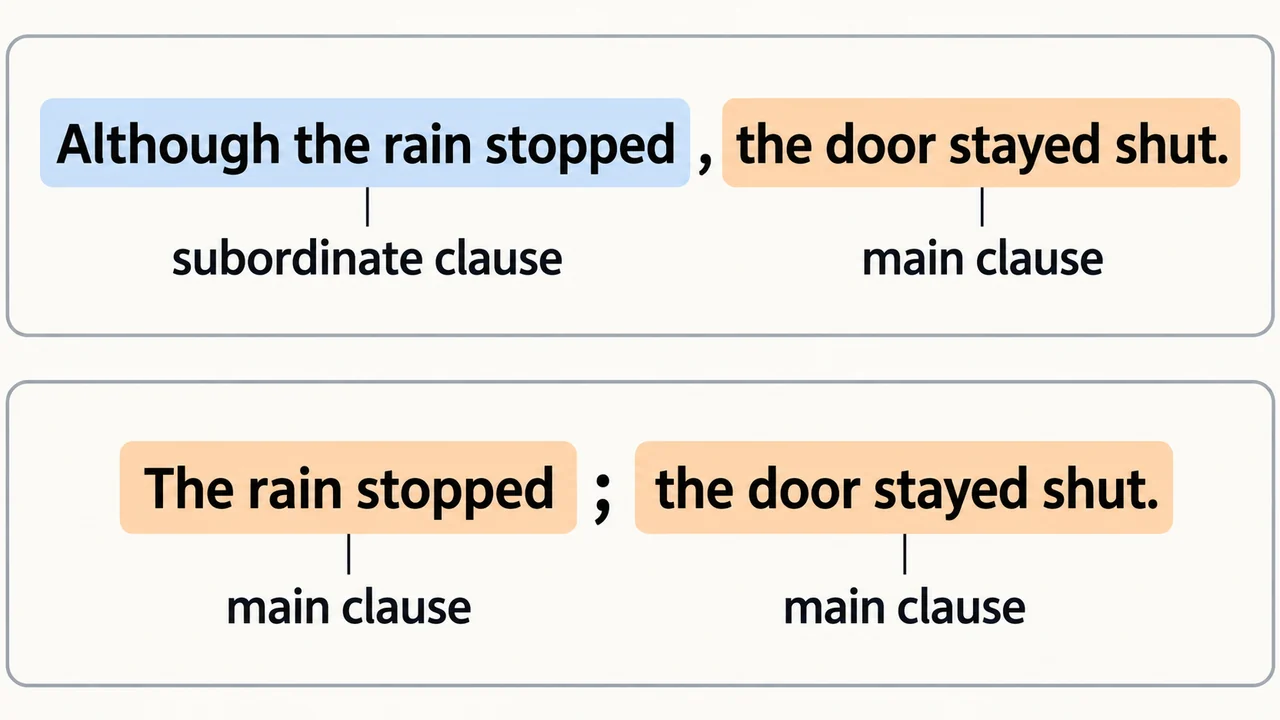
Image: illustration, not a documentary photograph. Original teaching model created for myAudience. · Original generated teaching illustration; no source textbook artwork reproduced.
Grammar as choice: main clauses, subordination and emphasis
Grammar describes patterns that make relationships between words and ideas clear. In the finite-clause examples used here, a main clause can normally stand alone as a complete sentence, while a subordinate clause depends on another clause. A finite verb marks tense or includes a tensed auxiliary. You need to identify subjects and actions before comparing these patterns. Clause, coordination, subordination and emphasis are the key terms for this lesson.
“The door stayed shut” is a main clause: door is its subject and stayed is its finite verb. “Although the rain stopped” is subordinate because although marks a relationship that needs another clause here. Joining them gives “Although the rain stopped, the door stayed shut.” The subordinate opening acknowledges an expectation, while the main clause carries the contrasting outcome. The arrangement is useful when that contrast serves your meaning.
Coordination places clauses alongside one another: “The rain stopped, but the door stayed shut.” Subordination can give one idea a supporting role: “Although the rain stopped, the door stayed shut.” Both are grammatical, yet their organisation changes emphasis. A simple sentence can contain a long noun phrase, and a complex sentence can be quite short. Count clause relationships rather than assuming that word count decides the sentence category.
A sentence fragment may be a deliberate literary choice, but first learn to recognise it. “Although the rain stopped.” leaves the relationship incomplete in this exercise. In a sustained formal argument, accidental fragments can obscure reasoning. In fiction, a fragment such as “No footsteps.” might compress a character's attention after a complete sentence has established the scene. The label fragment explains the form; context explains whether the choice is controlled and useful.
Teaching research by Myhill and colleagues explored grammar within writing choices rather than terminology alone. This cohort adopts that principle as a design rationale, without claiming that reading these lessons will improve a GCSE grade. Practise by rewriting one pair of ideas in two grammatical forms and explaining the emphasis each produces. Standard English is a contextual written convention; using it for a formal task does not make other dialects inferior or reveal a speaker's intelligence.
Extended study W3. All model scenes, people, prices and survey examples are original fictional teaching inventions, not observed outcomes.
Practice word ranges are editorial guidance, not examination requirements. No model is an awarded response.
W3 — Clause choice, punctuation and technical control
Extends lessons 10–11. Prerequisites: original lessons 10–11. Vocabulary: finite verb, main clause, subordinate clause, concession, coordination. The plate uses finite clauses with overt subjects; it is not an exhaustive account of all clause forms. In 'Although the rain stopped, the door stayed shut', both clauses contain a subject and past-tense verb, but 'Although' marks the first as dependent. The main assertion is that the door stayed shut. The initial subordinate clause introduces a concession: stopping rain might have created an expectation of opening, but that expectation is not fulfilled. The comma marks the boundary after the initial dependent clause.
In 'The rain stopped; the door stayed shut', each side can stand as a full sentence. The semicolon links those related assertions while leaving their connection less explicit. A reader may infer contrast from context, but punctuation alone does not encode 'although'. The plate's matching main-clause colours show equal grammatical status, not equal emotional importance. Its blue and orange are redundant with labels, so the explanation can be followed without colour discrimination. Neither longer sentences nor semicolons automatically improve writing; accuracy and communicative purpose govern the choice. The Australian Government grammar source supports the mechanics of these examples, not an house style.
Worked revision set, all original: (a) 'Because the hall was cold.' is an incomplete standalone explanation in ordinary continuous prose: 'Because the hall was cold, we kept our coats on' supplies a main clause. (b) 'The hall was cold, we kept our coats on' joins independent clauses with only a comma; use a full stop, a semicolon or an appropriate conjunction. 'The hall was cold, so we kept our coats on' makes the consequence explicit. (c) 'Although the hall was cold; we stayed' incorrectly puts a semicolon between a dependent clause and its main clause in this construction; change it to a comma. (d) 'We stayed; despite the cold' has a phrase on the right, so use 'We stayed despite the cold' or give both sides full clauses. Explain the reason for each repair instead of memorising the mark.
Demanding task: assume more than one specialist.
Edit this invented report, preserving its facts and measured recommendation: 'The organisers plan one trial, it must have a budget. Although visitors enjoyed the afternoon. Their praise does not cover materials; or the specialists time. The committee should check its records before promising weekly sessions.' One defensible revision is: 'The organisers plan one trial; it must have a budget. Although visitors enjoyed the afternoon, their praise does not cover materials or the specialists’ time. The committee should check its records before promising weekly sessions.' The plural possessive assumes more than one specialist, as specified in the exercise; use specialist's if there is only one. The semicolon preserves two linked assertions, the comma completes the concession, and the spurious semicolon before a coordinated noun phrase disappears. 'Its' is possessive here; 'it's' would expand to 'it is' and change the syntax.
Competing editorial choice: 'The organisers plan one trial, which must have a budget' makes the budget a relative-clause qualification of the trial. 'The organisers plan one trial. It must have a budget' separates the requirement more sharply. All three can be grammatical. Choose by what the report needs to emphasise, then justify the choice in 80 words. Correctness does not prescribe a single rhythm. Deliberate fragments can have expressive use in creative writing, but calling an accidental broken explanation deliberate does not repair its unclear relation to the preceding sentence.
Spelling practice within revision: choose 'practice' for the noun in 'The practice takes time' and 'practise' for the verb in standard British usage in 'We practise explaining our choices'. Distinguish 'affect' as a verb in 'Costs affect the plan' from 'effect' as a noun in 'The effect is a smaller service'. These taught uses do not exhaust every meaning. Proofread one category at a time: boundaries, agreement, possession, then frequently confused words. Explain why each edit improves meaning. A technically accurate text still needs developed content; a semicolon cannot repair an unsupported conclusion.
Full original grammar-choice justification. I would choose 'The organisers plan one trial. It must have a budget' when the report needs to emphasise the requirement. The full stop gives the budget its own assertion instead of embedding it within a description of the trial. The semicolon keeps both main clauses closely linked; the relative clause makes the requirement a qualification of 'trial'. All three are grammatical. Their difference concerns how readers encounter the same information, not whether a budget is necessary in this report.
Worked example: Combine these original ideas in two ways: the rain stopped; the door stayed shut. Explain the effect of putting the rain clause in a subordinate role.
Check both original clauses have subjects and finite verbs.
Coordinate with but, then subordinate with although.
Compare how the subordinate version places the stopped rain as a concession to the main outcome.
Answer: Coordination: “The rain stopped, but the door stayed shut.” Subordination: “Although the rain stopped, the door stayed shut.” The second makes the rain stopping a concessive background condition and foregrounds the door remaining shut.
Check your understanding: In “Although the lamp failed, Mara continued working”, which clause is main and why?
Answer: “Mara continued working” is the main clause. It can stand alone as a complete sentence in this example.
Why: Although marks the other clause as subordinate. Continued is the main clause’s finite verb; working is non-finite here. The distinction depends on structure, not on which clause appears first.