Punctuation and spelling: make relationships readable
By UK GCSE English Language · independent study · myAudience
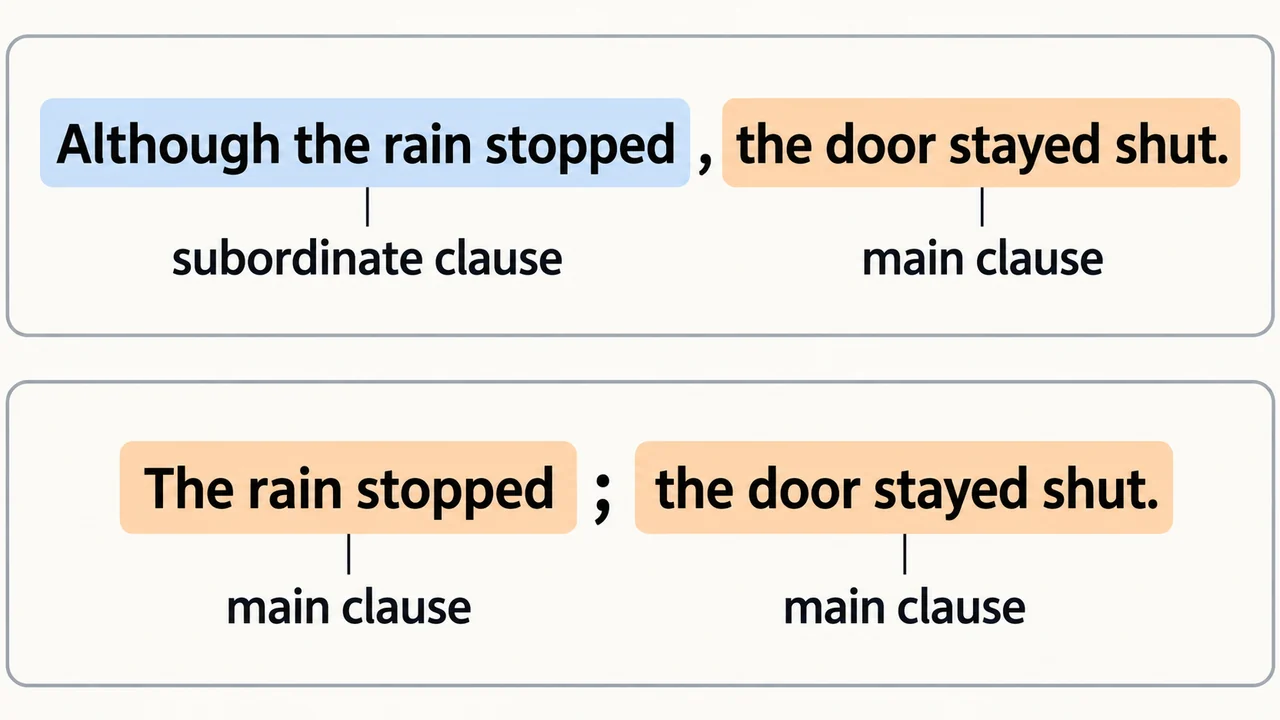
Image: illustration, not a documentary photograph. Original teaching model created for myAudience. · Original generated teaching illustration; no source textbook artwork reproduced.
Punctuation and spelling: make relationships readable
Punctuation helps the reader follow sentence boundaries and relationships. A full stop closes a sentence; a semicolon can connect closely related main clauses; an apostrophe can mark missing letters or possession. You need the clause distinction from Lesson 10 before choosing between them. Accuracy is purposeful communication rather than a demand to insert every available mark. The key vocabulary is boundary, comma splice, contraction and possession.
“The lamp failed, Mara continued working” joins two main clauses with only a comma. In ordinary formal prose, this comma splice needs revision. You could write “The lamp failed. Mara continued working” to give each event its own sentence, “The lamp failed, but Mara continued working” to mark a contrast, or “The lamp failed; Mara continued working” to connect the closely related events. The semicolon requires complete clauses on both sides in this use.
An introductory subordinate clause can be followed by a comma: “Although the lamp failed, Mara continued working.” That comma marks a different relationship from the splice above. Do not place commas wherever you would breathe; breath varies with speaker and pace. Check the sentence structure and the intended grouping instead. Punctuation choices sometimes vary with style, but a clear explanation should distinguish a defensible variation from an accidental boundary error.
Apostrophes also carry meaning. “The volunteer's notebook” belongs to one volunteer; “the volunteers' notebooks” relates to several volunteers. The ordinary plural volunteers needs no apostrophe by itself. In “It's lost its cover”, it's contracts it is, while its marks the notebook's relationship to the cover. Expanding a possible contraction is a practical test. Do not copy a punctuation convention for an unrelated language or regional style without checking the task's convention.
Proofread spelling separately from meaning. Read slowly for confusable words such as their, there and they're, then check a reliable dictionary when unsure. A broad vocabulary is useful only when a selected word says what you intend. First correct boundaries that obstruct comprehension, then apostrophes and local spelling. This staged check is a teaching strategy, not a guarantee of perfect accuracy. Preserve an intentional literary effect only when you can explain it and the reader can follow it.
Extended study W3.
All model scenes, people, prices and survey examples are original fictional teaching inventions, not observed outcomes. Practice word ranges are editorial guidance, not examination requirements. No model is an awarded response.
W3 — Clause choice, punctuation and technical control
Worked revision set, all original: (a) 'Because the hall was cold.' is an incomplete standalone explanation in ordinary continuous prose: 'Because the hall was cold, we kept our coats on' supplies a main clause. (b) 'The hall was cold, we kept our coats on' joins independent clauses with only a comma; use a full stop, a semicolon or an appropriate conjunction. 'The hall was cold, so we kept our coats on' makes the consequence explicit. (c) 'Although the hall was cold; we stayed' incorrectly puts a semicolon between a dependent clause and its main clause in this construction; change it to a comma. (d) 'We stayed; despite the cold' has a phrase on the right, so use 'We stayed despite the cold' or give both sides full clauses. Explain the reason for each repair instead of memorising the mark.
Demanding task: assume more than one specialist. Edit this invented report, preserving its facts and measured recommendation: 'The organisers plan one trial, it must have a budget. Although visitors enjoyed the afternoon. Their praise does not cover materials; or the specialists time. The committee should check its records before promising weekly sessions.' One defensible revision is: 'The organisers plan one trial; it must have a budget. Although visitors enjoyed the afternoon, their praise does not cover materials or the specialists’ time. The committee should check its records before promising weekly sessions.' The plural possessive assumes more than one specialist, as specified in the exercise; use specialist's if there is only one. The semicolon preserves two linked assertions, the comma completes the concession, and the spurious semicolon before a coordinated noun phrase disappears. 'Its' is possessive here; 'it's' would expand to 'it is' and change the syntax.
Competing editorial choice: 'The organisers plan one trial, which must have a budget' makes the budget a relative-clause qualification of the trial. 'The organisers plan one trial. It must have a budget' separates the requirement more sharply. All three can be grammatical. Choose by what the report needs to emphasise, then justify the choice in 80 words. Correctness does not prescribe a single rhythm.
Deliberate fragments can have expressive use in creative writing, but calling an accidental broken explanation deliberate does not repair its unclear relation to the preceding sentence.
Spelling practice within revision: choose 'practice' for the noun in 'The practice takes time' and 'practise' for the verb in standard British usage in 'We practise explaining our choices'. Distinguish 'affect' as a verb in 'Costs affect the plan' from 'effect' as a noun in 'The effect is a smaller service'. These taught uses do not exhaust every meaning. Proofread one category at a time: boundaries, agreement, possession, then frequently confused words. Explain why each edit improves meaning. A technically accurate text still needs developed content; a semicolon cannot repair an unsupported conclusion.
Worked example: Edit this original sentence for ordinary formal prose: “The volunteers notebook lost it’s cover, she repaired it.” Assume one female volunteer.
Use singular possessive volunteer’s because one volunteer owns the notebook.
Use its for the cover relationship; it is cover does not fit.
Separate the two main clauses with a full stop or appropriate connection.
Answer: “The volunteer’s notebook lost its cover. She repaired it.” A semicolon could also join these closely related main clauses, but a full stop is clear and sufficient.
Check your understanding: Can a semicolon repair “Although the lamp failed; Mara continued working” in the clause-linking use taught here?
Answer: No. The first clause is subordinate, so the main-clause linking rule is not met. Use a comma after the subordinate opening.
Why: The semicolon is not a stronger comma. Its function here depends on complete main clauses on both sides; punctuation should reflect the actual grammatical relationship.