Make possessions clear without guessing an owner
By UK GCSE Spanish · independent study · myAudience
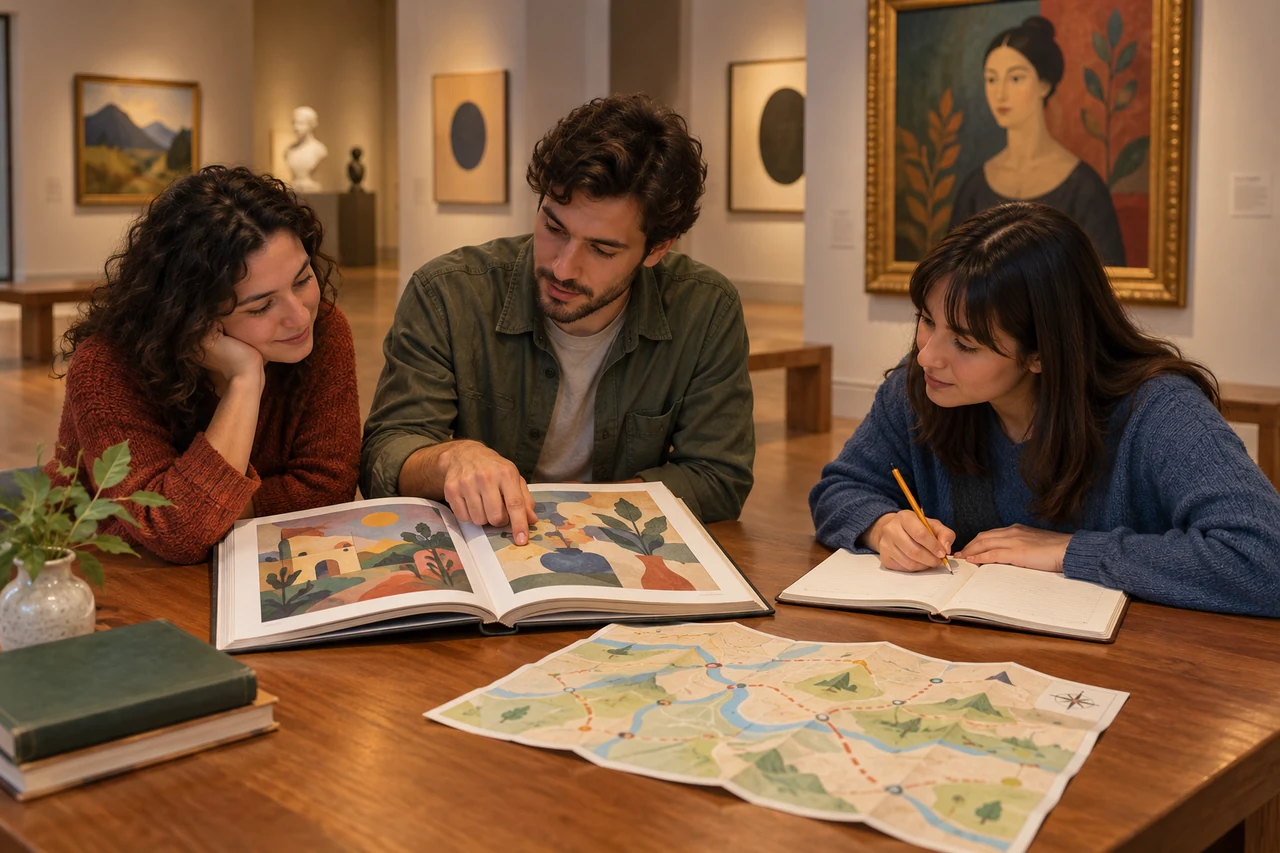
myAudience original newly generated teaching scene. Image: illustration, not a documentary photograph. · Operator-authored generated artwork; fictional context, no exam-board art or documentary photograph reproduced.
Make possessions clear without guessing an owner
Possessives connect people and objects, but they do not always name a unique owner. Read an original message: « Mi amiga trae su libro. Nuestro cuaderno está en la mesa. Tus libros están en el bolso ». Trae means brings, supplied here as a vocabulary form. The message distinguishes an individual item, a shared notebook and the addressee’s plural books. It does not say how many people own the shared notebook.
Mi, tu and su change for number as mis, tus and sus but do not have separate masculine/feminine forms. Nuestro and vuestro also agree for gender: nuestro libro, nuestra mesa, nuestros libros and nuestras mesas. The possessed noun controls that agreement. A group of several owners can still have one nuestro libro; plurality of owners is not a command to make the object plural.
Su can mean his, her, its, their or your in a formal address, depending on context. Do not infer a uniquely named owner from su alone. In a message with two possible people, an added phrase such as el libro de Sara may be clearer. Grammatical clarity is a practical communication skill, not a demand to reveal real household or account information.
Look at the notebooks and open book in the invented learning-gallery illustration. The scene offers several possible possessions but gives no evidence of ownership. Invent a short exchange, then ask a partner to identify each owner from the text alone. If more than one reading remains possible, rewrite it with a name or a precise noun phrase rather than guessing from appearance.
Worked example: Change “our book” and “our notebooks” into Spanish noun groups.
Libro is masculine singular, so use nuestro libro.
Cuadernos is masculine plural, so use nuestros cuadernos.
Agree the possessive with the possessed noun, not the number of people owning it.
Answer: Nuestro libro; nuestros cuadernos.
Check your understanding: A short message only says « Alex mira su libro ». Can you identify whether the book belongs to Alex, another person or the addressee? Write a clearer version if it belongs to Sara.
Answer: The isolated su is ambiguous without context. A clear version is Alex mira el libro de Sara.
Why: Su can refer to several grammatical owners, including formal addressees. A de phrase or suitable surrounding text resolves the ownership; a nearby name alone need not do so.