Build a travel plan with ir a and an infinitive
By UK GCSE Spanish · independent study · myAudience
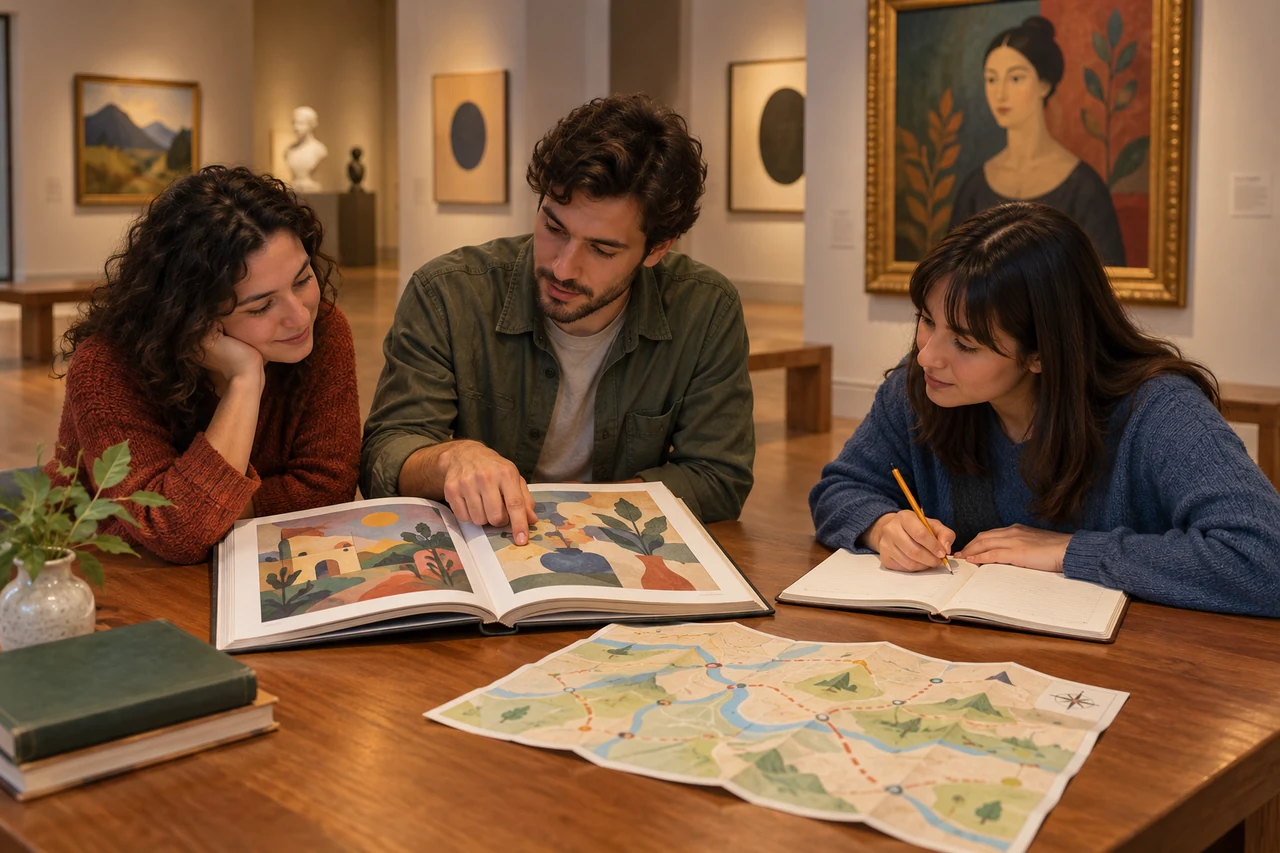
myAudience original newly generated teaching scene. Image: illustration, not a documentary photograph. · Operator-authored generated artwork; fictional context, no exam-board art or documentary photograph reproduced.
Build a travel plan with ir a and an infinitive
Travel writing should distinguish a place’s documented heritage from a learner’s proposed itinerary. The Alhambra and Generalife in Granada entered the World Heritage List in 1984, according to their own managing authority. The following message is newly written practice, not a real booking: « Mañana voy a visitar Granada con mi amiga. Vamos a leer sobre la Alhambra y después vamos a caminar por la ciudad ».
Ir a plus an infinitive expresses a planned or prospective action. The present ir forms are voy, vas, va, vamos, vais and van. In « Voy a visitar », voy supplies the speaker’s person and visitar names the action. Omitting a, or changing visitar to visito, breaks this particular construction. A destination after ir and an action infinitive have different grammatical roles.
Mañana points to tomorrow and después sequences the next planned activity. The message does not guarantee that transport is available, tickets are obtained or the visitor has already arrived. Current practical arrangements need their own checks; a heritage date cannot establish admission conditions. A faithful reading preserves the planned status of each action.
The illustration shows a folded map and an open illustrated book in an invented gallery. Notice those as prompts for planning and learning about a place. Neither is a verified map or view of Granada or the Alhambra. Write a two-person itinerary with different activities, then explain each ir form and infinitive. Wider travel vocabulary, narrated past journeys and sustained writing remain unfinished.
Worked example: Write “Tomorrow we are going to visit the museum, but she is going to read” in Spanish.
Use vamos for the plural we and va for singular she.
Keep a between ir and the action infinitive.
Use visitar and leer, not a second conjugated form.
Answer: Mañana vamos a visitar el museo, pero ella va a leer.
Check your understanding: Correct « Nosotros vamos visitar Granada y ella va a lee ». Then explain why the corrected sentence does not prove that the visit has happened.
Answer: Nosotros vamos a visitar Granada y ella va a leer. It states plans, rather than reporting completed events.
Why: The construction requires a plus an infinitive. Conjugated ir supplies the subject information; neither that construction nor an illustration verifies a future outcome.