Locate completed events with a regular preterite
By UK GCSE Spanish · independent study · myAudience
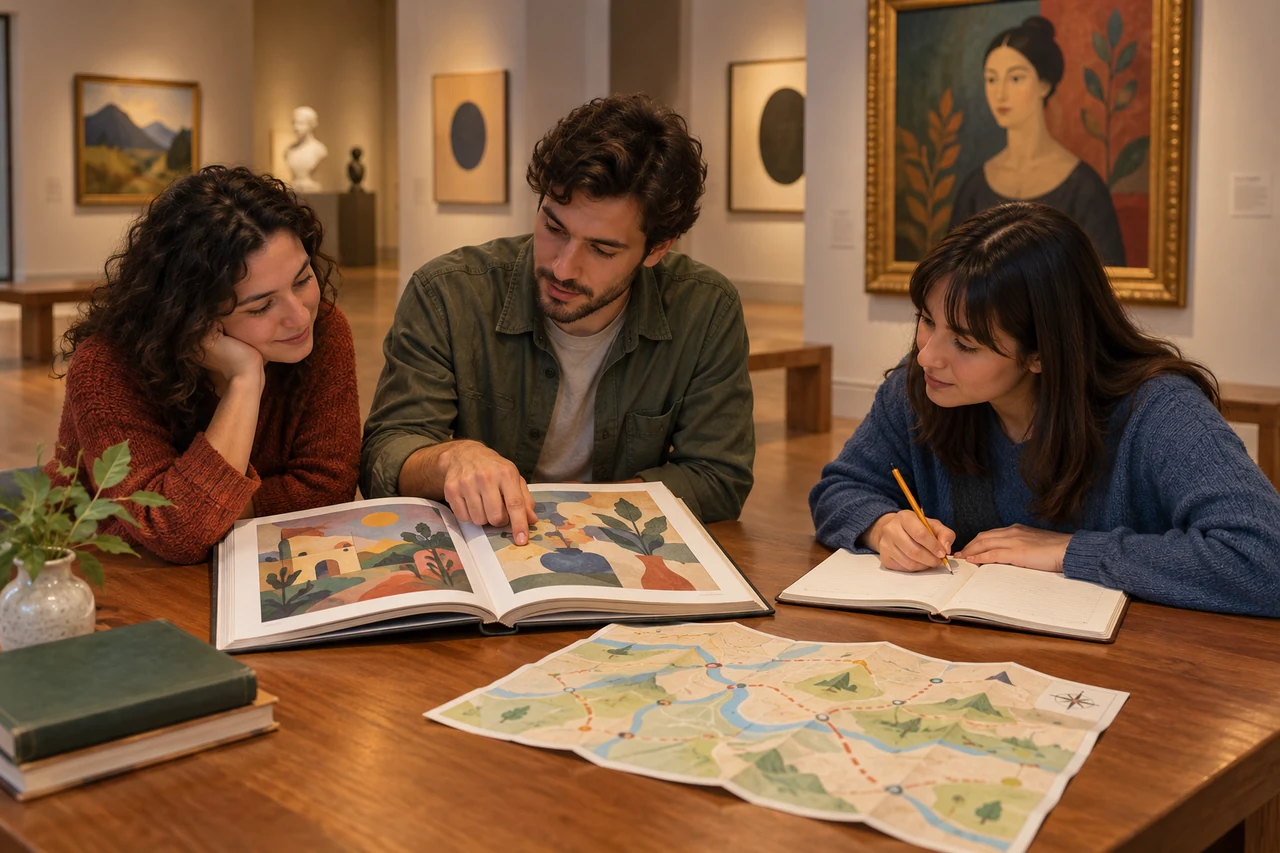
myAudience original newly generated teaching scene. Image: illustration, not a documentary photograph. · Operator-authored generated artwork; fictional context, no exam-board art or documentary photograph reproduced.
Locate completed events with a regular preterite
A past account must preserve who performed each action and when it occurred. Read this original gallery diary: « Ayer visité el museo con Ana. Ella compró un cuaderno. Después comimos en la plaza y escribimos unas notas ». Ayer fixes yesterday. The verbs report completed events within that visit, while después orders the meal and notes. The text does not describe the group’s usual routine or a visit still planned for tomorrow.
For regular ar verbs, the preterite endings are é, aste, ó, amos, asteis and aron. The regular er/ir set is í, iste, ió, imos, isteis and ieron. Attach the appropriate set to the verb stem: visitar becomes visité for I and visitaron for they; comer becomes comimos for we. The accented endings distinguish certain persons from superficially similar present or noun forms. Copying only the infinitive into a past paragraph does not supply a subject or tense.
Some complete forms overlap with the present: estudiamos and escribimos can each belong to either tense. The surrounding account resolves the time; a form is not necessarily wrong because it has two grammatical uses. In the diary, ayer and the completed visit favour a past reading. In « Cada día escribimos », the habitual marker gives a different context. Interpret the clause rather than mechanically labeling every imos ending past.
Before translating, construct a short event ledger: speaker—visited—yesterday; Ana—bought—during that visit; group—ate/wrote—later. This exposes an English I/we change that a fast word-by-word translation might miss. Preserve ordering without inventing exact clock times, motives or purchases. A valid account can be modest in vocabulary but precise in agreement and temporal relations.
The gallery illustration shows people consulting books and notes. It provides an imaginable setting for the fictional diary, but cannot establish yesterday’s actions or who bought anything. Notice the notebook and use the text for temporal evidence. Practice across all six persons, additional regular verbs, negative clauses and unfamiliar accounts is still needed; this lesson introduces a reusable method rather than closing the prescribed tense.
Worked example: Rewrite the diary as “Yesterday they visited the museum; afterwards I ate in the square and you wrote some notes,” addressing one person informally.
Change the museum subject to ellos/ellas, so use visitaron.
Choose comí for the first-person speaker and escribiste for singular tú.
Retain ayer and después; do not replace them with a habitual marker.
Answer: Ayer visitaron el museo. Después comí en la plaza y escribiste unas notas.
Check your understanding: An editor changes « Ayer escribimos unas notas » to « Cada día escribimos unas notas ». Has the identical verb spelling guaranteed an identical time meaning? Explain, then translate both.
Answer: No. The first means Yesterday we wrote some notes; the second means Every day we write some notes. The repeated form is interpreted with its different time context.
Why: Escribimos can be present or preterite. The time expression and discourse distinguish a completed episode from a routine; form recognition without contextual interpretation loses the contrast.