Describe visible evidence in five bounded sentences
By UK GCSE Spanish · independent study · myAudience
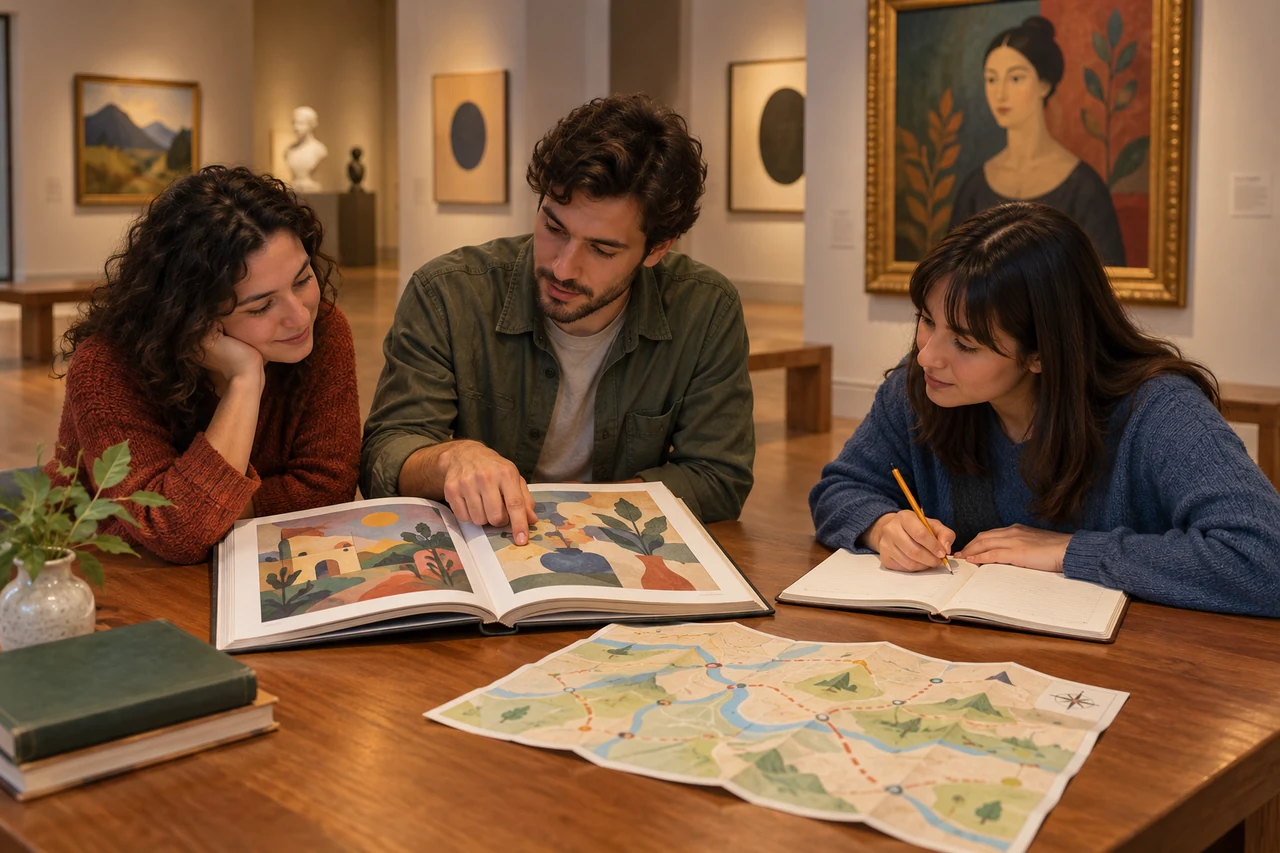
myAudience original newly generated teaching scene. Image: illustration, not a documentary photograph. · Operator-authored generated artwork; fictional context, no exam-board art or documentary photograph reproduced.
Describe visible evidence in five bounded sentences
The Foundation written photo task asks for five short relevant sentences. Here we practise that observation-to-sentence process with a generated illustration, not a documentary photo or an official examination image. Keep claims inside the visible evidence. A picture can show people and objects; it cannot establish their names, grades, nationality, private relationships or yesterday’s actions.
Inspect the gallery illustration: three people are gathered around a table with an open book and a notebook; a framed portrait is visible behind them. A concise sentence can name one visible element, locate an object or state an apparent action. Hay introduces existence, while estar locates something. An action such as writing needs actual visible support; an opinion such as they love science cannot be read directly from posture.
A possible five-sentence response is supplied in the worked example. Its purpose is to demonstrate independent relevant statements, not an obligatory formula to memorize for every picture. Different valid observations may work if they match the actual image and their grammar is sound. Repeating the same sentence five times adds little variety, while adding unsupported biographical detail can move the response away from the task.
Check one sentence at a time: can I point to the evidence; does the noun group agree; does the verb match its subject; is an object’s location expressed clearly? Do not use hay with an invented auxiliary or switch to son merely because people is plural. Hay tres personas is an impersonal existence statement. This lesson does not claim that every depicted person is a student or that the fictional portrait depicts a known artist.
The illustration is the actual task support, so look carefully at the three people, table, book, notebook and framed picture rather than relying only on the caption. A new image needs new observations. Five written statements do not complete the speaking photo-card task, and a single worked response is not full Foundation written-photo competence. Further independently checked examples across contexts and learner production are still needed.
Worked example: Write five short relevant Spanish sentences about the actual gallery illustration, keeping each statement tied to visible evidence.
Name the three visible people with hay rather than guessing their identities.
Name the table and locate the visible book and notebook.
Name the framed picture without claiming it is a real painting or known person.
Answer: Hay tres personas. Hay una mesa. El libro está en la mesa. Hay un cuaderno. Hay un cuadro en la pared.
Check your understanding: An alternative response says « Son estudiantes de Madrid y ayer aprobaron un examen ». Why is this unsuitable as visible evidence, and replace it with two supported sentences.
Answer: The image does not establish their school status, city or examination history. Supported replacements include Hay tres personas and El libro está en la mesa.
Why: The task practises describing actual visible content. A grammatically plausible invented biography is not the same as a relevant evidence-based description of this illustration.