Distinguish ability and permission with pouvoir
By UK GCSE French · independent study · myAudience
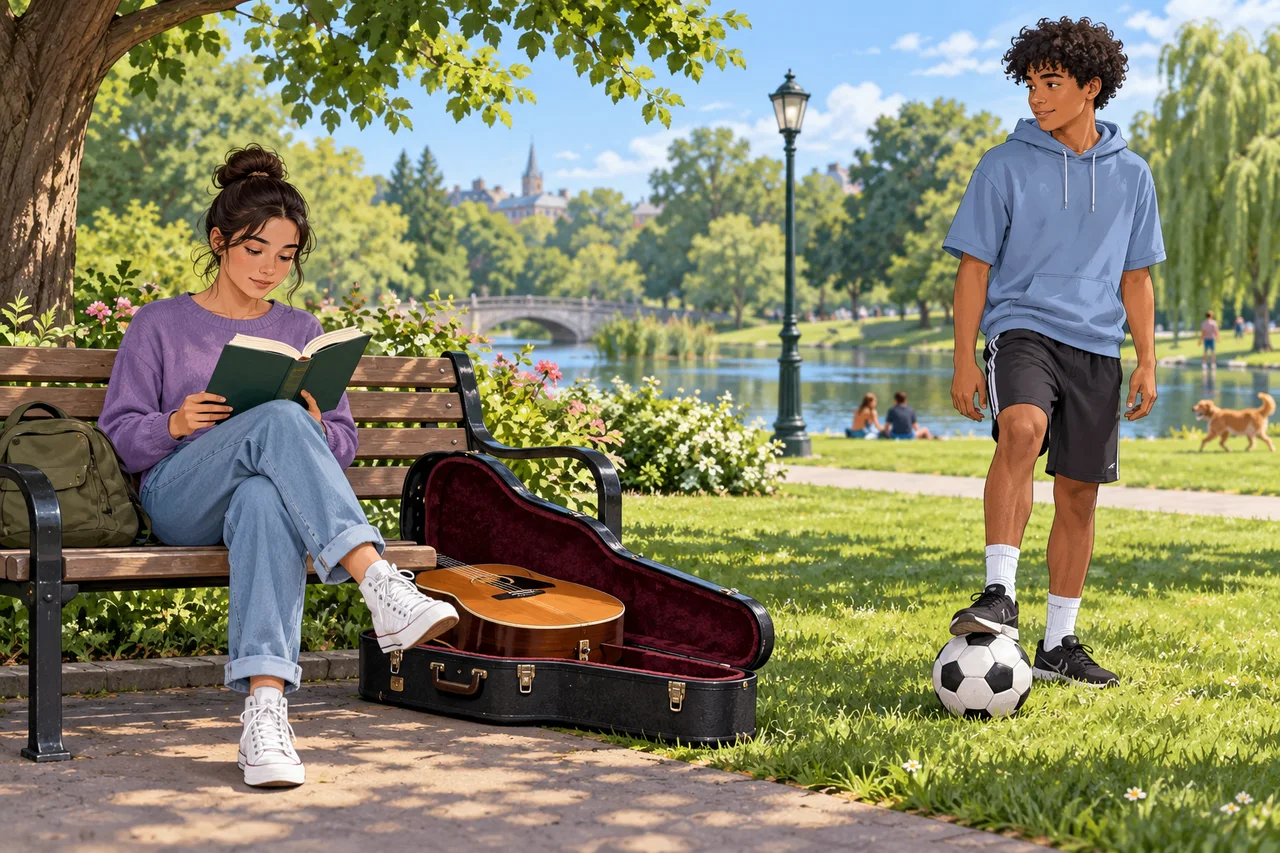
Original illustration generated with OpenAI imagegen for myAudience; fictional teaching scene. · Original generated artwork; no exam-board art or photograph reproduced.
Distinguish ability and permission with pouvoir
Pouvoir often expresses being able to do something or having permission to do it. « Je peux jouer » can mean I can play; the surrounding situation tells you whether capacity, opportunity or permission is the point. The verb does not independently verify someone’s skill or grant permission in the real world. It reports what the sentence says.
Its present forms are je peux, tu peux, il peut, elle peut, nous pouvons, vous pouvez, ils peuvent and elles peuvent. These are irregular; do not construct them by attaching regular er endings. After the conjugated pouvoir form, keep the next verb as an infinitive: « Nous pouvons parler », not « Nous pouvons parlons ».
Contrast a statement with a question: « Tu peux jouer » states a possibility; « Est-ce que je peux jouer ? » may ask whether playing is allowed. In a fictional park notice, context could make this a permission question. A separate answer or rule is still needed; the question itself does not supply approval.
Use a practical editing check. Identify who can act, select the corresponding pouvoir form, then identify the action in its infinitive. A negative such as « Je ne peux pas jouer » can describe lack of opportunity, capacity or permission. Avoid replacing every instance with “I do not know how to play”, which makes a narrower claim.
Read the situation before deciding what pouvoir means: « Aujourd’hui, Léa peut préparer les images, mais Hugo ne peut pas venir au parc. Nous pouvons parler français dans la bibliothèque. » The first clause offers an available contribution; the second denies an opportunity or ability to come; the third states what the group can do in the supplied context. None tells us that the activity was actually completed. The present forms peut and pouvons carry the subject agreement, while préparer, venir and parler remain infinitives. A permission context could change the English interpretation, so can is often safer than inventing a medical limitation or an explicit rule that the passage never mentions.
Transfer task: turn the first two clauses into a polite message to one visitor who can prepare the images but cannot come. A model is « Aujourd’hui, vous pouvez préparer les images, mais vous ne pouvez pas venir au parc. » Pouvez is required in both clauses, and ne…pas surrounds it in the negative. Explain why « vous pouvez préparez » is incorrect: the second verb cannot receive another finite present ending in this construction. The message states possibility and its restriction, not a command or a completed visit. The illustration may suggest a place to practise conversation, but cannot tell you whether its pictured people can speak French or have permission to do so.
Worked example: Write “We can speak French” using pouvoir and parler.
Choose nous pouvons.
Keep parler in the infinitive.
Add français without an extra être.
Answer: Nous pouvons parler français.
Check your understanding: Correct « Elle peux joue ».
Answer: Elle peut jouer.
Why: Elle needs peut, and the second verb stays as the infinitive jouer.