Connect actions with purpose and sequence
By UK GCSE French · independent study · myAudience
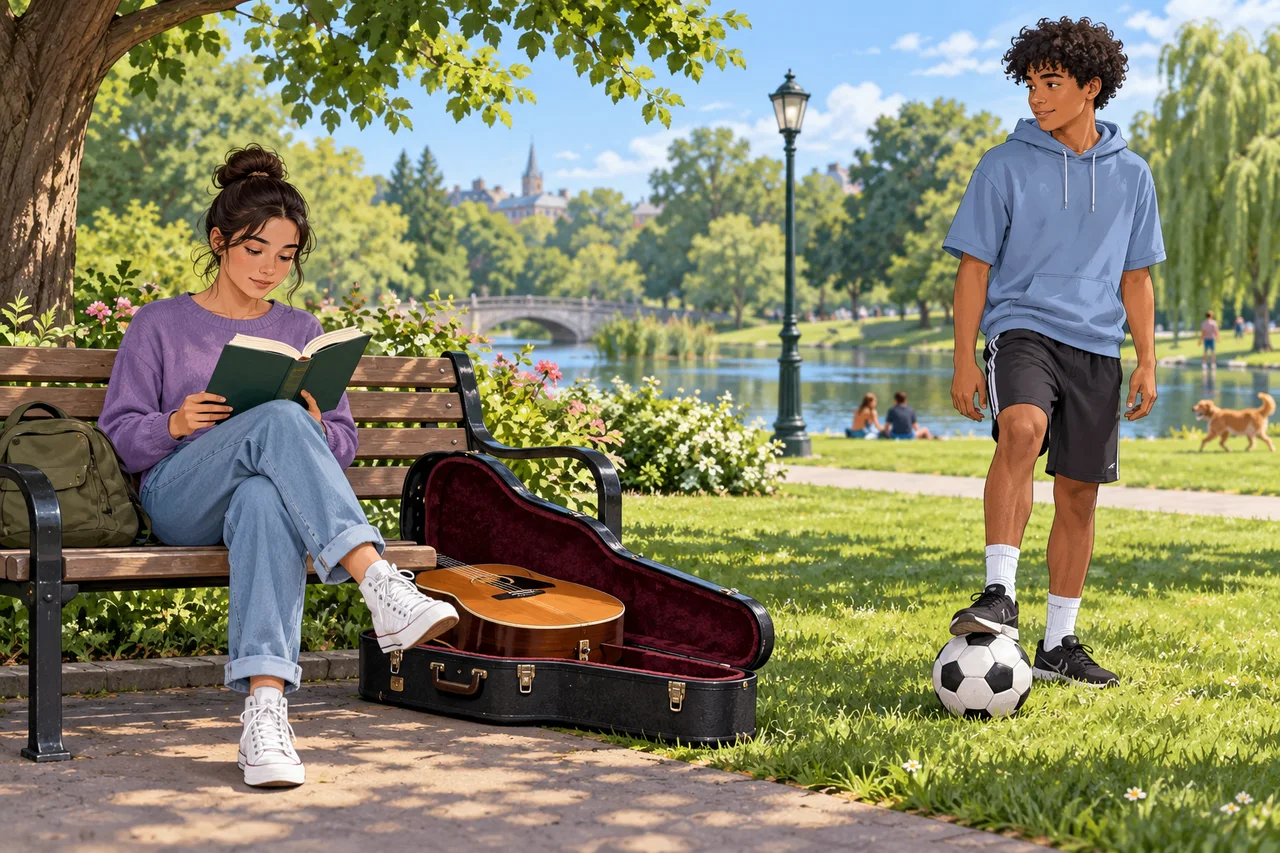
Original illustration generated with OpenAI imagegen for myAudience; fictional teaching scene. · Original generated artwork; no exam-board art or photograph reproduced.
Connect actions with purpose and sequence
A longer sentence can explain a purpose without adding a second fully conjugated clause. « Je vais au parc pour jouer » means I go, or am going, to the park to play. In this example the same person goes and plays. Pour introduces the intended purpose; jouer stays in the infinitive rather than becoming joue.
Sans followed by an infinitive can describe an action that is not carried out: « Elle lit sans parler » means she reads without speaking. The English form speaking does not mean that French needs a conjugated present form. In this pattern, use parler. Keep the intended actor clear rather than attaching a purpose to the wrong person.
Sequence words organise a short account. An original example is « D’abord, je choisis un livre. Ensuite, je lis. Enfin, je vais au parc pour jouer. » D’abord means first, ensuite means next, and enfin can mean finally in this sequence. These words order the account; they do not themselves force all its verbs into a past tense.
A purpose is not proof of success. « Je vais au parc pour jouer » explains the stated aim but does not establish that playing actually happened. Read a passage for actions, sequence and purposes separately. This note uses simple pour/sans infinitive constructions and adverb placement, not Higher-tier before/after perfect-infinitive structures.
A purpose links an action to its intended outcome; it does not guarantee success. In « D’abord, je vais à la bibliothèque pour préparer une présentation. Ensuite, je regarde les images sans parler. Enfin, je prépare le texte », pour préparer names the reason for going, and sans parler describes an activity omitted while looking. Both infinitives have the same understood actor as the main subject in these examples. D’abord, ensuite and enfin order the account, rather than giving exact clock times. Sans parler does not mean that the person never speaks. The illustration can suggest books and a place to work, but cannot establish the speaker's purpose without the accompanying text.
Transfer task: write a plan in which you go to the park to read, look at images without speaking, then prepare a presentation. A model is « D’abord, je vais au parc pour lire. Ensuite, je regarde les images sans parler. Enfin, je prépare une présentation. » Lire and parler remain infinitives after pour and sans. Explain why « pour je lis » cannot replace pour lire in this supplied same-subject infinitive construction. Another construction with an expressed subject would require different grammar, not merely inserting je. Keep the stated sequence and distinguish purpose from result when judging alternatives. Before/after infinitive patterns are a separate extension and are not introduced or claimed by this exercise.
Worked example: Join “She goes to the park” and the purpose “to play” using pour.
Keep elle va au parc as the main action.
Add pour to introduce the purpose.
Use the infinitive jouer.
Answer: Elle va au parc pour jouer.
Check your understanding: Correct « Elle lit sans parle ».
Answer: Elle lit sans parler.
Why: After sans in this construction, the action is an infinitive, not a second conjugated present verb.