Compare two leisure choices and their reasons
By UK GCSE French · independent study · myAudience
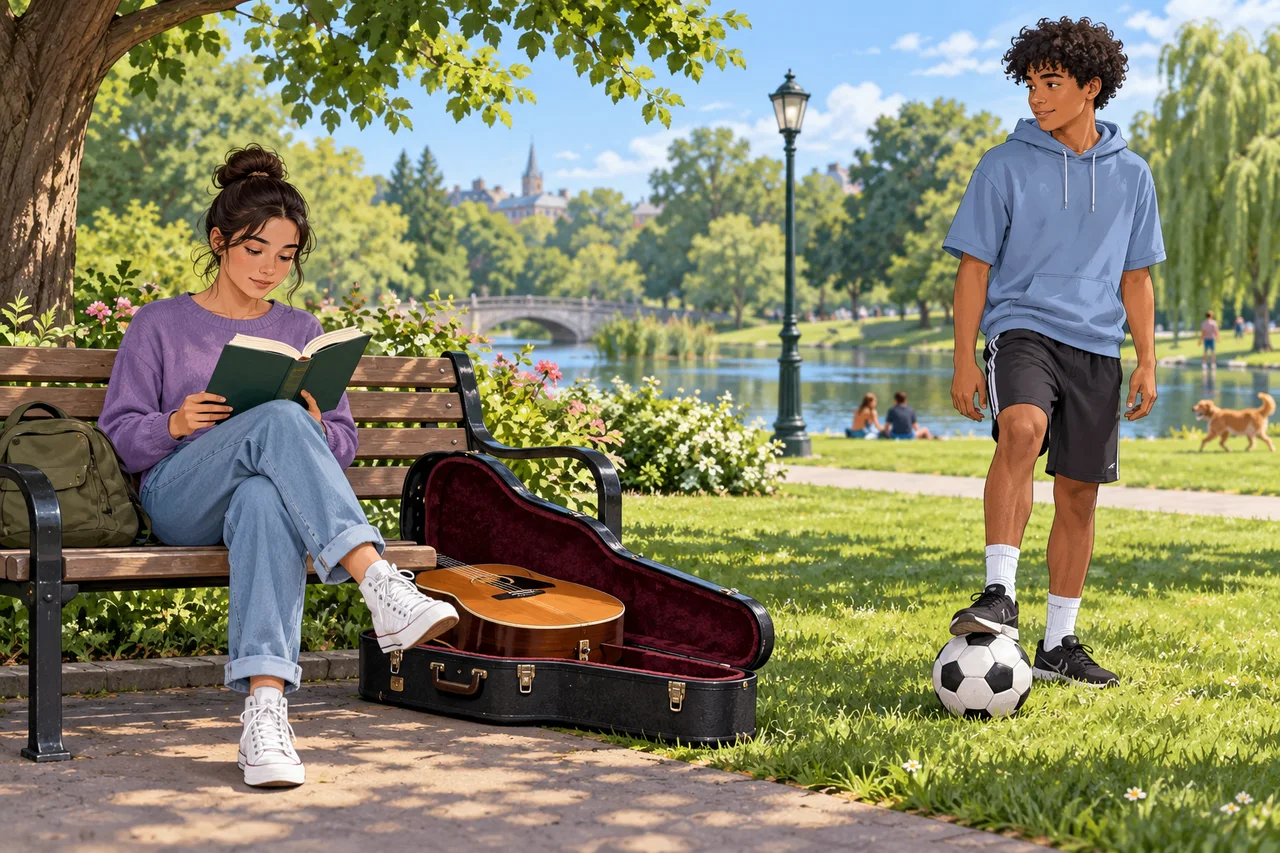
Original illustration generated with OpenAI imagegen for myAudience; fictional teaching scene. · Original generated artwork; no exam-board art or photograph reproduced.
Compare two leisure choices and their reasons
Leisure reading is more interesting when people do not all share the same taste. Read this original exchange: « Léa: J’aime lire dans le parc parce que c’est calme. Hugo: Je préfère jouer au football avec mes amis. Je n’aime pas jouer seul. Léa: Samedi, nous pouvons écouter la musique ensemble. » Here calme describes the setting; it does not diagnose either person’s emotional state.
Léa gives a reason for reading in the park. Hugo gives a preferred activity and then a limit: he does not like playing alone. The negative applies to jouer seul, not to all football or all leisure. The final sentence suggests a shared possibility for Saturday. Pouvons does not establish that tickets have been bought or the activity has already happened.
Use a two-column comparison instead of a single label such as sporty or quiet. Record the activity, any companion and the stated reason. A person can enjoy both reading and sport; a short passage gives selected information. In your own writing, connect one opinion to a reason and add a contrasting preference with mais. This creates useful detail without needing a long list of hobbies.
In the illustration, a reader, a football and a guitar case offer different possible leisure topics. Notice the objects rather than guessing everybody’s personality from them. Your practice response could propose an activity to share, then make its status clear: a suggestion, an intention or a reported event. That distinction helps both reading accuracy and natural written communication.
Preferences become more useful when a passage supplies qualifications: « Léa aime lire dans le parc parce que les livres sont intéressants. Hugo préfère le football, mais aujourd’hui il veut écouter la musique. Nous pouvons aller au concert samedi. Léa ne veut pas jouer au football, mais elle peut venir avec nous. Hier, nous avons choisi les images pour une présentation sur les loisirs. » Intéressants agrees with plural masculine livres in this supplied example. Préférer does not mean never enjoying anything else, and coming with a group does not mean playing its sport. The past choice and Saturday's opportunity have different time status.
Transfer task: explain why the statement “Hugo dislikes music and Léa cannot join the group” misreads the passage. Hugo wants to listen today, and Léa can come despite not wanting to play football. A model correction is « Hugo préfère le football, mais aujourd’hui il veut écouter la musique. Léa peut venir, mais elle ne veut pas jouer au football. » Each contrast must keep its subject and modal. Do not claim that the group attended the concert merely because it can go. The guitar, book and football in the illustration give concrete leisure prompts; they do not identify the pictured people's tastes or establish that they performed any activity described in the fictional text.
Worked example: Why does Hugo reject the activity jouer seul?
Read the complete negative je n’aime pas jouer seul.
Identify seul as alone.
Preserve his preference for football with friends.
Answer: He does not like playing alone; he prefers football with friends.
Check your understanding: Write a proposal inviting a friend to listen to music together on Saturday; use pouvoir. Then explain why this is not proof of a completed outing.
Answer: Samedi, nous pouvons écouter la musique ensemble. It proposes a possible shared activity; it does not report that we have already done it.
Why: Pouvons keeps the first-person plural possibility and écouter stays infinitive. A future time expression with a modal does not establish a past event.