Names, nouns and meaningful introductions
By UK GCSE German · independent study · myAudience
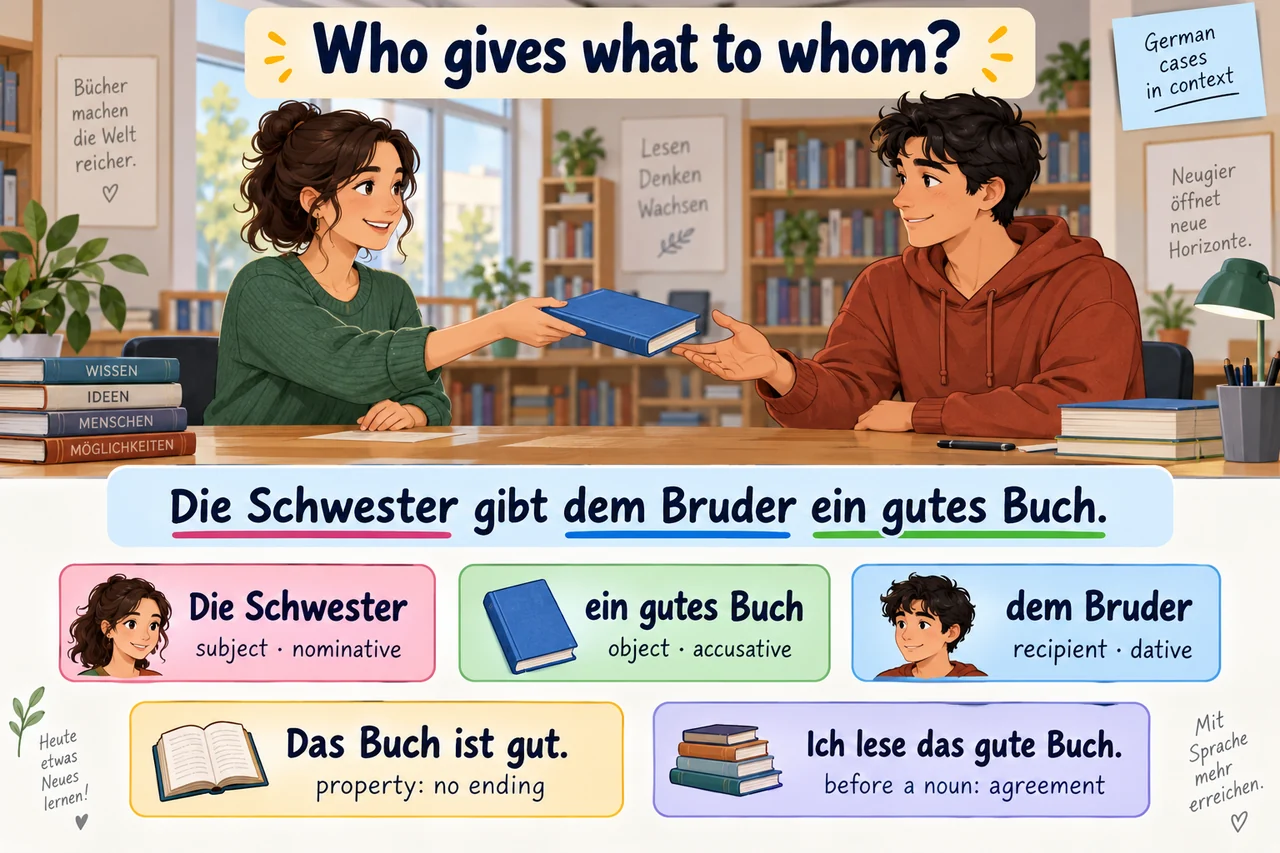
Image: illustration, not a documentary photograph. Original teaching model created for myAudience. · Original generated teaching illustration; no board endorsement or source textbook artwork reproduced.
Names, nouns and meaningful introductions
A noun names a person, object or idea; a German noun starts with a capital letter. Grammatical gender is a property of the noun, not a conclusion about a person's identity. Learn a noun as a small usable package: der Freund, die Freunde (male friend, friends); die Freundin, die Freundinnen (female friend, female friends); das Buch, die Bücher (book, books). The singular articles der, die and das distinguish masculine, feminine and neuter nouns; the plural definite article is die for all three. These are nominative forms, suitable for the subject of a sentence. Later lessons change the article when the noun has another grammatical role.
An introduction needs a finite verb, a verb form that agrees with its subject. Ich bin Mira means I am Mira; ich habe einen Bruder means I have a brother. Bin belongs to sein, to be, whereas habe belongs to haben, to have. Do not substitute English word order for agreement: wir sind means we are, not wir bin. German has no separate present progressive form here: ich wohne in Bonn can mean I live in Bonn or I am living in Bonn. Bonn is a real place, but Mira and every event in this cohort are invented; the prose is not evidence about German households.
A compound noun normally takes the gender of its final noun: das Schulbuch is neuter because das Buch is neuter. Read from the final noun backwards: it is a book for school, not a school made from books. Connecting letters belong to the word, but are not a reliable way to predict meaning or gender. Plural patterns are useful clues, never a universal instruction to add -s. The feminine occupation pattern Lehrerin → Lehrerinnen adds -nen to the singular ending -in. A person's preferred description should be respected; learning a conventional grammatical pattern does not prescribe which identity someone must use.
Read this original profile as a communication rather than a word list: Ich heiße Mira. Ich wohne in Bonn. Meine Freundin heißt Lea. Wir lernen Deutsch. Die Bücher sind interessant. Translation: My name is Mira. I live in Bonn. My friend's name is Lea. We learn German. The books are interesting. The feminine form Freundin supports female friend, but friend alone is natural English when gender is irrelevant. Heißen in this context means to be called; translating it as to heat would confuse an unrelated English-looking form with the German meaning.
To transfer the pattern, change the person and then repair the verb: Ich wohne becomes wir wohnen. Change the number and repair agreement: Das Buch ist interessant becomes Die Bücher sind interessant. Keep the proposition stable while editing its grammar. A frequent misconception is that a plural article makes the verb singular because die can also be singular feminine. Number comes from the whole noun phrase and context. Vocabulary for reuse: heißen, to be called; wohnen, to live/reside; lernen, to learn; interessant, interesting. This lesson establishes forms for later case work; it does not yet teach every plural or determiner.
In the giving plate, Die Schwester is the actor, ein gutes Buch the thing given and dem Bruder the recipient. The contrasting strips separate predicative gut from attributive gute. Illustration supplies a fictional situation; case grammar, not physical appearance, establishes the roles. Original transfer challenge: A message says: Die Bücher sind neu. Meine Freundin heißt Lea. Change the first statement to one book, then change it back to two books. Translate both versions. Can the message establish a romantic relationship with Lea? Explain what its grammar does and does not tell us.
Reasoned model and indicative author criteria: Das Buch ist neu. Die Bücher sind neu. — The book is new. The books are new. Buch/Bücher changes number, so das/die and ist/sind must change together. Meine Freundin identifies the speaker’s friend using a feminine form; Freundin can also mean girlfriend in suitable context, but this brief message does not establish a romantic relationship. A literal gender distinction and a social inference are different decisions. An indicative response should preserve newness, justify three agreement repairs and withhold the unsupported relationship claim. This is not an official mark scheme or evidence of independently attempted mastery.
Worked example: Introduce two friends who live in Bonn and learn German; then say their books are interesting.
Choose a plural subject, Lea und Mira, so the regular verbs require -en.
Wohnen and lernen are the lexical infinitives; their plural present forms are wohnen and lernen.
Bücher is the checked plural of Buch; die Bücher requires sind, not ist.
Answer: Lea und Mira wohnen in Bonn. Sie lernen Deutsch. Ihre Bücher sind interessant. — Lea and Mira live in Bonn. They learn German. Their books are interesting.
Check your understanding: 1 Translate Wir wohnen in Bonn. 2 Correct Die Bücher ist interessant. 3 Explain the gender of Schulbuch and why the same rule cannot predict the plural of Buch.
Answer: 1 We live/are living in Bonn. 2 Die Bücher sind interessant. 3 Schulbuch is neuter because its final component Buch is neuter; gender inheritance does not generate a plural, so Bücher must be learned.
Why: Wohnen conveys residence, not ownership. The plural subject requires sind. Compounding and plural formation answer different questions; assuming one determines the other produces incorrect forms.