Present tense, agreement and the first constituent
By UK GCSE German · independent study · myAudience
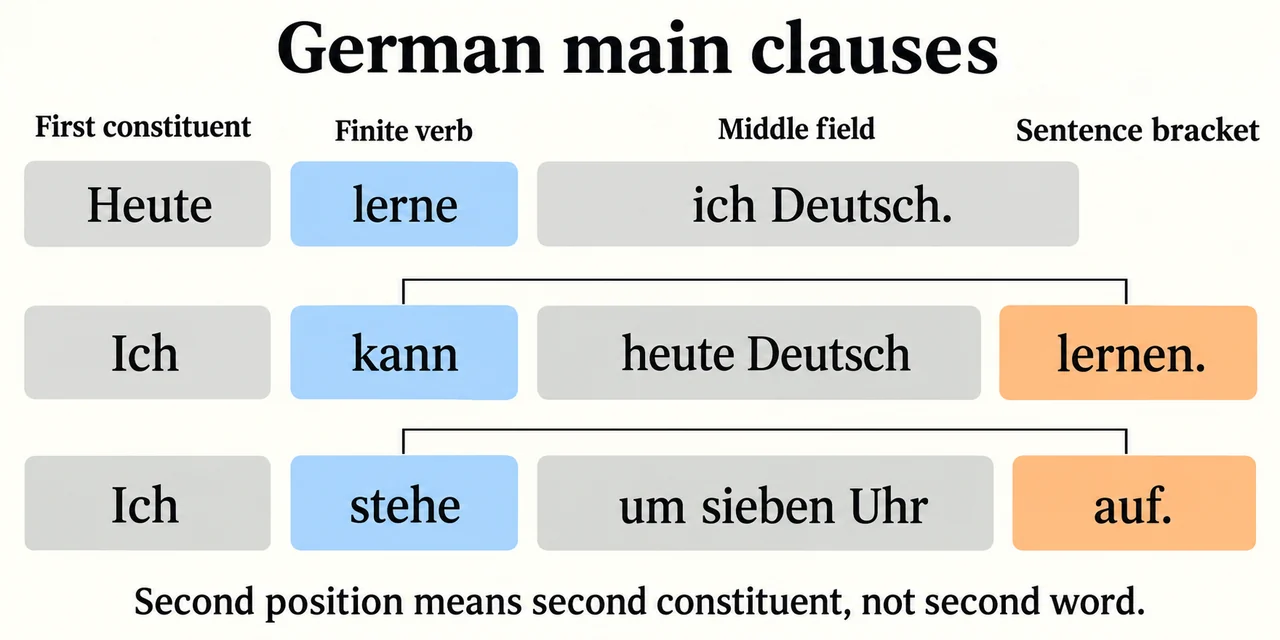
Image: illustration, not a documentary photograph. Original teaching model created for myAudience. · Original generated teaching illustration; no board endorsement or source textbook artwork reproduced.
Present tense, agreement and the first constituent
The finite verb anchors a standard written declarative main clause. It occupies the second constituent, not necessarily the second word. A constituent is a grammatical unit that can move together: heute (today) is one unit, but jeden Morgen (every morning) is also one unit. Ich lerne jeden Morgen Deutsch and Jeden Morgen lerne ich Deutsch express the same basic event with different starting emphasis. Moving the time phrase to the front makes ich follow the verb; leaving ich before lerne would incorrectly create two constituents before it.
For a regular present verb, remove -en from the infinitive and add endings: lernen gives ich lerne, du lernst, er/sie/es lernt, wir lernen, ihr lernt, sie/Sie lernen. Capital Sie is the polite you and uses the plural-looking verb form even for one addressee. Sein has its own forms: bin, bist, ist, sind, seid, sind in that person order. Haben gives habe, hast, hat, haben, habt, haben. Some strong verbs change a vowel only in du and er/sie/es: lesen gives du liest, er liest, but wir lesen. Retrieve those irregular forms rather than applying the regular rule blindly.
German present forms cover both habitual and ongoing events: Lea liest ein Buch can mean Lea reads a book or Lea is reading a book. A time expression may give future reference without changing the tense: Morgen lerne ich Deutsch means Tomorrow I will study German in this context. Tense is a grammatical form; time reference is the interpretation supplied by that form and the surrounding words. Do not label every sentence containing morgen as future tense. The finite form is still present even when the planned event is tomorrow.
The clause plate shows Heute | lerne | ich Deutsch. The blue tile is the finite verb. Its next two rows bracket kann … lernen and stehe … auf: a non-finite verb or a separated prefix can close the main-clause bracket. The first row has no second verbal element, so its right-hand bracket is empty. The plate groups material for teaching, not to claim that every middle-field word is one constituent. Read its caption literally: second position counts constituents, not words. The orange endings will become meaningful in the modal and separable-verb lessons.
Original mini-message: Jeden Morgen lese ich ein Buch. Heute lernt Lea Deutsch. Morgen lernen wir zusammen. Translation: Every morning I read a book. Today Lea studies German. Tomorrow we will study together. Zusammen means together, so the final sentence does not tell us where they meet. Work from evidence: the first sentence establishes habit, the second today's activity, the third a plan. Adding a location would invent information. A good reading answer identifies what the text entails; a good writer makes the intended time explicit when it matters.
The main-clause plate locates finite lerne/kann/stehe in the second constituent and separately shows final lernen/auf. It is a bounded model of these main clauses, not a diagram of every subordinate construction. For relatives, identify the subordinate clause separately; the picture cannot establish its local case. Original transfer challenge: Rewrite Heute lernt Lea Deutsch with Jeden Morgen first and Lea und Mira as the subject. Then interpret Morgen lernen Lea und Mira Deutsch. State the finite form, the number of the subject, and one thing the sentence leaves unknown.
Reasoned model and indicative author criteria: Jeden Morgen lernen Lea und Mira Deutsch. — Every morning Lea and Mira study German. The entire time phrase is one first constituent; lernen is the plural finite verb in the second slot, and the two-name subject follows it. Morgen lernen Lea und Mira Deutsch means Tomorrow Lea and Mira will study German in this planning context, although lernen remains present tense. It does not say where they will study or that the plan has already happened. Credit the unchanged activity, plural agreement, constituent order and distinction between form and future reference; do not reward an invented meeting place. This is not an official mark scheme or evidence of independently attempted mastery.
Worked example: Front Jeden Morgen in Ich lese jeden Morgen ein Buch. Then replace ich with wir.
Jeden Morgen moves as one constituent, leaving the finite verb in position two.
For ich, the irregular present form is lese; ich follows it after fronting.
Changing the subject to wir requires lesen, and wir now follows lesen.
Answer: Jeden Morgen lese ich ein Buch. Jeden Morgen lesen wir ein Buch. — Every morning I/we read a book.
Check your understanding: 1 Supply the verb: Wir ___ Deutsch (lernen). 2 Correct Morgen ich lese ein Buch. 3 Explain why Morgen lesen wir zusammen has future meaning but not future tense.
Answer: 1 lernen. 2 Morgen lese ich ein Buch. 3 Lesen is a present form; morgen supplies tomorrow as its future time reference.
Why: Agreement and placement must both be checked. A time phrase does not add a separate tense inflection. The correction preserves the intended subject and time; changing ich to wir would alter the message.