Descriptions that agree: adjective endings and comparisons
By UK GCSE German · independent study · myAudience
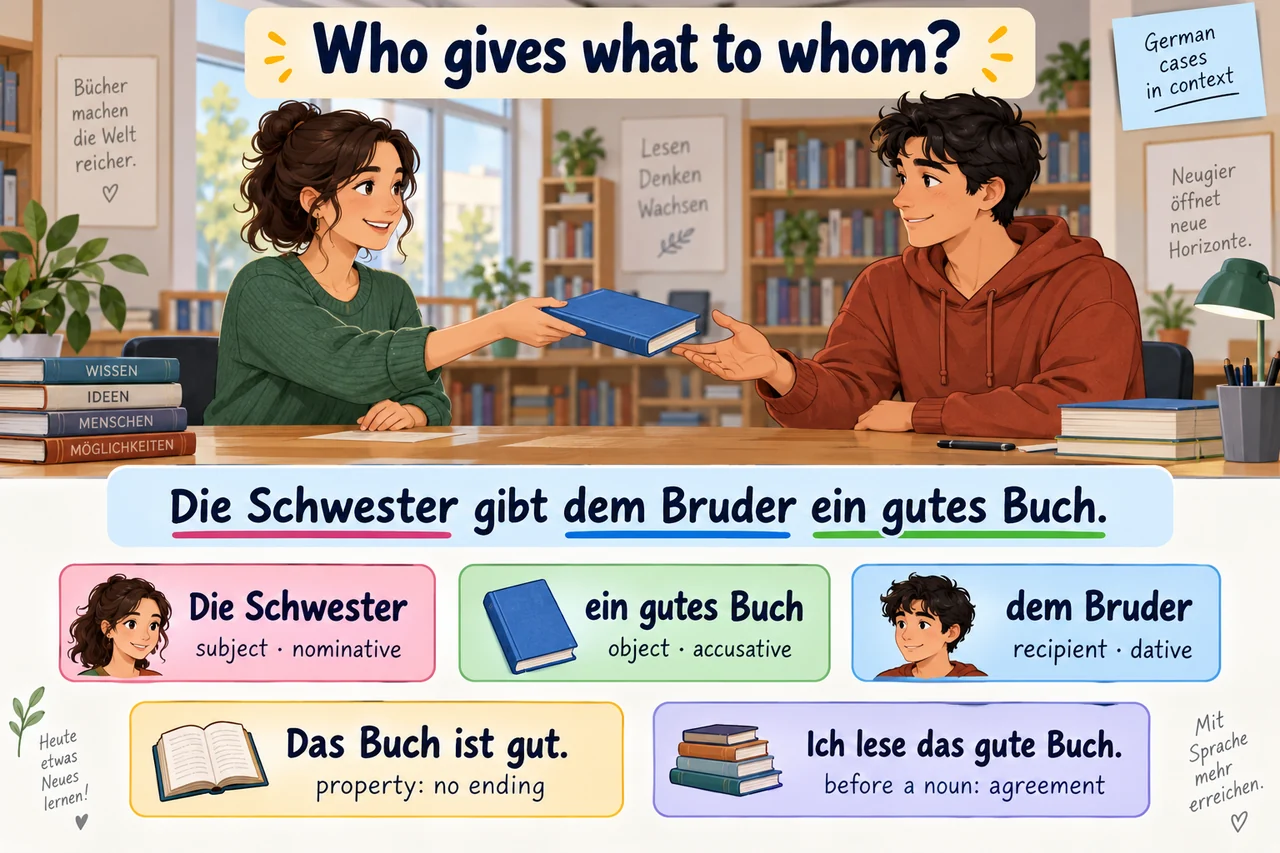
Image: illustration, not a documentary photograph. Original teaching model created for myAudience. · Original generated teaching illustration; no board endorsement or source textbook artwork reproduced.
Descriptions that agree: adjective endings and comparisons
An adjective describes a noun or supplies a property after a verb. In Das Buch ist interessant, interessant is a predicative adjective and has no case ending. Before the noun it must agree: das interessante Buch. The noun phrase's gender, number and case are established first; the article then influences the adjective ending. The ending is not a decoration attached whenever a word sounds descriptive. Deutsch in ich lerne Deutsch names a language; it is not being used as an adjective before a noun here.
After the definite article, weak endings are -e for nominative singular and for accusative feminine/neuter; use -en for accusative masculine, all dative forms and plural forms. Thus der gute Freund becomes den guten Freund as object and dem guten Freund in dative. Die gute Freundin becomes der guten Freundin in dative. Das gute Buch becomes dem guten Buch. The article has already carried much of the grammatical signal, allowing the adjective to use the smaller set of endings. This is a reasoning aid, not permission to ignore the case table.
Ein and possessives leave some slots without a visible gender signal. The adjective supplies it: ein guter Freund, eine gute Freundin, ein gutes Buch. Accusative masculine is einen guten Freund, and dative masculine is einem guten Freund. Without an article, nominative plural is gute Bücher; dative is mit guten Büchern. Here the adjective marks -en and the noun gains its dative plural -n. Learn these whole contrasting phrases. Memorising that adjectives always end in -en would happen to work for some objects and fail for a subject such as ein gutes Buch.
Comparing properties requires a precise relationship. Dieses Buch ist interessanter als das andere means This book is more interesting than the other one. So interessant wie expresses equal interestingness: as interesting as. Besser is the irregular comparative of gut; mehr means more and is not the adjective for better. Comparative judgement belongs to a speaker and a criterion. Saying a school is better without explaining for whom or why is an opinion, not an established institutional ranking. A reason clause later allows the writer to identify the criterion.
Original recommendation: Ich lese ein interessantes Buch. Mein Bruder liest das neue Buch. Mein Buch ist billiger als sein Buch. Translation: I am reading an interesting book. My brother is reading the new book. My book is cheaper than his book. Interessantes is accusative neuter after ein; neue is accusative neuter after das. Billiger is predicative and does not take a further case ending. The comparison concerns price only; it says nothing about which book is better written. Separate accurate translation from inference, then use the pattern to describe a different item.
In the giving plate, Die Schwester is the actor, ein gutes Buch the thing given and dem Bruder the recipient. The contrasting strips separate predicative gut from attributive gute. Illustration supplies a fictional situation; case grammar, not physical appearance, establishes the roles. Original transfer challenge: Complete and translate: Ich sehe einen ___ Freund (gut). Ich lese das ___ Buch (neu). Das Buch ist ___ (neu). Compare Mein Buch ist billiger als dein Buch with Mein Buch ist so billig wie dein Buch: what is changed and what is still not known?
Reasoned model and indicative author criteria: Ich sehe einen guten Freund. Ich lese das neue Buch. Das Buch ist neu. — I see a good friend. I read the new book. The book is new. Guten belongs to masculine accusative after einen; neue belongs to neuter accusative after das; predicative neu has no case ending. Billiger als means cheaper than, whereas so billig wie means as cheap as. Neither gives exact prices or establishes better content. Credit endings only when supported by case/article/property reasoning, then preserve the unequal versus equal comparison. An adjective’s evaluation does not turn a speaker’s judgement into an independently verified ranking. This is not an official mark scheme or evidence of independently attempted mastery.
Worked example: Translate: I see a good friend (male). The book is good. I read the good book.
Seeing selects the accusative object; masculine ein becomes einen and the adjective is guten.
After ist, gut is predicative and uninflected.
Buch is neuter accusative; the definite article stays das and the weak adjective ending is -e.
Answer: Ich sehe einen guten Freund. Das Buch ist gut. Ich lese das gute Buch.
Check your understanding: 1 Choose gut/gute in Das Buch ist ___. 2 Complete mit einem ___ Freund (gut). 3 Translate The book is as interesting as the film and explain why als would alter the meaning.
Answer: 1 gut. 2 guten. 3 Das Buch ist so interessant wie der Film. Als would express an unequal comparison after a comparative, rather than equal degree.
Why: After ist the adjective gives a property; before Freund it belongs to a dative phrase selected by mit. Equality and superiority are different propositions, so comparative connectors cannot be exchanged freely.