Questions and negation: ask precisely, deny precisely
By UK GCSE German · independent study · myAudience
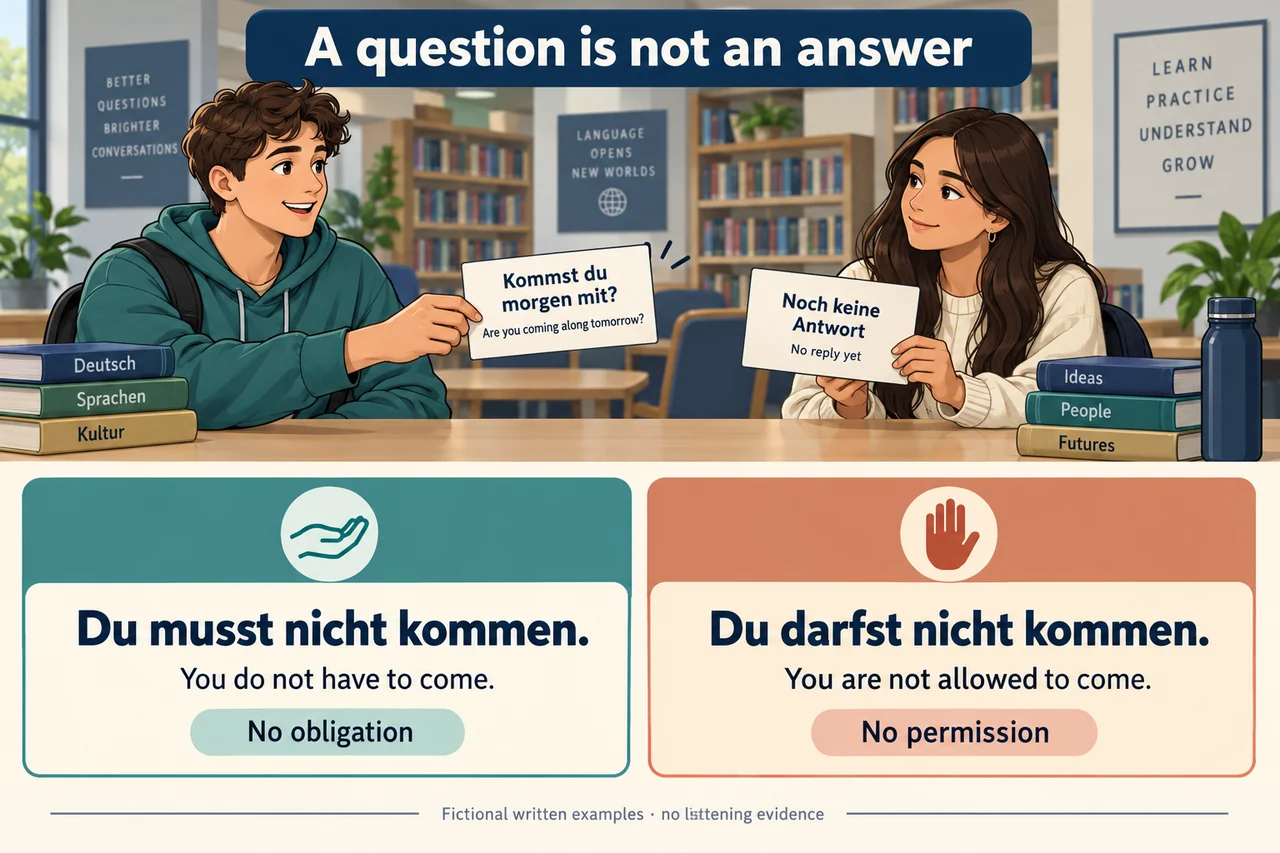
Image: illustration, not a documentary photograph. Original teaching model created for myAudience. · Original generated teaching illustration; no board endorsement or source textbook artwork reproduced.
Questions and negation: ask precisely, deny precisely
A question can request a yes/no decision or missing information. In a standard written yes/no question, the finite verb comes first: Lernst du Deutsch? means Do you learn/Are you learning German? English inserts do, but German does not translate that auxiliary separately. With a question constituent, the finite verb follows it: Wann lernst du Deutsch? means When do you study German? Wer lernt Deutsch? asks who is studying; wer itself is the subject, so it is not followed by another subject pronoun.
Question words distinguish kinds of evidence: wo asks location, wohin destination, woher origin, wann time, warum reason, wie manner and was a thing or activity. Warum lernst du Deutsch? cannot be answered fully with in Bonn because a place is not a reason. Formulate the information gap before selecting the question word. Learners sometimes translate where as wo for every situation; German makes a useful destination/location distinction which will also matter when deciding the case after in.
Kein negates an indefinite or articleless noun phrase: Ich habe keinen Bruder means I do not have a brother. Bruder is masculine accusative after habe, so kein becomes keinen. Ich habe keine Bücher means I have no books. Nicht can negate a property, action or specific element: Das Buch ist nicht teuer means The book is not expensive; ich lerne heute nicht means I am not studying today. There is no rule that nicht must be the last written word: ich kann heute nicht kommen places it before the final infinitive.
Nie means never; nichts means nothing. Ich lese nie means I never read, whereas ich lese nichts means I read nothing/am not reading anything. Each negative has scope, the part of the meaning it denies. Nicht heute means not today and may leave tomorrow possible; never denies occasions across the relevant time span. Do not add an extra nicht to nie or nichts to imitate English negatives: ordinary standard German does not need a double denial here. Choose the intended claim, then its grammatical form.
Original exchange in writing: Wann kommst du? Heute komme ich nicht. Morgen kann ich kommen. Hast du ein Buch? Nein, ich habe kein Buch. Translation: When are you coming? I am not coming today. I can come tomorrow. Do you have a book? No, I do not have a book. The reply suggests another available day but does not promise an exact time. The last reply denies possession, not the existence of every book. This is written dialogue practice; without checked audio it supplies no evidence of listening comprehension or pronunciation.
The written-card plate leaves the invitation unanswered. Its two lower statements contrast denied necessity with denied permission. These are fictional language examples, not rules for using this service, and there is no recording that could establish listening or pronunciation skill. Original transfer challenge: Turn Lea wohnt in Bonn into a location question addressed directly to Lea and into a yes/no question about Lea. Next translate Ich habe kein Buch, Ich lese nichts and Ich lese nie. Explain why these three denials cannot be substituted without changing the message.
Reasoned model and indicative author criteria: Wo wohnst du, Lea? — Where do you live, Lea? Wohnt Lea in Bonn? — Does Lea live in Bonn? Direct address changes the person to du/wohnst; asking about Lea keeps third-person wohnt. Ich habe kein Buch means I have no book; Ich lese nichts means I read nothing or am not reading anything; Ich lese nie means I never read. The first denies possession, the second the object of reading, and the third occasions of reading. An indicative response locates each information gap or negative scope before choosing order and agreement. A written question offers no evidence that the addressee has replied. This is not an official mark scheme or evidence of independently attempted mastery.
Worked example: Ask where Lea lives and whether she has a brother; then give negative replies.
Wo requests residence, and wohnt must follow the question word before Lea.
Hat opens the yes/no question; a masculine direct object uses einen Bruder.
Negate residence with nicht plus the denied place, but negate the indefinite noun phrase with keinen.
Answer: Wo wohnt Lea? Hat sie einen Bruder? Sie wohnt nicht in Bonn. Sie hat keinen Bruder. — Where does Lea live? Does she have a brother? She does not live in Bonn. She has no brother.
Check your understanding: 1 Translate Ich lese nichts. 2 Correct Ich kann kommen nicht. 3 Write a question asking Lea why she studies German, then explain why a time alone cannot answer it.
Answer: 1 I am reading nothing/I do not read anything. 2 Ich kann nicht kommen. 3 Warum lernst du Deutsch, Lea? A reason is required; morgen only answers when.
Why: Nothing concerns the object, not frequency. The infinitive closes the modal bracket, with nicht inside it. In a direct address to Lea, du requires lernst; asking about her instead would be Warum lernt Lea Deutsch?