Ability, permission, obligation and preference
By UK GCSE German · independent study · myAudience
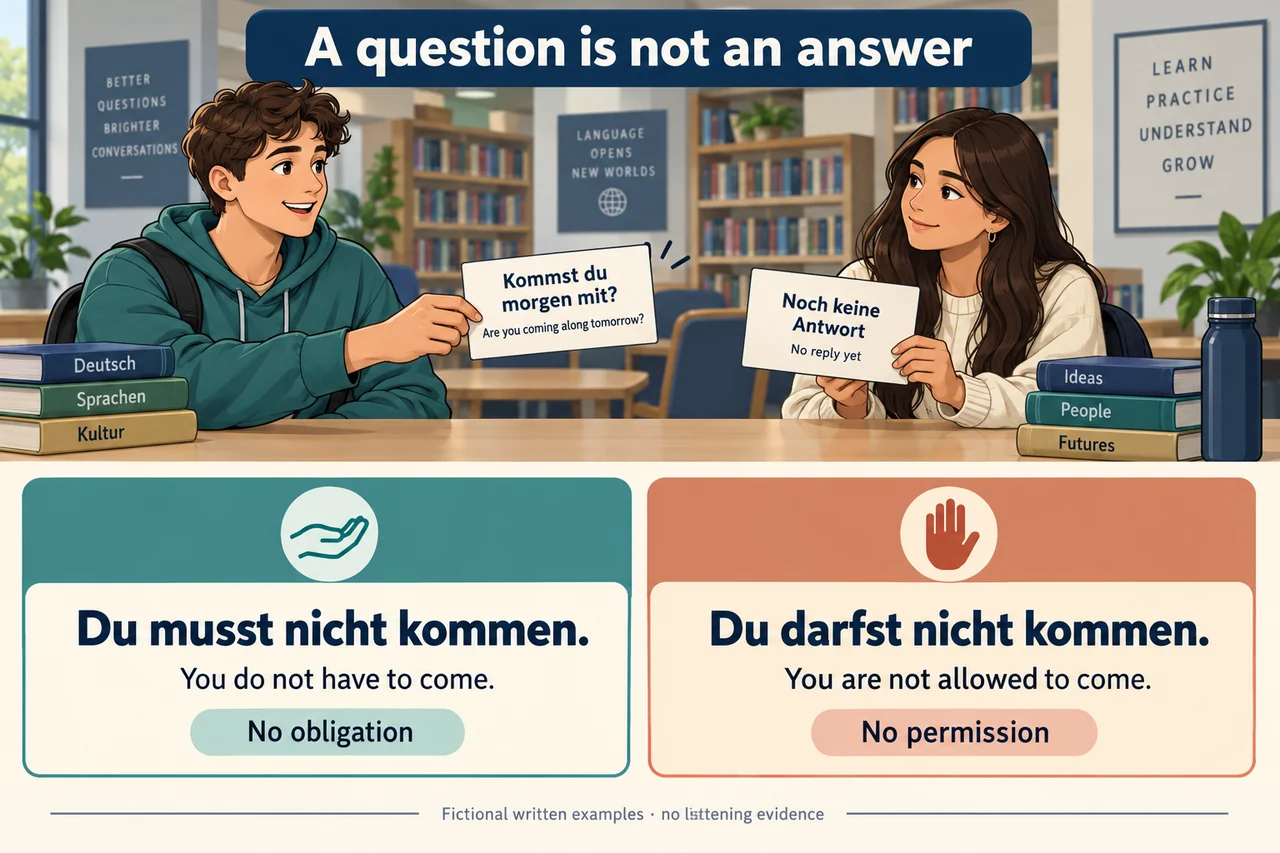
Image: illustration, not a documentary photograph. Original teaching model created for myAudience. · Original generated teaching illustration; no board endorsement or source textbook artwork reproduced.
Ability, permission, obligation and preference
A modal verb modifies the meaning of another action: können expresses ability or possibility, dürfen permission, müssen necessity, sollen an expectation/instruction, wollen intention and mögen liking. A modal is finite and agrees with the subject; the action normally appears as an infinitive at the end of a main clause without zu. Ich kann Deutsch lernen means I can learn German. The clause plate brackets kann … lernen, showing why the second verb is not placed directly after kann as in English.
Present singular forms are irregular: ich/er kann, du kannst; ich/er muss, du musst; ich/er darf, du darfst; ich/er will, du willst; ich/er soll, du sollst; ich/er mag, du magst. Plurals use forms such as wir können, ihr könnt, sie können. Möchte expresses would like: ich möchte ein Buch or ich möchte ein Buch lesen. It is a useful polite desire, not a general device that makes every sentence future tense. In Morgen möchte ich lesen, morgen points to tomorrow and möchte expresses the wish.
Negation changes the modal proposition. Du musst nicht kommen means You do not have to come: necessity is denied, but coming remains possible. Du darfst nicht kommen means You must not/are not allowed to come: permission is denied. Translating both as must not loses the contrast and could change someone's action. This lesson describes meanings; it does not issue actual rules for a classroom or give advice about health. When interpreting instructions, establish who sets the rule and whether the modal signals permission, necessity or a reported expectation.
German also expresses preference through gern and lieber. Ich lese gern means I like reading, literally I read gladly; ich lese lieber means I prefer reading, with a comparison often understood from context. Compare Ich mag Bücher, I like books, with Ich lese gern Bücher, I like reading books. The former evaluates an object; the latter evaluates an activity. Neither implies that the activity is healthy or compulsory. Add a reason only if the text or speaker provides one.
Original plan: Heute müssen wir lernen. Morgen können wir den Garten besuchen. Lea möchte lieber zu Hause bleiben. Translation: Today we have to study. Tomorrow we can visit the garden. Lea would prefer to stay at home. The first two sentences front time expressions; the finite modals still occupy the second constituent and wir follows them. Besuchen and bleiben close their brackets. Zu Hause is a fixed expression meaning at home; it is not the infinitive marker zu. A demanding writer checks meaning, conjugation and placement together rather than treating a modal as a vocabulary swap.
The written-card plate leaves the invitation unanswered. Its two lower statements contrast denied necessity with denied permission. These are fictional language examples, not rules for using this service, and there is no recording that could establish listening or pronunciation skill. Original transfer challenge: Translate Tomorrow we do not have to come, but we would like to read the book. A proposed alternative uses dürfen nicht instead of müssen nicht. Explain the resulting change in permission and obligation; do not invent a rule that the speaker has not stated.
Reasoned model and indicative author criteria: Morgen müssen wir nicht kommen, aber wir möchten das Buch lesen. — Tomorrow we do not have to come, but we would like to read the book. Müssen is finite after the fronted time constituent, wir follows it, and kommen closes the first bracket. Möchten agrees with wir and lesen closes the second. Dürfen wir nicht kommen or wir dürfen nicht kommen denies permission; müssen nicht denies necessity. Lacking an obligation does not prove permission has been expressly granted by every relevant authority. Credit meaning and both verb brackets, and explain why the replacement is a substantive change, not a more formal synonym. This is not an official mark scheme or evidence of independently attempted mastery.
Worked example: Translate: Tomorrow I can read the book, but I do not have to read it.
Morgen occupies the first constituent, so kann precedes ich; lesen goes at the end.
Buch is accusative neuter, giving das Buch and later es.
Deny necessity with muss nicht, not darf nicht; aber connects main clauses without changing their internal order.
Answer: Morgen kann ich das Buch lesen, aber ich muss es nicht lesen.
Check your understanding: 1 Supply ich ___ (können). 2 Translate Du darfst nicht kommen and Du musst nicht kommen distinctly. 3 Rewrite Ich lese gern with lieber and explain the information needed for a meaningful comparison.
Answer: 1 kann. 2 You are not allowed to come; you do not have to come. 3 Ich lese lieber. Context must supply the alternative, for example reading rather than watching a film.
Why: The irregular modal form and final infinitive are separate decisions. Denied obligation permits choice; denied permission restricts it. A preference is relational, so an isolated comparative leaves its comparison implicit.