Daily routines and separable verbs
By UK GCSE German · independent study · myAudience
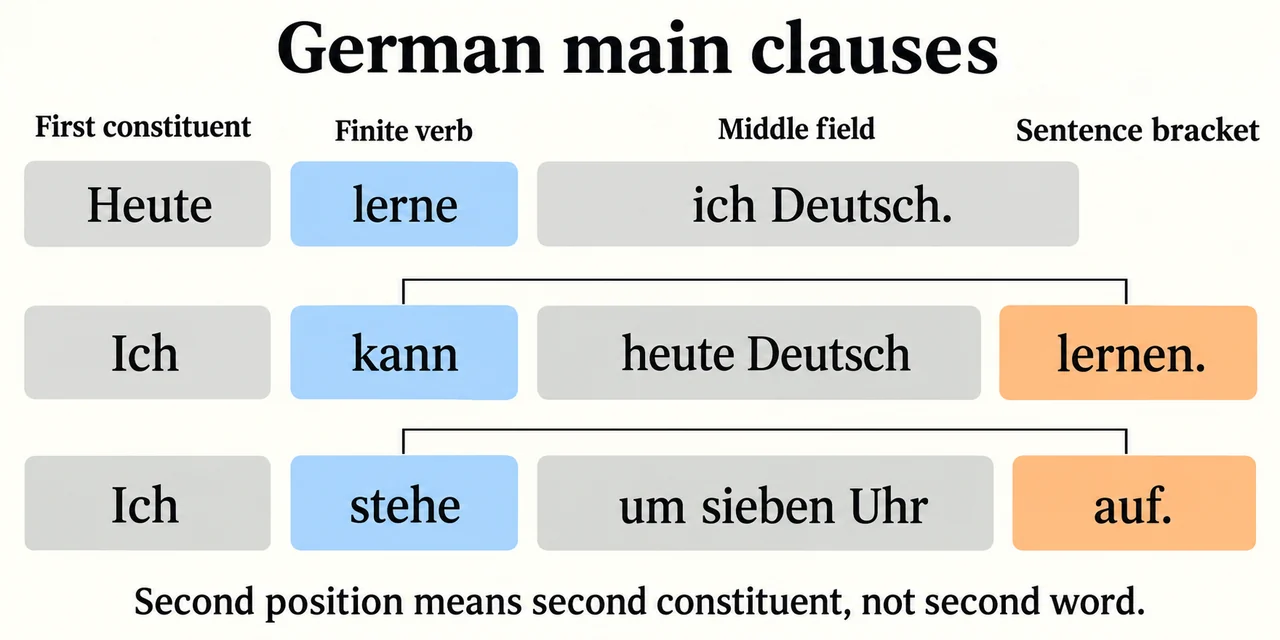
Image: illustration, not a documentary photograph. Original teaching model created for myAudience. · Original generated teaching illustration; no board endorsement or source textbook artwork reproduced.
Daily routines and separable verbs
Some German verbs contain a stressed particle that separates in a present main clause. Aufstehen means to get up: ich stehe um sieben Uhr auf. The finite stem stehe occupies second position; auf closes the clause bracket. Auf is part of the verb's meaning here, not a preposition demanding a noun object. Without it, ich stehe means I stand/am standing, so accidentally dropping the particle changes the event rather than merely its spelling.
Begin from the whole infinitive: aufstehen → steh- plus the person ending, with auf at the end. Er steht auf and wir stehen auf retain the same particle while changing agreement. If another verb is finite, the separable infinitive stays whole: ich muss früh aufstehen. The modal occupies second position and aufstehen goes to the end. Do not write ich muss früh stehen auf, because the split is licensed by the separable verb itself being finite in that main clause.
A reflexive pronoun shows that an action returns to its subject or has a learned reflexive meaning. Ich wasche mich means I wash myself; du wäschst dich, er wäscht sich, wir waschen uns, ihr wascht euch, sie waschen sich. Mich and dich are accusative pronouns here. The stem change in wäschst/wäscht belongs to waschen and must also be learned. A reflexive construction is not automatically a statement about hygiene standards; it describes the actor and the action. Some verbs have a different meaning when reflexive, so consult the lexical entry rather than inventing a reflexive form for every verb.
The clause plate shows Ich | stehe | um sieben Uhr | auf. Its blue tile changes with the subject; its orange tile preserves the particle. Count um sieben Uhr as a time phrase, not three separate competitors for second position. In Um sieben Uhr stehe ich auf, the whole time phrase is first and ich follows stehe. This demonstrates the same main-clause principle used in the present-tense lesson, now with a lexical bracket.
Original diary: Am Montag stehe ich früh auf. Dann wasche ich mich. Mein Bruder steht später auf. Wir müssen um acht Uhr lernen. Translation: On Monday I get up early. Then I wash myself. My brother gets up later. We have to study at eight o'clock. Früh means early; später is later, not necessarily late. The text gives an order and a comparison but not the brother's exact waking time. To extend the diary, alternate starting phrases while preserving the bracket and agreement. Never claim to infer a character's habits from one described day.
The main-clause plate locates finite lerne/kann/stehe in the second constituent and separately shows final lernen/auf. It is a bounded model of these main clauses, not a diagram of every subordinate construction. For relatives, identify the subordinate clause separately; the picture cannot establish its local case. Original transfer challenge: Give a main-clause statement that we get up at eight, then a statement that we can get up at eight. Add a statement that we wash ourselves. An editor puts the particle after the infinitive and uses mich with wir: diagnose both errors.
Reasoned model and indicative author criteria: Wir stehen um acht Uhr auf. Wir können um acht Uhr aufstehen. Wir waschen uns. — We get up at eight. We can get up at eight. We wash ourselves. In the first clause stehen is finite, so auf separates; in the second können is finite and the complete infinitive aufstehen remains together. Uns agrees in reflexive reference with wir; mich refers to ich. Both case and participant reference matter, not merely the word’s position. An indicative answer should preserve the time and action through the modal transformation, retain the particle, and explain why Wir waschen mich would instead make me the object rather than express the intended we wash ourselves. This is not an official mark scheme or evidence of independently attempted mastery.
Worked example: Say that Lea gets up at seven; then say she must get up at seven.
Lea is third person singular: steht is the finite form of aufstehen.
In the first main clause place auf at the end, after the time phrase.
In the modal sentence muss is finite; leave aufstehen whole as the final infinitive.
Answer: Lea steht um sieben Uhr auf. Lea muss um sieben Uhr aufstehen.
Check your understanding: 1 Translate Ich wasche mich. 2 Correct Morgen ich stehe früh auf. 3 Transform Wir stehen früh auf into a modal sentence expressing ability, and explain why the particle no longer separates.
Answer: 1 I wash/am washing myself. 2 Morgen stehe ich früh auf. 3 Wir können früh aufstehen. Können is now finite and aufstehen is a complete infinitive, so its particle stays attached.
Why: Agreement, reflexive reference and clause structure all carry meaning. Morgen has already filled the first constituent. The split depends on the verb form and construction, not simply the presence of the word auf.