Past events: building and interpreting the perfect
By UK GCSE German · independent study · myAudience
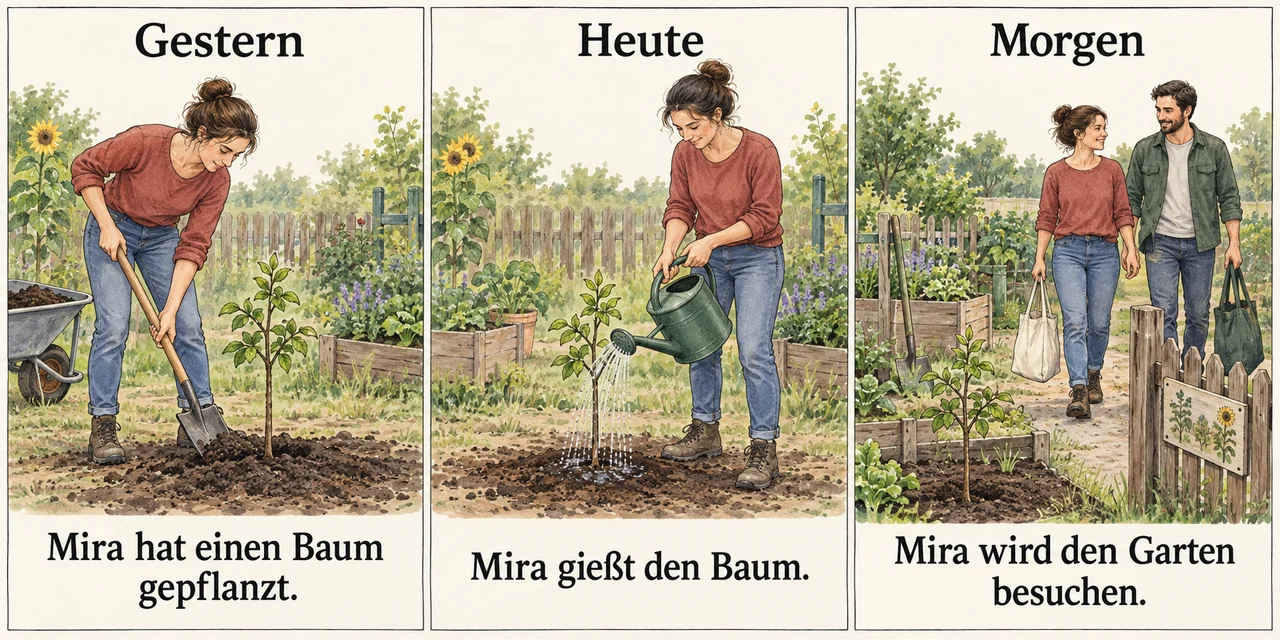
Image: illustration, not a documentary photograph. Original teaching model created for myAudience. · Original generated teaching illustration; no board endorsement or source textbook artwork reproduced.
Past events: building and interpreting the perfect
The perfect combines a present finite auxiliary, haben or sein, with a past participle. Ich habe ein Buch gelesen means I read/have read a book. Habe agrees with ich and occupies the finite slot; gelesen closes the main clause. A participle alone does not make a complete independent clause: gestern gelesen lacks the subject and finite verb needed for this ordinary sentence. English can choose simple past or present perfect according to context; German perfect does not demand a word-for-word English have construction.
Regular participles commonly use ge- plus the stem plus -t: machen → gemacht, pflanzen → gepflanzt. Verbs in -ieren do not take ge-: studieren → studiert. Inseparable prefixes such as be- also suppress ge-: besuchen → besucht. Separable verbs place ge inside the prefix: einkaufen → eingekauft. Strong forms may change the vowel and end in -en: lesen → gelesen, sprechen → gesprochen, gehen → gegangen. These patterns reduce memory load, but not every strong participle can be generated from a universal vowel rule.
Most verbs take haben. Common intransitive changes of location or state take sein: ich bin nach Bonn gefahren, I went/travelled to Bonn; ich bin aufgestanden, I got up. Learn a verb with its auxiliary and participle. The shortcut all moving bodies take sein fails: ich habe im Garten gearbeitet includes physical activity but uses haben. Some verbs and regions allow different choices in particular uses, so this introductory rule is deliberately bounded to the examples. It is not a complete linguistic account of every movement verb.
The garden plate's left panel depicts a completed planting yesterday: Mira hat einen Baum gepflanzt. Hat is finite and gepflanzt is the participle. The new sapling is the planted object; the plate supplies a fictional visual situation rather than evidence of an actual environmental project. The middle panel is watering today and the right panel a planned visit tomorrow. The tree remains the same size to avoid implying that it matures overnight. The three scenes make time contrast visible, while the grammatical analysis comes from the captions. Context vocabulary: pflanzen means to plant; gießen means to water here. These supplementary scene words are not asserted to be prescribed Appendix 2 entries. The caption is an original teaching example, not a simulated list-restricted examination passage.
Original report: Gestern habe ich im Garten gearbeitet. Danach bin ich nach Hause gegangen. Mein Bruder hat ein Buch gelesen. Translation: Yesterday I worked in the garden. Afterwards I went home. My brother read a book. Danach orders events; it does not say how many minutes passed. Ich … gearbeitet uses haben, while gegangen uses sein for this change of location. The brother's activity could overlap with either event: the report does not establish his exact position in the sequence. Reading carefully includes refusing a chronology that the writer did not supply.
The garden plate contrasts yesterday’s reported planting, today’s watering and a pictured plan for tomorrow. The future image does not establish fulfilment. In the Higher continuing-time lesson this provides a contrast: a sequence of dated episodes alone does not establish an activity continuing since an earlier date. Original transfer challenge: Translate Yesterday we visited the garden. Afterwards we went home. Contrast the two auxiliary choices and reject the claim that all physically active events need sein. State whether the report establishes how long the visit lasted.
Reasoned model and indicative author criteria: Gestern haben wir den Garten besucht. Danach sind wir nach Hause gegangen. — Yesterday we visited the garden. Afterwards we went home. Besuchen uses haben and inseparable be- gives besucht without ge-; destination gehen uses sein and gegangen here. The plural subject needs haben/sind, while the participles do not change with that subject. Work such as Wir haben gearbeitet uses haben despite physical movement. Danach orders these narrated events but supplies no duration. Credit complete finite-plus-participle structures, both plural auxiliaries, a justified contrast and the refused duration inference; do not use a picture as a substitute for textual timing evidence. This is not an official mark scheme or evidence of independently attempted mastery.
Worked example: Translate: Yesterday Lea visited the garden. Afterwards she went home.
Besuchen is transitive and has inseparable be-, so choose hat and besucht, not gebesucht.
Gestern fronts time; hat follows it before Lea.
Gehen in this destination use takes sein; sie agrees with ist and gegangen closes the clause.
Answer: Gestern hat Lea den Garten besucht. Danach ist sie nach Hause gegangen.
Check your understanding: 1 Give the participle of machen. 2 Correct Ich habe nach Bonn gegangen. 3 Explain why Gestern habe ich im Garten gearbeitet does not take sein merely because work involves movement.
Answer: 1 gemacht. 2 Ich bin nach Bonn gegangen. 3 Auxiliary choice depends on the verb and its use. Arbeiten takes haben in this sentence; motion of the body alone is not sufficient.
Why: The repair preserves the participle and changes the incompatible auxiliary. Perfect construction needs both elements. A physical scene helps identify the event but cannot replace learning the grammatical pattern of the verb.