Now, then and next: contrasting time without confusing tense
By UK GCSE German · independent study · myAudience
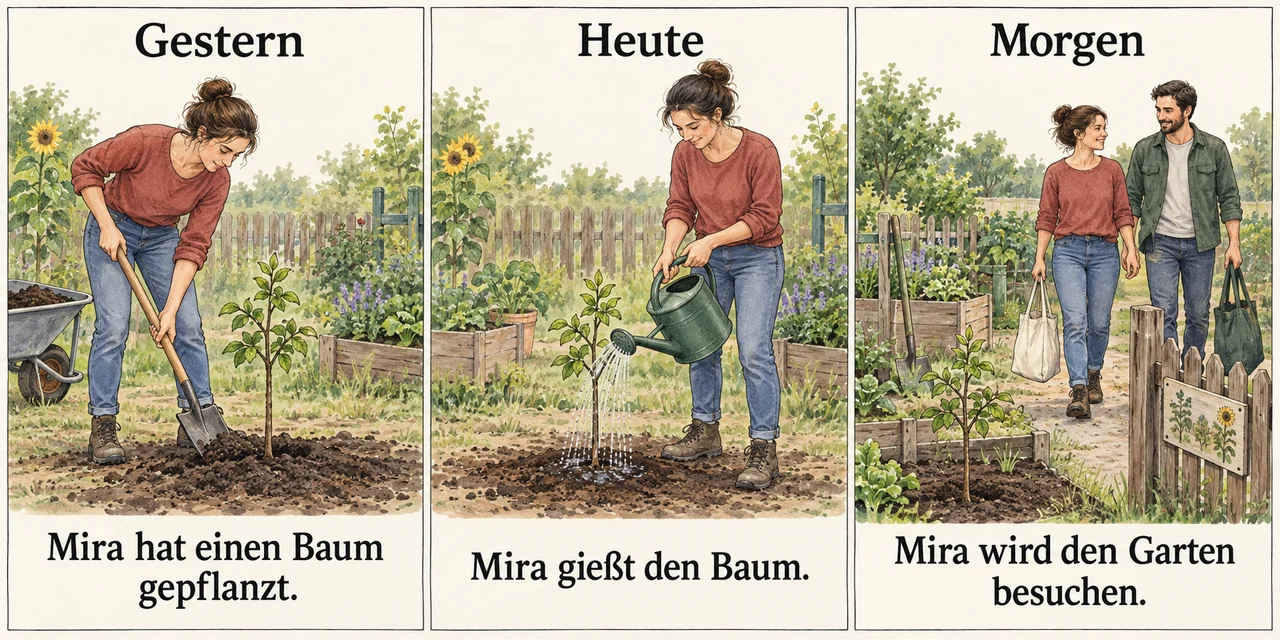
Image: illustration, not a documentary photograph. Original teaching model created for myAudience. · Original generated teaching illustration; no board endorsement or source textbook artwork reproduced.
Now, then and next: contrasting time without confusing tense
Time reference locates an event; tense is the grammatical form used to express it. Heute lerne ich Deutsch is present tense with present reference. Morgen lerne ich Deutsch remains present tense but suggests a planned future event. Morgen werde ich Deutsch lernen uses the grammatical future: a finite form of werden plus an infinitive. Both future-reference sentences are natural in an appropriate context. An English will need not always correspond to werden; translate the intended meaning and choose a structure you can use accurately.
The future auxiliary forms are ich werde, du wirst, er/sie/es wird, wir werden, ihr werdet, sie/Sie werden. The action stays infinitive: wir werden lesen, not wir werden gelesen. Contrast perfect wir haben gelesen, where gelesen is a participle. Both have two verbal elements, but the second element and the relationship in time differ. A future sentence does not prove that a plan will occur. It expresses a prediction, intention or future situation as presented by the writer.
For simple past descriptions of states, learn sein and haben: ich/er war, du warst, wir/sie waren, ihr wart; ich/er hatte, du hattest, wir/sie hatten, ihr hattet. Ich war müde means I was tired; ich hatte ein Buch means I had a book. These are single finite past forms, unlike perfect ich bin gegangen. Foundation grammar includes these past verbs and singular past modals; wider narrative simple past is a separate Higher demand in this map. Do not present every narrative verb as a compulsory Foundation production target.
The garden plate contrasts yesterday's planting, today's watering and tomorrow's visit. Translate its captions as Mira planted a tree; Mira waters/is watering the tree; Mira will visit the garden. The finite words hat, gießt and wird identify different structures, while gestern, heute and morgen clarify reference. The image cannot establish that today's weather is good or that the planned visit happened. Its small sapling is a visual continuity device, not a growth experiment. The right panel represents the plan pictorially; the caption supplies its future status.
Original postcard: Gestern war ich in Bonn. Ich hatte wenig Zeit, aber ich habe den Garten besucht. Heute bin ich zu Hause. Morgen werde ich ein Buch lesen. Translation: Yesterday I was in Bonn. I had little time, but I visited the garden. Today I am at home. Tomorrow I will read a book. Wenig is little, not none; the visit is compatible with limited time. Aber signals the writer's contrast between the constraint and what happened. Three time frames make a coherent account without requiring an invented causal explanation.
The garden plate contrasts yesterday’s reported planting, today’s watering and a pictured plan for tomorrow. The future image does not establish fulfilment. In the Higher continuing-time lesson this provides a contrast: a sequence of dated episodes alone does not establish an activity continuing since an earlier date. Original transfer challenge: Translate Yesterday I had little time. Today I am reading a book. Tomorrow I will read it. Then write tomorrow’s plan using present tense and explain why neither future version proves completion.
Reasoned model and indicative author criteria: Gestern hatte ich wenig Zeit. Heute lese ich ein Buch. Morgen werde ich es lesen. Morgen lese ich es. — Yesterday I had little time. Today I am reading a book. Tomorrow I will read it. The first uses finite simple-past hatte; the next uses present lese; explicit future has finite werde plus infinitive lesen, whereas the alternative keeps present lese with future reference from morgen. Es refers to the book. Wenig permits a small amount of time rather than none. An indicative response should preserve pronoun reference and all three time relationships, and distinguish a writer’s planned event from a witnessed outcome. This is not an official mark scheme or evidence of independently attempted mastery.
Worked example: Create a three-part account: yesterday I was tired; today I study; tomorrow I will read a book.
Use war for the earlier state, with gestern first and ich after the finite verb.
Use lerne as a present finite form for today.
Use werde plus final lesen for explicit future tense; ein Buch is the neuter accusative object.
Answer: Gestern war ich müde. Heute lerne ich. Morgen werde ich ein Buch lesen.
Check your understanding: 1 Translate Ich hatte wenig Zeit. 2 Correct Morgen werde ich ein Buch gelesen. 3 Give a present-tense alternative with the same planned future reference and explain its limit.
Answer: 1 I had little time. 2 Morgen werde ich ein Buch lesen. 3 Morgen lese ich ein Buch. Morgen establishes tomorrow; the present form conveys a plan in context but does not itself guarantee fulfilment.
Why: Wenig and kein express different quantities. Werden requires an infinitive in this future construction. Tense recognition must inspect the verb forms, not just a time adverb or the English translation.