Reasons and relative clauses: connecting one-verb ideas
By UK GCSE German · independent study · myAudience
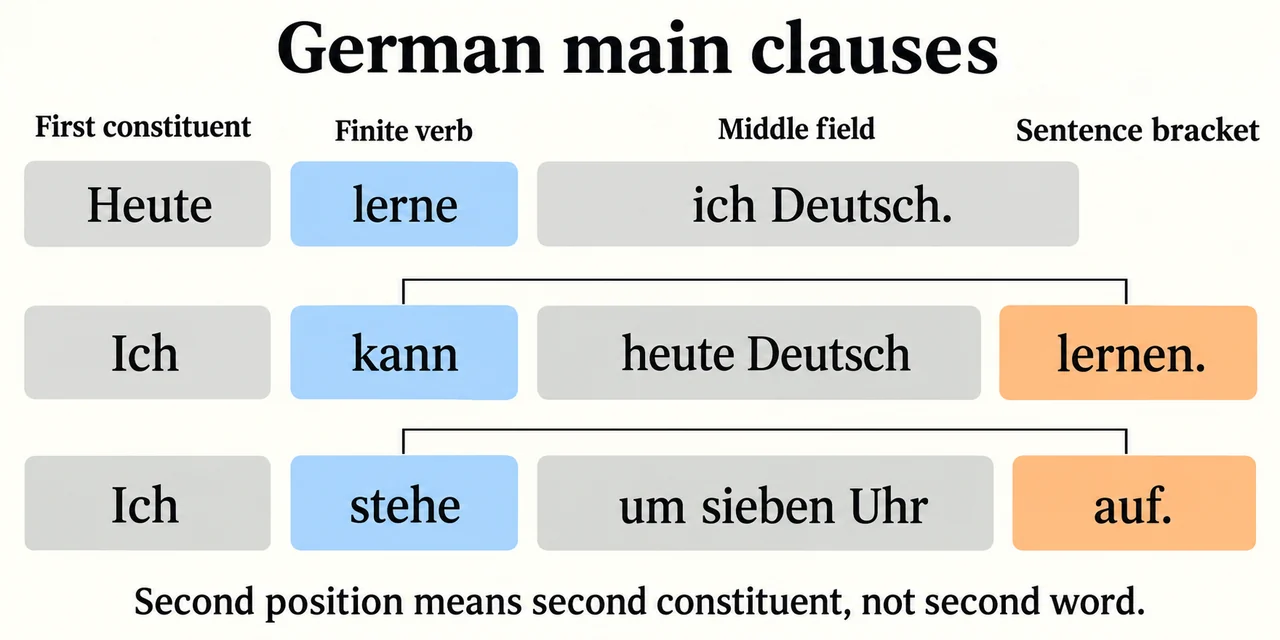
Image: illustration, not a documentary photograph. Original teaching model created for myAudience. · Original generated teaching illustration; no board endorsement or source textbook artwork reproduced.
Reasons and relative clauses: connecting one-verb ideas
A subordinate clause depends on another clause and adds a relationship such as reason or description. In standard written German, weil introduces a reason with the finite verb at the end: Ich lerne Deutsch, weil die Sprache interessant ist. Translation: I study German because the language is interesting. A comma separates the clauses. Each clause has its own subject and verb. Interesting is the writer's evaluation; the sentence does not establish that everyone shares it.
Do not transplant English subject-verb order into the reason clause: weil die Sprache ist interessant breaks the written pattern taught here. Find the finite verb ist, remove it from the English-like middle, and place it after interessant. Denn can also introduce a reason but joins a main-clause pattern: Ich lerne Deutsch, denn die Sprache ist interessant. This is a structural contrast, not a rule that one conjunction is always stylistically superior. Spoken varieties sometimes use weil with verb-second order; the target in this course is the standard written form required for controlled exam writing.
A subject relative clause describes a noun using a relative pronoun as its own subject: Der Freund, der in Bonn wohnt, lernt Deutsch. Translation: The friend who lives in Bonn studies German. The relative der agrees with masculine singular Freund and is nominative because it does the living. The main subject is the whole expanded noun phrase Der Freund, der in Bonn wohnt. The main verb lernt follows that complete first constituent. The embedded wohnt is final inside its own clause, even though it is not the final verb of the whole sentence.
Use die for a feminine singular or plural subject relative and das for neuter singular: das Buch, das interessant ist, the book that is interesting; die Freunde, die in Bonn wohnen, the friends who live in Bonn. Gender and number come from the described noun; case comes from the pronoun's job inside the relative clause. This lesson stays with subject relatives and one finite verb in each subordinate clause. Two-verb and separable subordinate patterns appear later in the Higher branch so they are not silently assigned to Foundation.
Original notice: Wir suchen eine Freundin, die gern liest. Das Treffen ist am Montag, weil Lea am Dienstag arbeitet. Translation: We are looking for a female friend who likes reading. The meeting is on Monday because Lea works on Tuesday. Suchen takes an accusative object eine Freundin, but die in the relative clause is nominative as subject of liest. That contrast is the essential reasoning: do not simply copy the case of the preceding noun into the relative pronoun. The notice explains the chosen day, not the meeting time or a guarantee of attendance.
The main-clause plate locates finite lerne/kann/stehe in the second constituent and separately shows final lernen/auf. It is a bounded model of these main clauses, not a diagram of every subordinate construction. For relatives, identify the subordinate clause separately; the picture cannot establish its local case. Original transfer challenge: Write The book that is new is interesting. Then write I am looking for a friend (female) who reads gladly. In the second sentence identify the case of the main object and the case of the relative subject, explaining why they need not match.
Reasoned model and indicative author criteria: Das Buch, das neu ist, ist interessant. Ich suche eine Freundin, die gern liest. — The book that is new is interesting. I am looking for a female friend who likes reading. The first ist closes the relative clause and the second is the main finite verb; they perform different clause jobs. Eine Freundin is the accusative object selected by suche, but die is nominative as the subject of liest inside its own clause. Gender and number connect pronoun to antecedent; the local clause role determines case. Credit punctuation, agreement and both boundaries, not an instruction to copy the main object’s case into every relative pronoun. This is not an official mark scheme or evidence of independently attempted mastery.
Worked example: Join The book is interesting and I read the book as a reason; then describe a friend who lives in Bonn.
Use ich lese das Buch as the main clause, then weil and a complete reason clause.
Das Buch is neuter singular, so use es in the reason; move ist to the end.
For a masculine subject relative use der and put wohnt at its clause end.
Answer: Ich lese das Buch, weil es interessant ist. Der Freund, der in Bonn wohnt, liest gern.
Check your understanding: 1 Supply ist placement: weil das Buch interessant ___. 2 Translate Die Freunde, die in Bonn wohnen, lernen Deutsch. 3 Explain why the relative pronoun in Wir suchen eine Freundin, die gern liest is nominative despite eine Freundin being accusative.
Answer: 1 ist at the end. 2 The friends who live in Bonn study German. 3 Die is the subject of liest inside its own clause; suchen governs only the main-clause object eine Freundin.
Why: Clause boundaries determine which verb governs which phrase. A relative clause is not merely an adjective ending attached to the main object. The pronoun shares gender and number with its antecedent while obtaining case within its own clause.