Place and destination: case follows the relationship
By UK GCSE German · independent study · myAudience
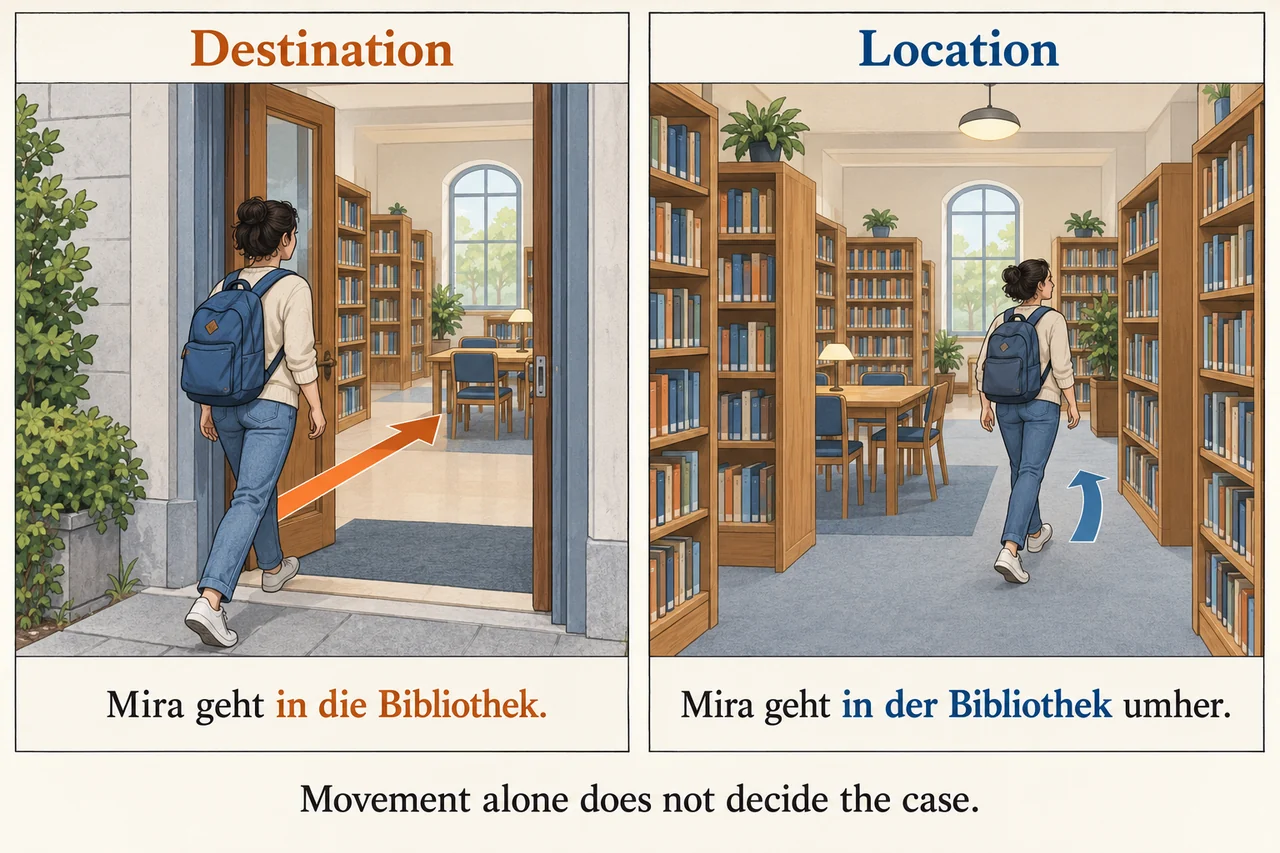
Image: illustration, not a documentary photograph. Original teaching model created for myAudience. · Original generated teaching illustration; no board endorsement or source textbook artwork reproduced.
Place and destination: case follows the relationship
A preposition relates its noun phrase to the rest of a sentence. Some require a fixed case: für and ohne take accusative; mit, nach and zu take dative in the patterns taught here. Mit meinem Bruder means with my brother, even when both people are moving. Für meinen Bruder means for my brother, even when the gift stays on a table. The preposition's grammatical pattern controls these endings. The Foundation inventory also includes bis/durch and aus/bei/von; their complete uses remain for later practice.
For spatial in, an and auf, distinguish a location relationship from a destination relationship. Ich bin in der Bibliothek means I am in the library: feminine dative. Ich gehe in die Bibliothek means I am going into the library: feminine accusative. A destination establishes where the movement leads; a location establishes the space within which an event takes place. This rule applies to these spatial two-way-preposition uses, not to every German expression containing in, including abstract verb-preposition combinations that may have their own learned case.
The library plate intentionally shows motion in both panels. Left, Mira crosses the doorway into the library; in die Bibliothek describes the destination. Right, she walks around inside; in der Bibliothek describes the location of that walking. Its caption Mira geht in der Bibliothek umher means Mira walks around in the library. Umhergehen is separable, so umher closes the main clause. The arrows show a spatial relationship, not speed or a real route. The apparent movement in both scenes disproves the shortcut movement equals accusative.
Common contractions combine a preposition and a definite article: im = in dem, ins = in das, am = an dem, ans = an das, beim = bei dem, vom = von dem, zum = zu dem, zur = zu der. Im Garten is dative masculine location; in den Garten is accusative masculine destination and has no comparable in-den contraction. Zum Garten remains dative because zu takes dative, even though the destination is a garden. A correct translation must preserve this distinction between case grammar and physical direction.
Original invitation: Kommst du mit deinem Bruder? Wir treffen uns im Garten. Danach gehen wir in die Bibliothek. Translation: Are you coming with your brother? We will meet in the garden. Afterwards we will go into the library. The present forms describe a plan in this invitation context. Uns is an accusative reciprocal/reflexive pronoun in wir treffen uns, we meet each other. These words do not establish that everyone has agreed to attend. For writing, select the relationship first, retrieve gender second, choose case and article third, then check the verb position.
The library plate depicts motion in both scenes. Only crossing into the destination uses in die; walking around within the location uses in der. Its arrows communicate a spatial relationship, not a measured path or universal movement-to-case rule. Original transfer challenge: Using Garten, which is masculine, contrast walking within the garden with going into it. Then translate I go to the garden with my brother using zu. Account for every case, including the fact that all three events involve motion.
Reasoned model and indicative author criteria: Ich gehe im Garten umher. Ich gehe in den Garten. Ich gehe mit meinem Bruder zum Garten. — I walk around in the garden. I go into the garden. I go to the garden with my brother. Spatial in gives dative im/in dem for the location of walking, but accusative den for a destination into the garden. Zu independently requires dative, so zum/zu dem remains dative even for a destination; mit requires meinem Bruder. Umher is the separated particle in the first main clause. An indicative answer should classify the relationship and chosen preposition before retrieving the article, rather than treating movement as an accusative switch. This is not an official mark scheme or evidence of independently attempted mastery.
Worked example: Translate: I work in the garden. Afterwards I go into the garden with my brother.
Working occurs at a location: Garten is masculine, so in dem contracts to im.
The next clause gives a destination after in: choose accusative den Garten.
Mit requires dative even alongside motion: meinem Bruder. Danach fronts one constituent, so gehe precedes ich.
Answer: Ich arbeite im Garten. Danach gehe ich mit meinem Bruder in den Garten.
Check your understanding: 1 Expand im. 2 Translate Ich gehe im Garten umher. 3 Explain why Ich gehe zum Garten uses dative even though it gives a destination; contrast in den Garten.
Answer: 1 in dem. 2 I walk/am walking around in the garden. 3 Zu requires dative: zum is zu dem. Spatial in switches with the relationship, so in den Garten uses accusative for entering the garden.
Why: Case is not a universal movement detector. Fixed-case and two-way prepositions follow different patterns. The answer must account for the chosen preposition as well as the intended spatial relationship.