Original reading: evidence, inference and a faithful translation
By UK GCSE German · independent study · myAudience
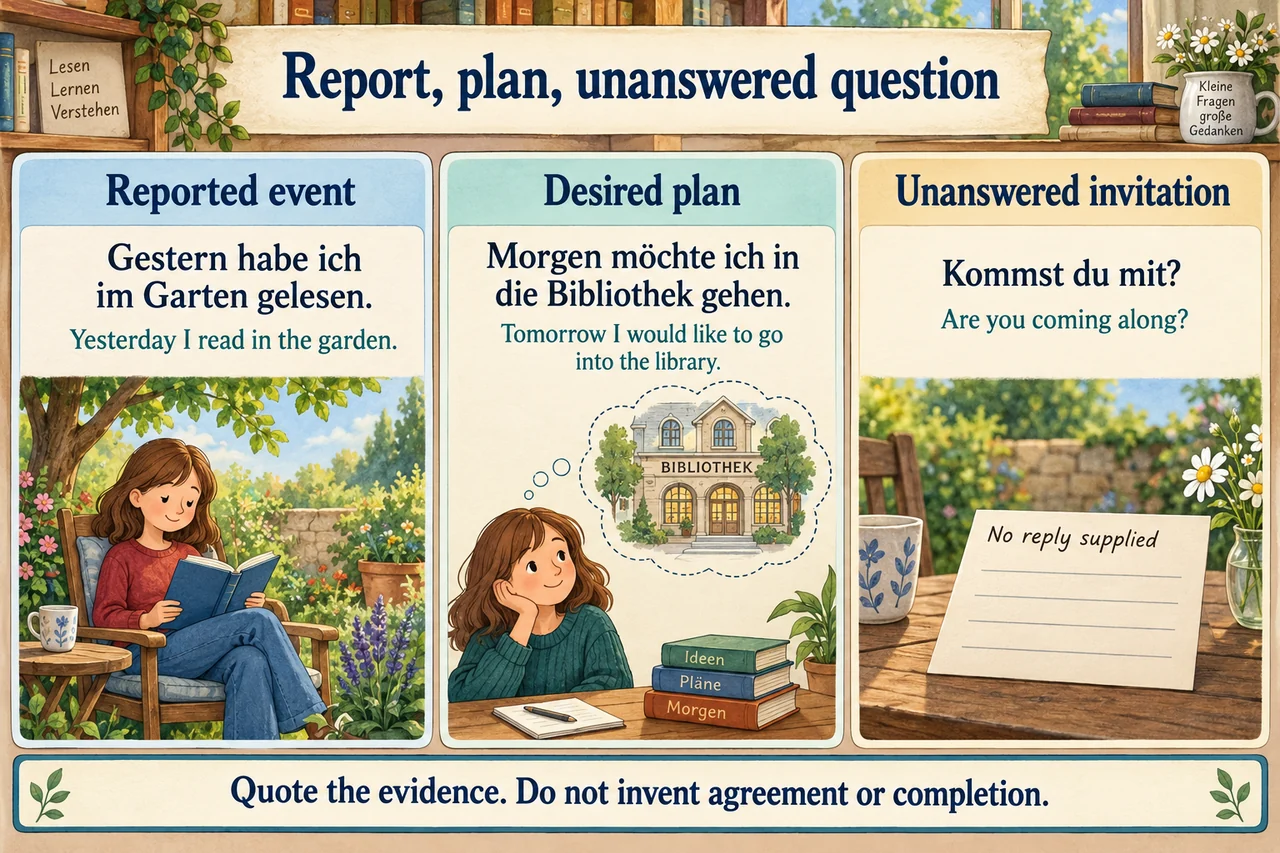
Image: illustration, not a documentary photograph. Original teaching model created for myAudience. · Original generated teaching illustration; no board endorsement or source textbook artwork reproduced.
Original reading: evidence, inference and a faithful translation
Reading comprehension separates explicit content from plausible inference. First identify the genre, audience and purpose; then locate the actor, event, time, negation and opinion in each clause. A copied German noun does not by itself answer an English question about why an action occurred. This lesson uses an original fictional community email with an authentic communicative purpose: changing a plan. It is not a quotation from a native speaker, a past paper or a measured sample of everyday German usage.
Original email: Hallo Lea! Am Samstag habe ich mit meinem Bruder den Garten besucht. Das Wetter war gut, aber wir hatten wenig Zeit. Heute arbeite ich zu Hause. Morgen muss ich Deutsch lernen. Am Sonntag möchte ich wieder in den Garten gehen. Kommst du mit? Du musst keine Bücher kaufen. Wir können dort zusammen lesen. Mira. Vocabulary support: wieder, again; dort, there. This original message supplies a real communicative sequence of report, plan and invitation, without asserting that it is a document from an actual community.
Translation: Hi Lea! On Saturday I visited the garden with my brother. The weather was good, but we had little time. Today I am working at home. Tomorrow I have to study German. On Sunday I would like to go into the garden again. Are you coming along? You do not have to buy any books. We can read together there. Mira. The separate sentences about today and tomorrow do not prove that tomorrow’s obligation caused today’s choice to work at home. Chronological proximity is not automatically a causal relationship.
Test a tempting wrong answer: Mira did not visit because she had no time. It conflicts with habe … besucht and replaces wenig, little, with none. Du musst keine Bücher kaufen denies a need to purchase books; it does not prohibit bringing a book. Möchte expresses a wish rather than an established arrangement. There is no evidence for the garden's opening hours or a ticket price. Answering an inference question should involve a claim plus the words that constrain it, not a guess supported by an attractive illustration.
For a derived unfamiliar word, use morphology and context together. Original extra sentence: Lea ist unglücklich, weil das Treffen nicht möglich ist. Glücklich means happy; un- creates its opposite here, so unglücklich means unhappy. Translation: Lea is unhappy because the meeting is not possible. This is a bounded derivational pattern, not evidence that every word beginning un- is a negation. A compound's final noun can similarly help identify category and gender, but context must still settle its intended meaning. Recognisable derivations are permitted across skills under the current dated amendment, subject to its recognition condition; this worked example practises reading only. It does not establish full prescribed vocabulary coverage.
The three-card plate separates a reported past reading event, a desired library visit and an unanswered invitation. Both German text and translation are supplied. Use the words to support a claim; the imagined scenes cannot prove agreement, completion or reliability of a reported event. Original transfer challenge: Original extra message: Gestern habe ich im Garten gelesen. Morgen möchte ich in die Bibliothek gehen. Kommst du mit? Translation: Yesterday I read in the garden. Tomorrow I would like to go into the library. Are you coming along? A summary says We have both agreed to read in the library tomorrow. Evaluate it sentence by sentence and supply a faithful shorter summary.
Reasoned model and indicative author criteria: Faithful summary: The writer reports reading in the garden yesterday and would like to go into the library tomorrow; the recipient is invited but no reply is supplied. Habe gelesen reports a completed past event from the writer’s perspective, not external verification. Möchte gehen expresses desire, not agreement or completed attendance, and the text does not state that reading is the activity planned in the library. Kommst du mit? is a question. Credit three separate pieces of evidence and the removal of both agreed and tomorrow reading. An attractive library sketch cannot fill those textual gaps; it visualises the proposed place, not an accepted arrangement. This is not an official mark scheme or evidence of independently attempted mastery.
Worked example: Use the Foundation-route email to explain what happened on Saturday, what is wished for Sunday, and whether books must be bought.
Locate the completed perfect visit and its companion: Mira visited with her brother.
Locate möchte and Sonntag: the return is desired, not reported as completed.
Parse musst plus keine … kaufen as lack of purchasing obligation, not a ban.
Answer: Saturday: Mira visited the garden with her brother. Sunday: she would like to return. Buying books is not required.
Check your understanding: 1 Translate wir hatten wenig Zeit. 2 Can we conclude that Lea will attend? Give evidence. 3 Infer unglücklich in the extra sentence and explain why the text supports that meaning without treating every unknown word as a cognate.
Answer: 1 We had little time. 2 No: Kommst du mit? is an unanswered invitation. 3 Unhappy: glücklich is happy and un- reverses it in this listed pattern; the failed meeting supplies a compatible reason.
Why: The email reports one visit and proposes another. A question is not acceptance, and a wish is not completion. Morphology constrains the inference; an English-looking spelling alone cannot prove meaning.