Writing a connected response to three bullets
By UK GCSE German · independent study · myAudience
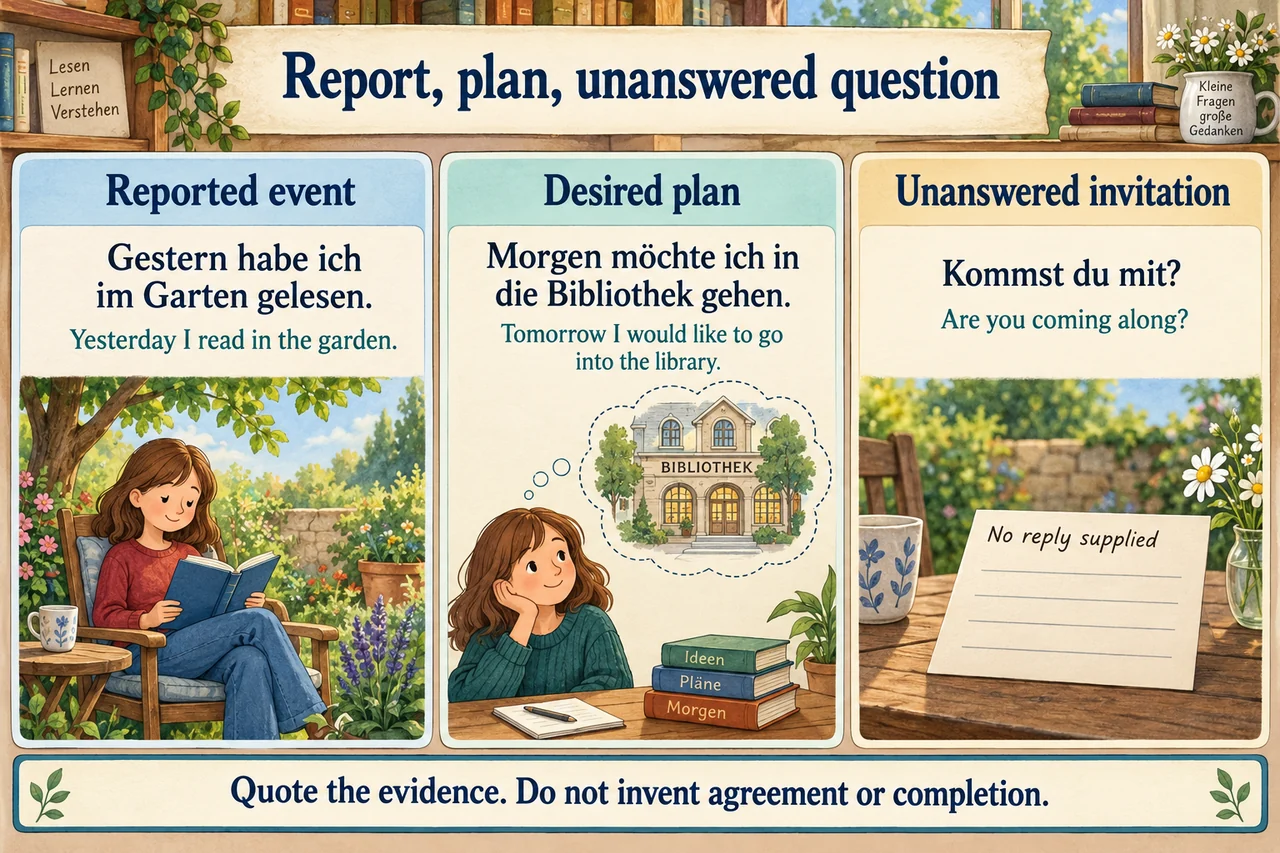
Image: illustration, not a documentary photograph. Original teaching model created for myAudience. · Original generated teaching illustration; no board endorsement or source textbook artwork reproduced.
Writing a connected response to three bullets
A structured response answers the required content before it displays grammatical range. In this original practice task the three bullets are: explain what you enjoy doing in your free time and why; describe a recent activity with another person; explain a future plan. These are our own prompts, not exam questions. The shared 90-word task is present at both tiers, but this practice response does not earn a predicted exam mark. A reader should be able to point to the sentence that answers each bullet.
Plan in meanings: present preference plus reason, completed activity plus detail, future plan plus companion or motive. Then choose reliable forms from earlier lessons. Lese gern expresses the activity preference; weil introduces a one-verb reason; habe gelesen or bin gegangen supplies a past event; möchte plus infinitive expresses an intended plan. A planned event can also use werden plus infinitive. These are alternatives for communicating the message, not a checklist that must be inserted regardless of sense. Repeatedly writing interesting without a reason makes the evaluation thin.
Original model: In meiner Freizeit lese ich gern, weil Bücher interessant sind. Meistens lese ich zu Hause, aber manchmal lese ich im Garten. Am Samstag bin ich mit meinem Bruder in die Bibliothek gegangen. Dort haben wir zwei Bücher gefunden. Mein Buch war neu und sehr interessant. Danach haben wir im Garten zusammen gelesen. Morgen möchte ich meine Freundin besuchen. Wir werden zuerst Deutsch lernen und dann ein Buch lesen. Ich freue mich auf den Besuch, weil meine Freundin nett ist. Vielleicht können wir später auch in den Garten gehen.
Translation: In my free time I like reading because books are interesting. I usually read at home, but sometimes I read in the garden. On Saturday I went into the library with my brother. There we found two books. My book was new and very interesting. Afterwards we read together in the garden. Tomorrow I would like to visit my friend. First we will study German and then read a book. I am looking forward to the visit because my friend is nice. Perhaps we can also go into the garden later. The friend's description is an opinion, and vielleicht marks the final idea as possible.
Audit meaning and structure in two passes. First, underline the preference/reason, Saturday event and tomorrow plan; all three original bullets have evidence. Second, check main finite verbs after time phrases, final infinitives/participles, noun capitals and case after in/mit. Freue mich auf is a learned reflexive-preposition combination meaning look forward to; it should not be mechanically derived from spatial auf. The response can be improved by a more specific reason, but do not replace all simple sentences with risky constructions. Clear connected content and accurate language matter together. The automatic author continuation should preserve the whole explanation and model; no card-length truncation is proposed.
The three-card plate separates a reported past reading event, a desired library visit and an unanswered invitation. Both German text and translation are supplied. Use the words to support a claim; the imagined scenes cannot prove agreement, completion or reliability of a reported event. Original transfer challenge: Improve this original shared-tier mini-response without changing its purpose: Ich lese gern, weil Bücher interessant sind. Gestern bin ich in den Garten gegangen. Morgen möchte ich Lea besuchen. Add a specific first-person reason, one relevant past detail and a possible future extension, then translate your revision. Explain how the possibility differs from a settled plan.
Reasoned model and indicative author criteria: One justified revision: Ich lese gern, weil ich dabei viel lerne. Gestern bin ich mit meinem Bruder in den Garten gegangen. Dort haben wir ein Buch gelesen. Morgen möchte ich Lea besuchen. Vielleicht können wir zusammen Deutsch lernen. — I like reading because I learn a lot while doing it. Yesterday I went into the garden with my brother. There we read a book. Tomorrow I would like to visit Lea. Perhaps we can study German together. The added reason is the writer’s experience, not a universal effect; the detail develops the past event, and vielleicht prevents the final activity becoming an asserted agreement. Credit purposeful development and accurate one-verb reason/final infinitive structures, not length alone. This is not an official mark scheme or evidence of independently attempted mastery.
Worked example: Revise Ich lese gern. Gestern ich gehe Bibliothek. Morgen ich besuchen Lea into three connected, correctly ordered sentences.
Add a one-verb reason: weil Bücher interessant sind, with sind final.
For yesterday use bin … gegangen; Bibliothek is a feminine destination so in die Bibliothek.
For tomorrow use möchte … besuchen and place ich after the finite verb following Morgen.
Answer: Ich lese gern, weil Bücher interessant sind. Gestern bin ich in die Bibliothek gegangen. Morgen möchte ich Lea besuchen.
Check your understanding: 1 Identify the recent event in the model. 2 Change Morgen möchte ich meine Freundin besuchen to a wir sentence. 3 Improve the generic reason for reading without changing the three-bullet purpose; justify the change.
Answer: 1 The Saturday library visit and subsequent garden reading. 2 Morgen möchten wir unsere Freundin besuchen. 3 For example: Ich lese gern, weil ich dabei viel lerne. This explains a specific learning benefit as the writer’s reason, with lerne final; it is an opinion about their experience, not proof that every book teaches equally well.
Why: The subject change requires möchten and our/unsere rather than my/meine. Adding a reason deepens relevance, while an unrelated memorised paragraph would not answer the task. Approximate length supports task planning; it is not evidence of grade attainment.