Higher: nested meaning, two-verb endings and separable subordinate clauses
By UK GCSE German · independent study · myAudience
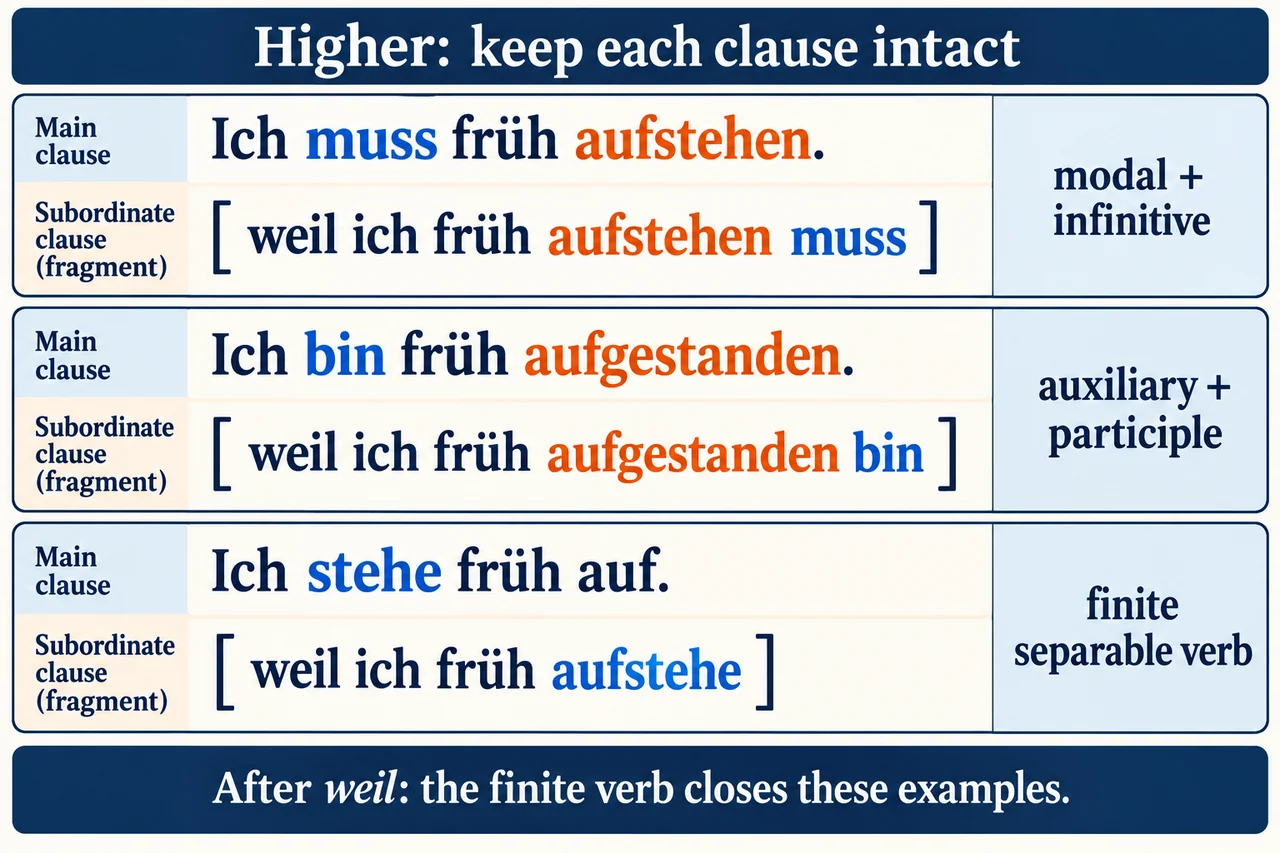
Image: illustration, not a documentary photograph. Original teaching model created for myAudience. · Original generated teaching illustration; no board endorsement or source textbook artwork reproduced.
Higher: nested meaning, two-verb endings and separable subordinate clauses
This is a Higher branch built on the shared case, perfect and reason lessons. In a simple two-verb subordinate structure, the finite verb follows the non-finite element: Ich bleibe zu Hause, weil ich Deutsch lernen muss. Translation: I am staying at home because I have to study German. Lernen is the infinitive, muss the finite modal. The English order have to study cannot be copied into the German clause. Keep the main clause and reason clause separate during editing so that each has an identified finite verb.
The same pattern applies to the perfect: Ich bin müde, weil ich im Garten gearbeitet habe. Translation: I am tired because I worked in the garden. Gearbeitet is the participle and habe is the final finite auxiliary. Compare the main clause Ich habe im Garten gearbeitet. It is not enough to remember put the second verb at the end, because the subordinate clause places the finite verb there too. This lesson treats straightforward perfect, future and modal structures; modal perfect double-infinitive exceptions are outside this slice and must not be generated from an overgeneralised rule.
A finite separable verb reunites in a subordinate clause: Ich bin müde, weil ich früh aufstehe. Translation: I am tired because I get up early. In the main clause ich stehe früh auf the particle is separated; after weil the full finite verb aufstehe is final. With a modal, weil ich früh aufstehen muss retains the full infinitive then the finite modal. These are different forms of the same lexical verb. The particle does not disappear, and the final form must still agree with ich.
Negation can correct an element using nicht … sondern: Ich lese nicht den Roman, sondern das andere Buch. Translation: I am reading not the novel but the other book. The sentence denies the first object and supplies its replacement; it does not deny all reading. Ordinary aber can contrast two statements without explicitly replacing a denied item. Locate the scope before moving nicht. A sophisticated response is precise about what it denies rather than sprinkling negatives through a sentence for complexity.
Original message: Heute bleibe ich zu Hause, weil ich morgen früh aufstehen muss. Ich lese nicht das neue Buch, sondern das alte Buch. Lea kommt später, weil sie den Garten besucht hat. Translation: Today I am staying at home because I have to get up early tomorrow. I am reading the old book rather than the new book. Lea is coming later because she has visited the garden. The message reports the reasons from its writer's perspective; it does not independently verify that those reasons are true. The first sentence contrasts today's choice with tomorrow's obligation without changing either tense.
The Higher plate compares three main statements with explicitly labelled subordinate fragments after weil. In its simple modal and perfect examples the final finite verb follows infinitive or participle; finite aufstehe reunites its particle. The fragments are not presented as independent sentences or a universal rule for every verb cluster. Original transfer challenge: Join Ich bin müde and Ich bin früh aufgestanden using weil. Then change the reason to the present obligation Ich muss früh aufstehen. Finally contrast Ich lese nicht das neue Buch, sondern das alte Buch with a denial that names no alternative. Translate and justify each structural change.
Reasoned model and indicative author criteria: Ich bin müde, weil ich früh aufgestanden bin. — I am tired because I got up early. Ich bin müde, weil ich früh aufstehen muss. — I am tired because I have to get up early. In the completed reason, participle aufgestanden precedes finite bin; in the modal reason, infinitive aufstehen precedes finite muss. Ich lese das neue Buch nicht denies reading the new book but supplies no alternative; nicht das neue Buch, sondern das alte Buch explicitly replaces it with the old book. Credit the exact finite/non-finite distinction and negative scope. These examples do not teach every German verb cluster; modal-perfect double-infinitive exceptions remain outside this slice. This is not an official mark scheme or evidence of independently attempted mastery.
Worked example: Join I am tired and I got up early using weil. Then write a reason meaning because I must get up early.
The main clause is Ich bin müde. The completed event uses bin … aufgestanden.
In the subordinate perfect put the participle before the finite auxiliary: früh aufgestanden bin.
For present obligation retain aufstehen as infinitive and put muss last.
Answer: Ich bin müde, weil ich früh aufgestanden bin. Ich bleibe zu Hause, weil ich früh aufstehen muss.
Check your understanding: 1 Identify the finite verb in weil ich lesen muss. 2 Correct weil ich stehe früh auf. 3 Contrast Ich lese nicht das neue Buch, sondern das alte Buch with Ich lese das neue Buch nicht; what is and is not established?
Answer: 1 muss. 2 weil ich früh aufstehe. 3 The first explicitly replaces the new book with the old one as the object being read. The second denies reading the new book but does not identify any replacement or prove another book is being read.
Why: Scope and clause type constrain the repair. Aufstehe combines the particle with the finite stem; the infinitive aufstehen would lack agreement without another finite verb. A denial without a supplied alternative leaves the alternative unknown.