Higher: narrative time, continuing situations and conditionals
By UK GCSE German · independent study · myAudience
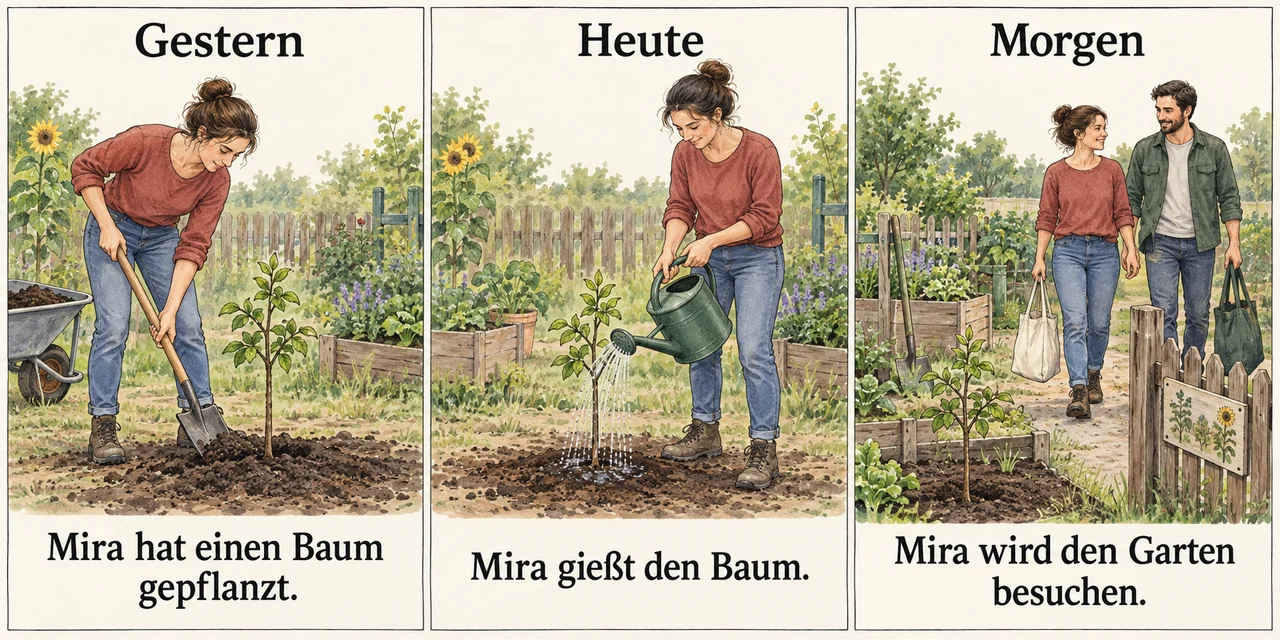
Image: illustration, not a documentary photograph. Original teaching model created for myAudience. · Original generated teaching illustration; no board endorsement or source textbook artwork reproduced.
Higher: narrative time, continuing situations and conditionals
A narrative can use simple past for event sequence as well as background states. Regular forms insert -te: ich lernte, du lerntest, er lernte, wir lernten, ihr lerntet, sie lernten. Frequent strong forms such as ging, went, must be learned: ich ging, du gingst, er ging, wir gingen, ihr gingt, sie gingen. Yesterday's ich bin gegangen and narrative ich ging can both report a past departure, but differ in form and typical register. The full Higher inventory includes more narrative verbs; these examples establish a pattern rather than completing it.
With seit and an ongoing situation, German commonly uses present tense where English uses have been: Ich lerne seit zwei Jahren Deutsch means I have been learning German for two years. Jahren is dative plural after seit. The activity started earlier and continues now. Ich habe zwei Jahre Deutsch gelernt can report a completed two-year period and does not by itself say that it continues. Changing to perfect merely to imitate English have been can therefore alter the time relationship. Identify whether the situation is still continuing before selecting the structure.
Conditionals distinguish a real description from a hypothetical possibility. Wenn ich mehr Zeit hätte, würde ich öfter lesen means If I had more time, I would read more often. Hätte is a subjunctive form of haben, not the ordinary past hatte. The fronted wenn clause is one first constituent of the whole main clause, so würde follows it before ich. Wäre is the corresponding hypothetical form of sein: wenn ich zu Hause wäre, if I were at home. These forms present possibilities; they are not evidence that the imagined situation is true.
Past modals report earlier obligation or ability: wir mussten lernen means we had to study; wir konnten lesen means we could read. The infinitive remains final in the main clause. Imperatives directly address someone: Lies das Buch! (Read the book!, informal singular), Lest das Buch! (informal plural), Lesen Sie das Buch! (formal). The choice depends on the addressee and register. An imperative is a linguistic instruction, not a policy that the learner must obey outside this exercise. Man kann hier lesen means One can read here; man is a singular indefinite subject, not the English noun man.
Original reflective note: Früher las ich wenig. Seit zwei Jahren lese ich jeden Tag. Letzte Woche mussten wir viel lernen. Wenn ich mehr Zeit hätte, würde ich öfter in die Bibliothek gehen. Translation: I used to read little. For two years I have been reading every day. Last week we had to study a lot. If I had more time, I would go into the library more often. Las is an irregular narrative form of lesen. The last clause expresses an unreal or tentative condition, not a firm timetable. A strong response can contrast experience, continuing habit and possibility while keeping their evidence status distinct.
The garden plate contrasts yesterday’s reported planting, today’s watering and a pictured plan for tomorrow. The future image does not establish fulfilment. In the Higher continuing-time lesson this provides a contrast: a sequence of dated episodes alone does not establish an activity continuing since an earlier date. Original transfer challenge: Translate I have been reading German texts for two years. If I had more time, I would read more often. Then turn the hypothetical proposal into a definite tomorrow plan and address a formal adult with an instruction to read the text. Explain the four differences in time, commitment and register.
Reasoned model and indicative author criteria: Ich lese seit zwei Jahren deutsche Texte. Wenn ich mehr Zeit hätte, würde ich öfter lesen. Morgen werde ich einen deutschen Text lesen. Lesen Sie bitte den Text! — I have been reading German texts for two years. If I had more time, I would read more often. Tomorrow I will read a German text. Please read the text! Seit with present conveys a continuing activity; hätte/würde presents a hypothetical change; werde plus infinitive states a future plan; formal Sie in the imperative addresses the adult politely. Deutsche is articleless nominative/accusative plural; deutschen follows einen in masculine accusative. Credit each changed relationship, not an assumption that formal instruction guarantees compliance or that a future plan is already fulfilled. This is not an official mark scheme or evidence of independently attempted mastery.
Worked example: Translate: I have been learning German for two years. If I had more time, I would visit the garden.
Use present lerne with seit; dative plural is zwei Jahren.
For the hypothetical possession of time choose hätte, not hatte.
The conditional clause is fronted, so würde follows the comma and besuchen closes the main clause.
Answer: Ich lerne seit zwei Jahren Deutsch. Wenn ich mehr Zeit hätte, würde ich den Garten besuchen.
Check your understanding: 1 Translate Wir mussten lernen. 2 Correct Seit zwei Jahren ich lerne Deutsch. 3 Contrast Ich hatte mehr Zeit with Wenn ich mehr Zeit hätte and explain why only one reports a past fact.
Answer: 1 We had to study. 2 Seit zwei Jahren lerne ich Deutsch. 3 Hatte states past possession of time; hätte inside the condition presents a hypothetical situation and does not assert that the writer actually had it.
Why: The time phrase is one constituent and the finite verb follows it. Mussten supplies past necessity, not prohibition. The accent in hätte changes the grammatical form and interpretation; context is needed to understand the precise reality of a conditional.