Cover five lifestyle bullets
By UK GCSE German · independent study · myAudience
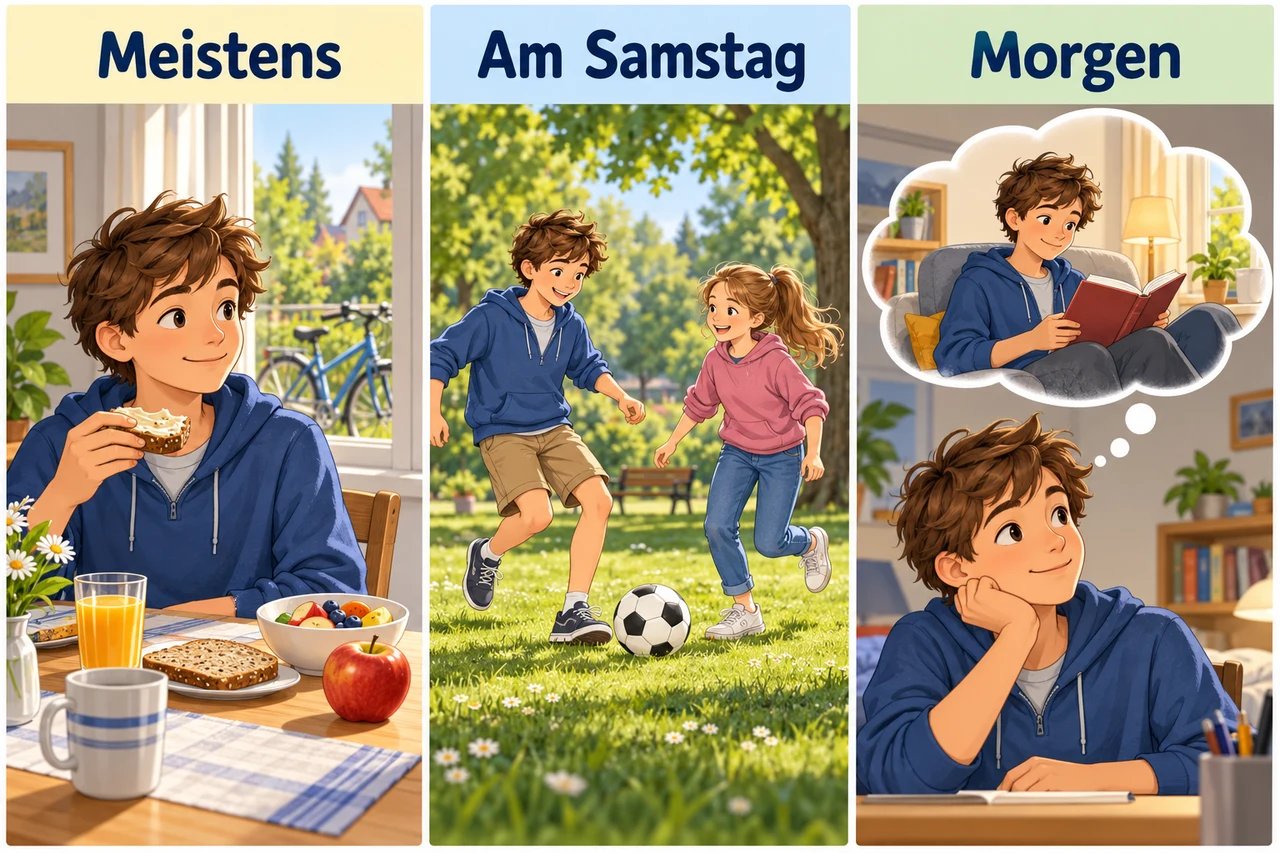
Image: illustration, not a documentary photograph. Original teaching model created for myAudience. · Original generated teaching illustration; no board endorsement or source textbook artwork reproduced.
Cover five lifestyle bullets
A short connected response must cover its whole task, not just its easiest bullet. Our original Foundation-style practice task has five compulsory points: say which free-time activity you enjoy and why; say what you usually eat in the morning; describe what you did last Saturday and with whom; say how you felt afterwards; explain one plan for tomorrow. Aim for approximately fifty German words. These are original instructional prompts. Their five-point structure reflects the published format, but no examiner's question or protected mark scheme is reproduced, and a completed model is not evidence that a learner can independently produce one.
Make a meaning plan before translating. The activity needs a preference and reason; breakfast needs a usual habit; Saturday needs a completed event and companion; the fourth point needs a subsequent feeling; tomorrow needs an intended action. This is more useful than deciding in advance to use a particular number of tenses. A feeling is legitimate here because the writer reports their own fictional experience, unlike guessing a stranger's feeling from a photograph. The lesson's illustration depicts this invented account; it is not a universal healthy-living recommendation or evidence that reading is always better than outdoor activity.
Full original model: In meiner Freizeit fahre ich gern Rad, weil ich dann draußen bin. Meistens esse ich morgens Brot und Obst. Am Samstag habe ich mit meiner Schwester im Park gespielt. Das war schön, aber später war ich müde. Morgen möchte ich zu Hause bleiben und ein Buch lesen. The preference and reason are in sentence one, breakfast in sentence two, completed event and companion in sentence three, feeling in sentence four and intended plan in sentence five. The response is deliberately compact rather than five unrelated mini-essays. Approximate word length guides planning; it is not the only criterion for communication.
Faithful translation: In my free time I like cycling because I am outside then. I usually eat bread and fruit in the mornings. On Saturday I played in the park with my sister. That was nice, but later I was tired. Tomorrow I would like to stay at home and read a book. War schön evaluates the event, while war ich müde states the writer's later condition. Neither proves that cycling caused the tiredness: the Saturday event was playing, and no causal statement links them. Preserve these relationships when translating instead of adding a convenient but invented reason.
Check forms that carry the time distinctions. Fahre and esse describe present habits; habe … gespielt describes a completed Saturday event; war reports the past feeling; möchte … bleiben und … lesen expresses an intention. The phrase zu Hause is a conventional location phrase, not a disputed infinitive-with-zu construction. Mit meiner Schwester is dative after mit. In im Park the event takes place within the park; movement during playing does not force accusative. The reason clause ends with bin. A learner who copies English because I am outside order directly must repair the finite position rather than change the intended reason.
A fluent-looking response can still omit a point. If the writer replaces sentence four with Ich mag den Park, the response supplies another preference but loses the requested later feeling. Adding Ich war müde restores it. If the writer changes Morgen möchte ich … to Gestern möchte ich …, the time cue and present wish no longer express the stated tomorrow plan. The plate separates habit, completed Saturday activity and tomorrow's intention; the plan is shown in a thought panel, not as something already completed. Use it to check narrative status, not to infer habits from an isolated depicted moment.
Transfer task: Replace the Saturday companion with two friends, replace tired with happy and make tomorrow's plan visiting a friend. Keep all five bullets. A complete revision is In meiner Freizeit fahre ich gern Rad, weil ich dann draußen bin. Meistens esse ich morgens Brot und Obst. Am Samstag habe ich mit zwei Freunden im Park gespielt. Danach war ich glücklich. Morgen möchte ich einen Freund besuchen. Translation: I like cycling because I am outside then; I usually eat bread and fruit in the mornings; on Saturday I played in the park with two friends; afterwards I was happy; tomorrow I would like to visit a friend. Mit zwei Freunden adds the dative plural ending; einen Freund is the masculine accusative object of besuchen.
Evaluate relevance first, then language. An alternative can change the fictional preference or breakfast if the prompt allows personal choices, but it must still answer every bullet and maintain a coherent timeline. Do not treat every minor variant as a single compulsory model phrase. Explain errors by the meaning they obscure: missing companion, lost time, wrong number or unsupported event. This lesson practises one short task in limited contexts; full theme coverage, all vocabulary, independently timed writing and external assessment remain open. It does not certify diet advice, spoken fluency or qualification attainment.
Worked example: A draft gives preferences, breakfast, Saturday activity and tomorrow plan but omits the later feeling. What is the smallest relevant repair?
Locate the missing fourth bullet.
Choose a past first-person feeling rather than another preference.
Insert it after the Saturday event.
Answer: Danach war ich müde.
Check your understanding: Change mit meiner Schwester to two friends and explain the noun ending.
Answer: Mit zwei Freunden: mit requires dative, and plural Freunde adds -n to form Freunden.
Why: Changing the companion changes number/case, not the Saturday tense.