Diagnose five grammar choices
By UK GCSE German · independent study · myAudience
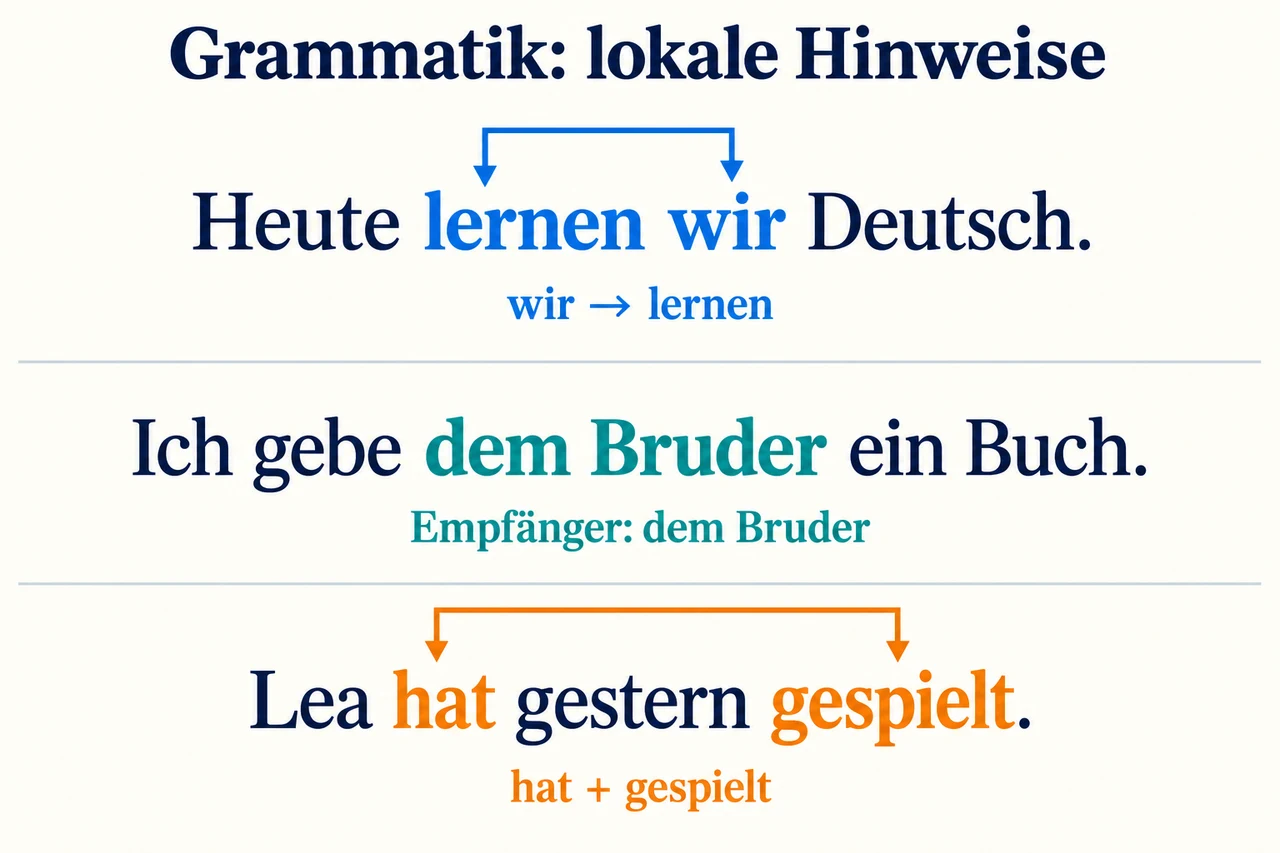
Image: illustration, not a documentary photograph. Original teaching model created for myAudience. · Original generated teaching illustration; no board endorsement or source textbook artwork reproduced.
Diagnose five grammar choices
A three-option grammar question is not a guessing contest based on which word looks familiar. Our original practice task supplies five sentences, each with one gap and three alternatives: (1) Heute ___ wir Deutsch: lerne / lernen / lernt. (2) Ich gebe ___ Bruder ein Buch: den / dem / der. (3) Lea ___ gestern im Park gespielt: hat / ist / haben. (4) Wir haben ___ Fahrrad: nicht / kein / keine. (5) Morgen ___ ich meine Freundin besuchen: möchte / möchten / möchtet. Select one answer per sentence, complete every sentence and explain the rejected forms. These are original sentences, not copied exam questions.
Locate the grammar-bearing relationships before looking at the options. In sentence one wir determines first-person plural agreement; Heute occupies the initial constituent, leaving the finite verb second. In sentence two Bruder is a recipient in a geben construction, so its masculine article is dative. Sentence three requires the ordinary perfect auxiliary for spielen and a singular subject. Sentence four negates possession of an indefinite neuter noun. Sentence five combines singular ich with a finite wish form and a final infinitive. Agreement, construction selection and case are different questions; one shortcut will not solve all five.
Complete model: Heute lernen wir Deutsch. Ich gebe dem Bruder ein Buch. Lea hat gestern im Park gespielt. Wir haben kein Fahrrad. Morgen möchte ich meine Freundin besuchen. Translation: Today we are learning German. I give the brother a book. Lea played in the park yesterday. We do not have a bicycle. Tomorrow I would like to visit my friend. The model preserves the supplied participants and time references. It does not turn the brother into the thing given, make the bicycle plural or assert that the friend has agreed to the visit.
Explain each distractor. Lerne fits ich, while lernt fits ihr or a singular er/sie/es in another sentence, not wir here. Den Bruder can be an accusative object in Ich sehe den Bruder; der Bruder can be a nominative subject, but neither fills the recipient slot here. Haben needs a different subject such as wir; hat agrees with Lea. Ist is not the ordinary auxiliary for this playing event. Physical activity in a park does not turn every verb into a sein verb. An incorrect option in this sentence is not an impossible German word.
Kein Fahrrad preserves neuter singular indefinite possession. Keine fits other forms, such as keine Bank or keine Fahrräder. Nicht can express a definite contrast in Wir haben nicht das blaue Fahrrad, sondern das rote; it does not provide the indefinite determiner required here. Möchten fits wir or sie plural, while möchtet fits ihr. Explain the environment that makes a rejected form possible. Otherwise a learner may incorrectly replace all occurrences of den or nicht with the answer memorised from this single task.
The concept plate links wir with lernen, marks dem Bruder as the recipient and pairs hat with gespielt. It shows local grammatical relationships, not physical movement or a universal claim that all recipients take dem. A feminine recipient needs a different article; other verbs may require different cases. The full five-item task and every option remain in the written lesson, so the image deliberately illustrates three representative mechanisms instead of compressing all explanations into tiny lettering. These three displayed examples are not the whole task.
Transfer task: Change sentence one to ihr, the recipient to a sister, sentence three to wir and sentence five to wir. Full answer: Heute lernt ihr Deutsch. Ich gebe der Schwester ein Buch. Wir haben gestern im Park gespielt. Morgen möchten wir unsere Freundin besuchen. Translation: Today you are learning German. I give the sister a book. We played in the park yesterday. Tomorrow we would like to visit our friend. Der Schwester is feminine dative, not nominative because der sometimes marks a masculine subject. Unsere changes my to our while the friend remains a singular object.
A useful author rubric requires the correct option and an explanation tied to the actual subject, construction or noun form. Choosing dem merely because a sentence contains a person fails: Ich sehe den Bruder disproves that rule. In transfer work preserve the event as well as agreement. This lesson supplies one original five-item set; full grammar/vocabulary, independently timed selection and external assessment remain open. Its explanations are not an official mark scheme and reading a solution does not establish independent mastery, a grade, or listening and speaking performance.
Worked example: Explain why dem fits Ich gebe ___ Bruder ein Buch but not Ich sehe ___ Bruder.
Identify recipient in geben.
Identify direct object in sehen.
Use masculine dative dem and accusative den.
Answer: Ich gebe dem Bruder ein Buch. Ich sehe den Bruder.
Check your understanding: Why does activity in a park not require ist in Lea hat … gespielt?
Answer: This playing construction uses haben, agreeing as hat with singular Lea; physical activity/location alone does not choose the auxiliary.
Why: Construction selection differs from spatial-preposition case.