Translate meaning rather than English order
By UK GCSE German · independent study · myAudience
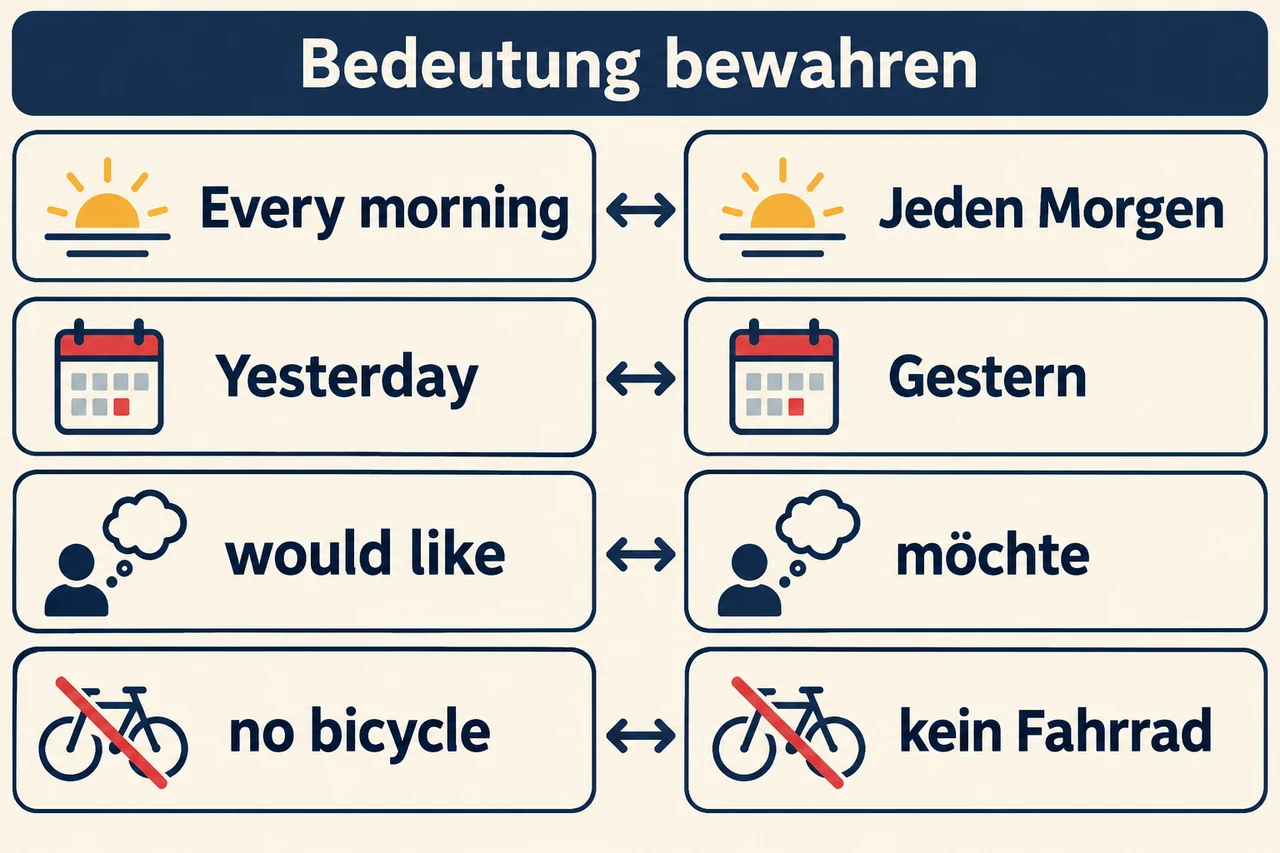
Image: illustration, not a documentary photograph. Original teaching model created for myAudience. · Original generated teaching illustration; no board endorsement or source textbook artwork reproduced.
Translate meaning rather than English order
Translation preserves a supplied message; it does not reward replacing it with a more elaborate favourite topic. Our original passage is: Every morning I go to school with my sister. Yesterday we played in the park. Tomorrow I would like to visit a friend because she is nice. We do not have a bicycle, but we like walking. Translate the whole passage into German. It exceeds the Foundation format's minimum thirty-five English words. These facts belong to a fictional instructional account, not a real profile or a claim about German school customs.
Break the passage into meaning units: repeated morning journey and companion; completed park event; tomorrow's wish and reason; absence of a bicycle contrasted with enjoyment of walking. Preserve who, what, when and the force of every assertion. Would like is a wish rather than a confirmed arrangement. We do not have a bicycle is negative possession, not refusal to ride. Because she is nice supplies the speaker's reason, not proof of universal agreement. Coherent meaning units are more reliable than assigning a German word to every English word in sequence.
Complete model: Jeden Morgen gehe ich mit meiner Schwester zur Schule. Gestern haben wir im Park gespielt. Morgen möchte ich eine Freundin besuchen, weil sie nett ist. Wir haben kein Fahrrad, aber wir gehen gern zu Fuß. Back translation: Every morning I go to school with my sister. Yesterday we played in the park. Tomorrow I would like to visit a female friend because she is nice. We do not have a bicycle, but we like walking. Freundin can mean female friend or girlfriend in context; the supplied message does not establish a romantic relationship.
Each construction has a reason. Jeden Morgen is one initial constituent, so gehe precedes ich. Mit meiner Schwester is dative after mit; zur contracts zu der before feminine Schule. Gestern haben wir … gespielt marks the completed event. Im Park says where playing took place, not a destination merely because playing involves movement. Morgen möchte ich … besuchen keeps the finite wish form second and its infinitive at the end of the main clause. Weil sie nett ist ends the reason clause with its single finite verb. Zu Fuß and zur Schule are prepositional phrases, not disputed infinitive-with-zu constructions.
Allow equivalent phrasing when its meaning fits. In die Schule can emphasise entering the school, whereas zur Schule naturally renders going to school here. Laufen can have walking/running nuances in context, so gehen gern zu Fuß explicitly conveys walking. Keine Fahrräder introduces a plural claim not supplied by the source. Muss introduces obligation instead of desire. A learner who knows complex structures should still use them only when they preserve the message. Complexity that changes the relationship, time or modality is not a better translation.
The plate connects four English meaning headings with German equivalents: repeated morning, yesterday, would like and no bicycle. Notice that German phrase order can differ while temporal status and participants remain the same. The plate is a compact guide to this passage, not a replacement source passage. Gestern wir gespielt im Park loses the finite auxiliary; repairing that is necessary. Adding a crowded park or a completed visit is an unsupported embellishment. The translator is not being invited to make the story more exciting or infer a friend's reply.
Transfer task: Change sister to brother, yesterday to last Saturday and we do not have a bicycle to I do not have a bicycle; keep the tomorrow wish and collective walking preference. Full answer: Jeden Morgen gehe ich mit meinem Bruder zur Schule. Am letzten Samstag haben wir im Park gespielt. Morgen möchte ich eine Freundin besuchen, weil sie nett ist. Ich habe kein Fahrrad, aber wir gehen gern zu Fuß. Meinem Bruder is masculine dative; habe agrees with ich. Changing the final wir to ich too would silently alter a fact that the transfer did not request.
Check every meaning unit before stylistic polishing. Accept equivalent accurate wording, but identify changed participant, missing negation or lost time rather than calling it merely awkward. Then audit finite forms, noun capitals, case and clause boundaries. This is an original instructional task with a model and author rationale, not an official mark scheme. Full lexical/grammar coverage, independently attempted accuracy and timed assessment remain open. The lesson supplies no evidence of listening or spoken translation and predicts no grade.
Worked example: Translate We do not have a bicycle, but we like walking without changing possession into prohibition.
Use kein before neuter singular Fahrrad.
Keep haben as possession.
Express preference with gehen gern zu Fuß.
Answer: Wir haben kein Fahrrad, aber wir gehen gern zu Fuß.
Check your understanding: Morgen muss ich eine Freundin besuchen replaces the supplied wish. What changed?
Answer: Muss adds obligation. Restore Morgen möchte ich eine Freundin besuchen.
Why: Modal force is part of meaning, not an optional stylistic choice.