Read a travel notice with constrained inference
By UK GCSE German · independent study · myAudience
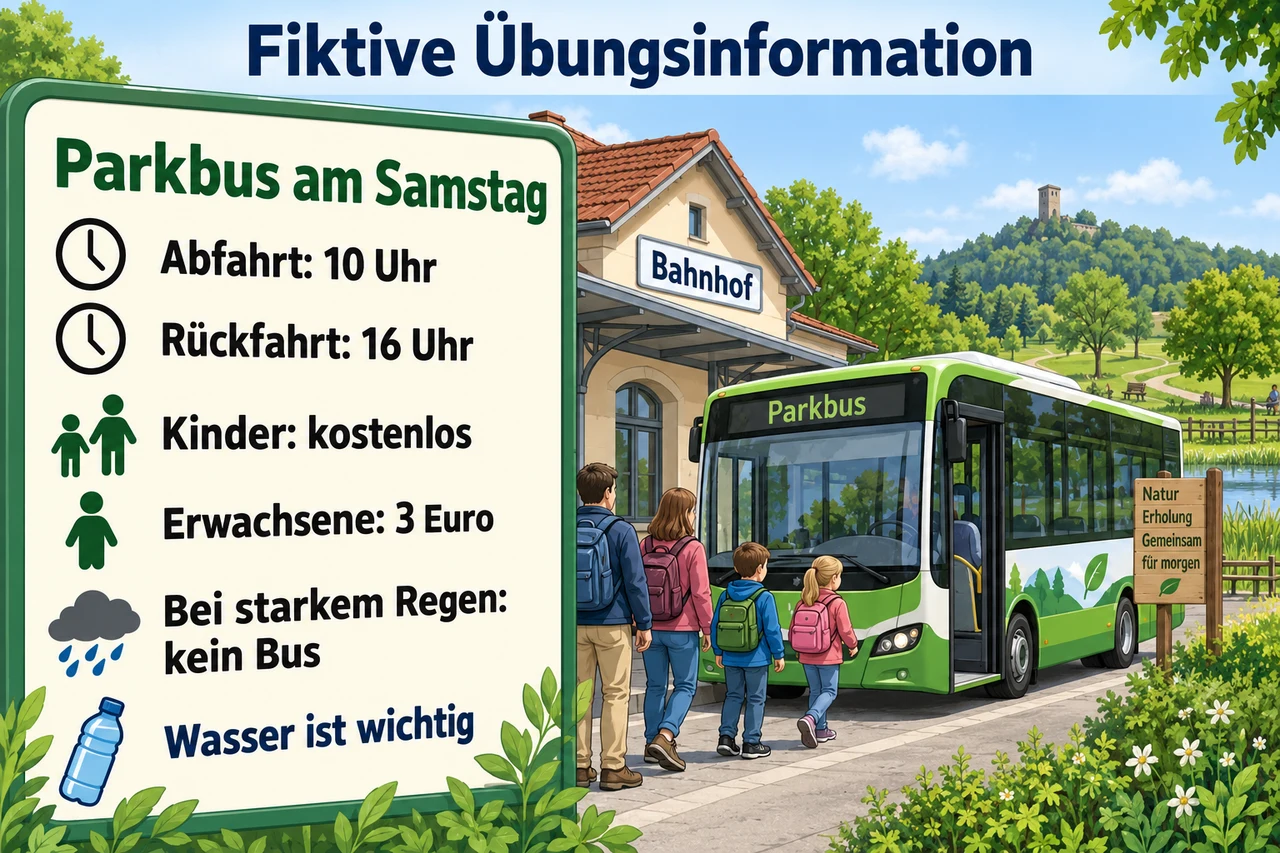
Image: illustration, not a documentary photograph. Original teaching model created for myAudience. · Original generated teaching illustration; no board endorsement or source textbook artwork reproduced.
Read a travel notice with constrained inference
Notices compress conditions, times and responsibilities, so reading them requires more than recognising a transport word. Our original fictional notice says: Parkbus am Samstag: Abfahrt am Bahnhof um zehn Uhr. Rückfahrt um sechzehn Uhr. Kinder fahren kostenlos. Erwachsene bezahlen drei Euro. Bei starkem Regen fährt der Bus nicht. Wasser für die Fahrt ist wichtig. Answer: where and when does the outward bus leave; what do adults pay; is service guaranteed in every kind of weather; what does the notice say about water? These invented facts are practice material, never public travel advice.
Faithful translation: Park bus on Saturday: departure at the station at ten o'clock. Return journey at sixteen o'clock. Children travel free of charge. Adults pay three euros. In heavy rain the bus does not run. Water for the journey is important. The notice gives a return time but not an arrival time, platform or journey duration. Nor does it define the child/adult age boundary. Preserve missing information instead of supplying a familiar local fare rule. Sechzehn Uhr is four in the afternoon in a twenty-four-hour clock convention.
A contrasting original email reads: Hallo Mira, ich möchte am Samstag mit dem Parkbus fahren. Die Fahrt klingt günstig. Wenn es stark regnet, bleiben wir zu Hause. Hast du schon Wasser gekauft? Translation: Hello Mira, I would like to take the park bus on Saturday. The journey sounds inexpensive. If it rains heavily, we will stay at home. Have you already bought water? A wish is not a booking; klingt günstig is the writer's impression, not a comparison with every alternative. The question supplies no answer about a purchase.
Complete answers: Departure is from the station at ten on Saturday; adults pay three euros; the bus is not guaranteed in heavy rain, when the notice says it does not run; water is described as important for the journey. Rückfahrt can be inferred as return journey from Abfahrt and its later time. Both compounds contain Fahrt, while Rück- and Ab- distinguish direction or stage. Guessing refund because something comes back does not fit the scheduled travel context. A contextual inference must fit the complete sentence rather than one familiar fragment.
Separate inference from imported knowledge. Kostenlos applies to the stated child fare, not every passenger. Bei starkem Regen states a condition, not an actual forecast. Die Fahrt klingt günstig is an opinion; the three-euro fare is the notice's stated fact. A reader cannot infer from either that seats have been reserved. In Wenn es stark regnet, bleiben wir zu Hause, the condition's finite verb regnet is final and the following main finite verb bleiben precedes wir. Zu Hause is a fixed location phrase, not an infinitive-with-zu construction.
The plate shows the same explicitly fictional notice with its station, ten and sixteen time cards, fare and heavy-rain condition. The time pairing does not represent a six-hour bus ride: travel duration and time at the destination remain unspecified. The water bottle illustrates the importance statement; it cannot prove that anyone has packed or bought water. Read the notice text, not a bus's appearance, for the facts. This single practice genre and its glosses do not constitute the complete travel theme or prescribed lexical inventory.
Transfer task: A revised notice changes only departure to eleven, return to seventeen and the adult price to four euros. The email still calls the journey inexpensive and asks about water. Full answer: Departure is eleven, return seventeen and adults pay four euros; the rain condition and water statement are unchanged. No purchase or actual journey is confirmed. Günstig remains the writer's opinion. A higher price alone does not prove the writer changed their view, because no comparison, budget or revised message is supplied.
An author rubric asks for the exact supporting phrase, labels an attitude as an attitude and marks unavailable information explicitly. Return trip and return journey are both suitable renderings. A claimed platform, arrival time or age threshold is overconfident even if plausible elsewhere. This lesson gives genre contrast and constrained word inference with an unfamiliar transfer, not independent unseen performance. Full travel vocabulary, all nine themes and listening/speaking remain open. No practical journey should be planned from this invented notice.
Worked example: Infer Rückfahrt from Abfahrt10Uhr and Rückfahrt16Uhr without inventing journey duration.
Recognise shared Fahrt.
Use the later return and Rück- contrast.
Render return journey, not an arrival time or duration.
Answer: Rückfahrt means return journey here. Arrival time and travel duration are not supplied.
Check your understanding: Does Hast du schon Wasser gekauft? show that water was bought?
Answer: No. It asks whether water has already been bought and supplies no reply.
Why: Questions do not assert completion.