Translate a community environmental message
By UK GCSE German · independent study · myAudience
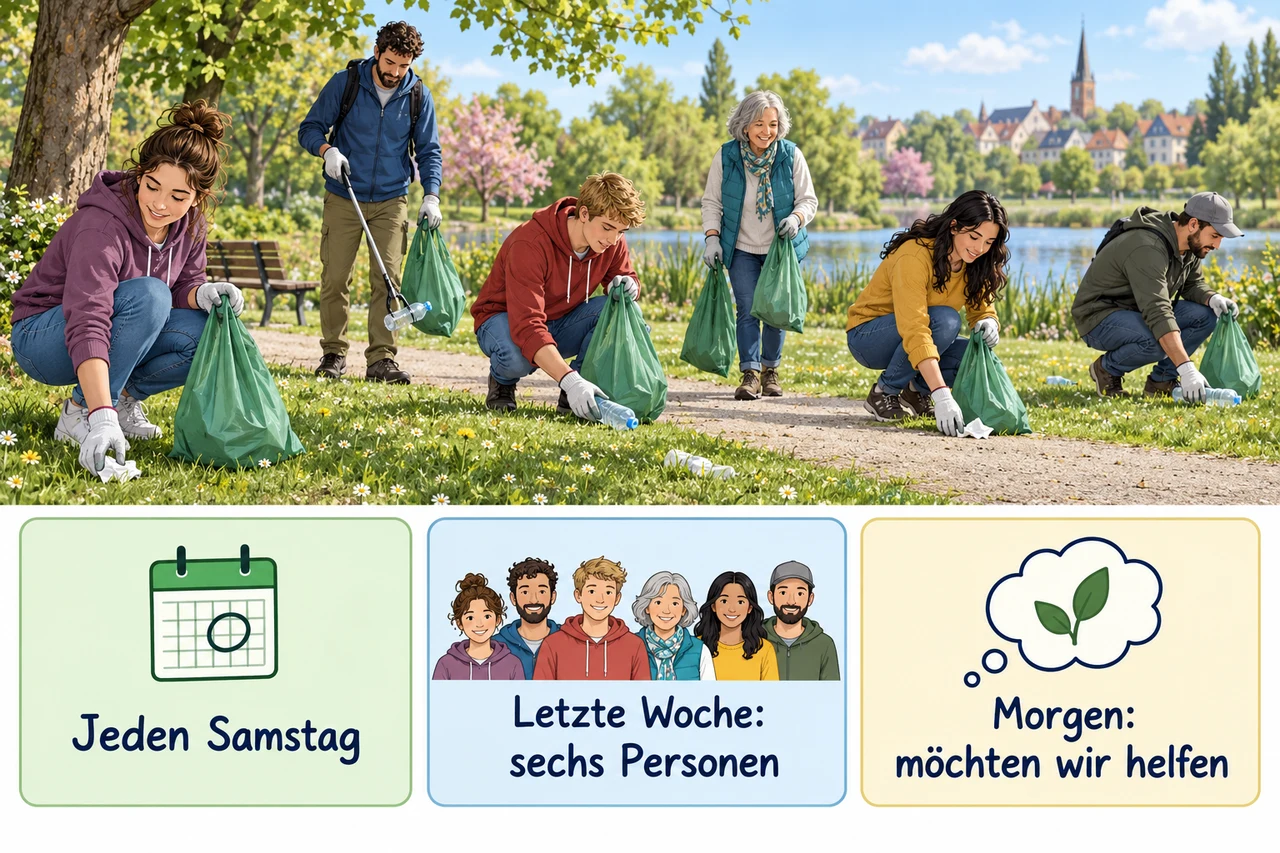
Image: illustration, not a documentary photograph. Original teaching model created for myAudience. · Original generated teaching illustration; no board endorsement or source textbook artwork reproduced.
Translate a community environmental message
Translation into English tests whether the original meaning survives, including small words that alter time, number or obligation. Translate this original fictional community message: In unserem Viertel gibt es einen kleinen Park. Jeden Samstag sammeln wir dort Papier und Flaschen. Das ist gut für den Park. Wir arbeiten zusammen, aber niemand muss kommen. Letzte Woche waren sechs Personen da. Morgen möchten wir wieder helfen. The German input exceeds thirty-five words. It is instructional practice, not a real municipal announcement or evidence that one collection method is an official recycling policy.
Read the whole message before translating individual phrases. It introduces a local park, a repeated Saturday activity, a positive evaluation, voluntary participation, a reported group size last week and a wish for tomorrow. The writer does not identify the six people, say that the same six always attend, or specify how the materials are processed after collection. A community account can include factual statements and an opinion in the same passage. An accurate translation preserves both without presenting the positive evaluation as a measured environmental outcome.
Full English model: In our neighbourhood there is a small park. Every Saturday we collect paper and bottles there. That is good for the park. We work together, but nobody has to come. Last week there were six people there. Tomorrow we would like to help again. Neighbourhood and district can be appropriate for Viertel in this setting. Nobody has to come expresses absence of obligation, not a ban. Would like preserves the wish in möchten; replacing it with definitely will would overstate the plan. The phrase good for the park is the writer's evaluation.
Several compact forms carry important meaning. Gibt es is an existential expression, not the literal someone gives it. Einen kleinen Park is its masculine accusative noun phrase. Jeden Samstag makes the activity recurrent, while letzte Woche dates the reported attendance. Niemand muss kommen means nobody is required to come: it does not prohibit attendance, and everyone must come reverses its scope. Waren agrees with sechs Personen. Helfen is the final infinitive after möchten. These meanings remain necessary even if a polished English version rearranges the words.
Compare faulty translations with the source. Six people must come tomorrow combines the old number with a new obligation and time not supplied. Nobody may come changes optional attendance into prohibition. Every Saturday we collected paper turns the present repeated activity into a past claim. Tomorrow we helped again replaces a desire with a completed event. Repair each by returning to the exact meaning-bearing phrase, not by making the English story more plausible. A translation should not infer the organisation's eligibility rules or what kinds of bottle can be accepted.
The plate depicts a clearly fictional neighbourhood collection and separates three word cards: Jeden Samstag, Letzte Woche: sechs Personen and Morgen: möchten wir helfen. It illustrates the same habitual/reported/planned distinctions as the text. The picture is not a measured count of last week's participants: the six-person statement comes from the written account. The plate deliberately avoids showing a real recycling-facility instruction. Notice that an appealing scene does not justify an extra claim about tonnes saved, carbon emissions or compulsory volunteering.
Transfer task: Change the German message only from sechs to vier, from morgen to am Sonntag and from niemand muss kommen to alle müssen kommen. Translate the changed units and explain the difference in obligation. Full answer: Last week there were four people there. On Sunday we would like to help again. Everyone has to come. Four replaces the reported number, Sunday replaces the desired action's time, and müssen now agrees with plural alle. The new compulsory statement is stipulated for this exercise; it is not the policy of the original fictional account.
An author rubric checks adequate meaning for every unit, allows natural English equivalents and rejects lost negation, number, time or modality. The transfer intentionally changes facts; the original translation must not import them. This shared-tier practice supplies a complete rendering of one thirty-five-plus-word passage. The Higher minimum-fifty-word reading translation format is not claimed complete by this shorter input, and full environment-theme/vocabulary, unseen independent performance and all listening/speaking remain open. No examiner's question, protected mark scheme or guaranteed score is supplied.
Worked example: Translate niemand muss kommen and contrast Niemand darf kommen.
Read muss as obligation.
Preserve the scope of niemand.
Distinguish no obligation from no permission.
Answer: Nobody has to come; Nobody may come expresses prohibition instead.
Check your understanding: Six people last week does not prove what two claims?
Answer: It does not prove that those same six attend every week or that six will attend tomorrow.
Why: A reported count is bounded by its time and cannot establish future attendance.