Preserve conditional and temporal meaning
By UK GCSE German · independent study · myAudience
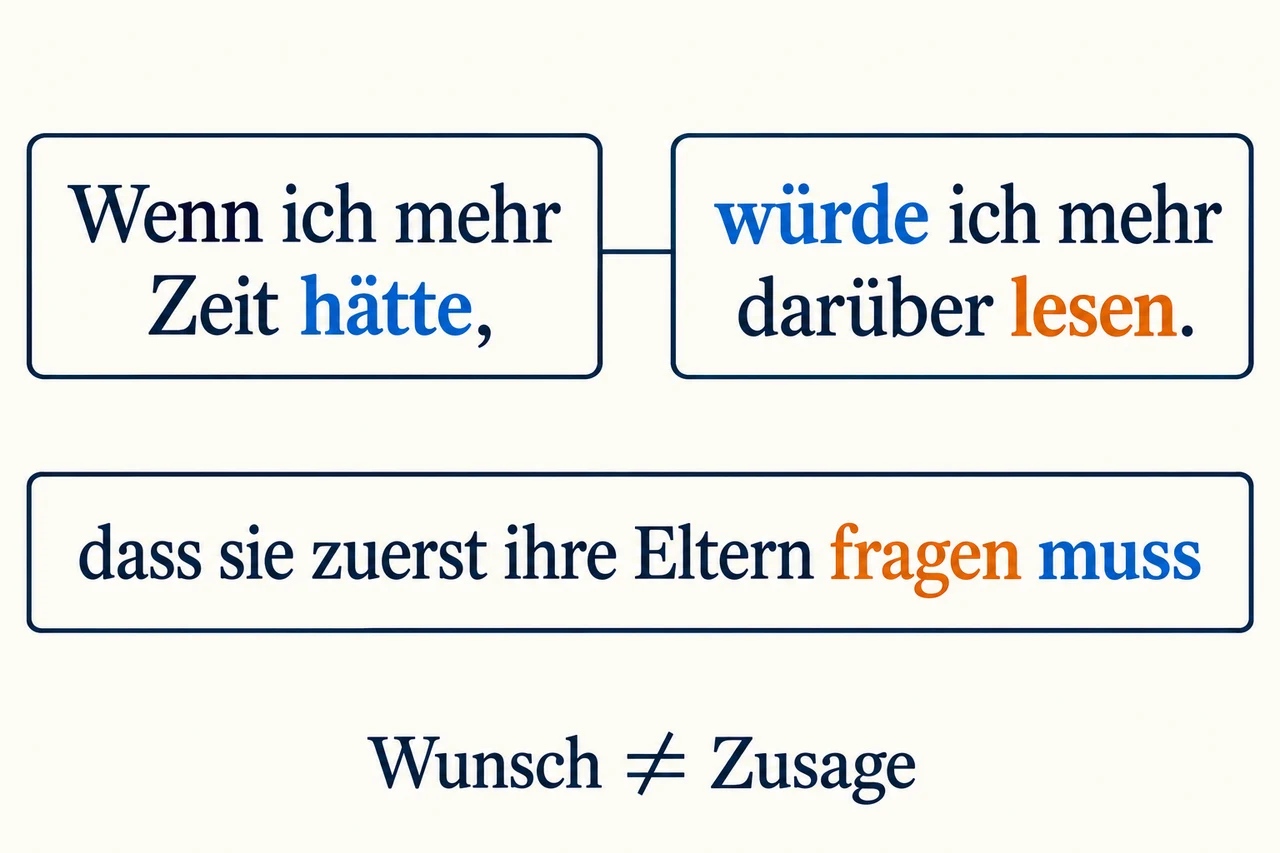
Image: illustration, not a documentary photograph. Original teaching model created for myAudience. · Original generated teaching illustration; no board endorsement or source textbook artwork reproduced.
Preserve conditional and temporal meaning
An extended translation must preserve nested messages rather than adding complexity for its own sake. Translate this original English passage: Last year our class visited a museum. I liked the old machines because they showed how people worked. If I had more time, I would read more about them. Next month we would like to go again, but the visit is not yet certain. My friend says that she must ask her parents first. The input exceeds the Higher minimum fifty English words. It describes a fictional learner's account, not the programme or permission policy of a real museum.
Plan five units: completed class visit; past opinion with a reason; hypothetical time and response; future wish qualified by uncertainty; reported obligation before permission is known. The if-clause does not assert that the writer actually has more time. Would like to go again is not a booking. Must ask describes a requirement to ask, not a successful request or parental agreement. Losing one of these distinctions can make a grammatical translation unfaithful. Here clarity of clause relationships matters more than displaying every Higher construction in one sentence.
Full model: Letztes Jahr besuchte unsere Klasse ein Museum. Ich mochte die alten Maschinen, weil sie zeigten, wie die Menschen arbeiteten. Wenn ich mehr Zeit hätte, würde ich mehr darüber lesen. Nächsten Monat möchten wir wieder dorthin gehen, aber der Besuch ist noch nicht sicher. Meine Freundin sagt, dass sie zuerst ihre Eltern fragen muss. Back translation: Last year our class visited a museum. I liked the old machines because they showed how people worked. If I had more time, I would read more about them. Next month we would like to go there again, but the visit is not yet certain. My friend says she must ask her parents first.
Besuchte is a regular narrative past form; mochte is the past of mögen, not möchte, the present wish form used elsewhere. In weil sie zeigten, wie die Menschen arbeiteten, the first reason clause contains a second clause saying what the machines showed. Work out the two subjects and verbs rather than assuming the final word of the whole sentence is the only relevant verb. Die alten Maschinen is a plural object in the opinion clause; the later sie refers to those machines. This is a particular coherent model, not evidence that every possible narrative past form is taught.
Wenn ich mehr Zeit hätte makes the stipulated hypothetical condition, and würde ich mehr darüber lesen supplies its consequence. The fronted whole condition occupies the initial position for the main clause, so würde precedes ich. Darüber is one pronominal adverb meaning about that/them and refers back to the machines and their history. In dass sie zuerst ihre Eltern fragen muss, fragen remains the infinitive and the finite modal muss closes the subordinate clause. The model uses no modal-perfect double-infinitive construction and imports no exception from that different structure.
The plate separates the conditional pair from the reported modal clause. Its boundary between Wenn … hätte and würde … lesen shows the relationship, not the passage of time or a promise. A further label Wunsch ≠ Zusage reminds the reader that möchten does not establish agreement. The image's exact words match the written model. Do not translate muss as may or hätte as has merely to simplify the image. A faithful simpler alternative might divide the nested reason into accurate short sentences, but it must still communicate why the writer liked the machines.
Transfer task: Change the hypothetical lack of time to lack of money, the response to buying a book, the desired return to next year and the friend to two friends who must ask their parents. Full changed units: Wenn ich mehr Geld hätte, würde ich ein Buch kaufen. Nächstes Jahr möchten wir wieder dorthin gehen, aber der Besuch ist noch nicht sicher. Meine Freundinnen sagen, dass sie zuerst ihre Eltern fragen müssen. Translation: If I had more money, I would buy a book. Next year we would like to go there again, but the visit is not yet certain. My friends say that they must ask their parents first. Müssen agrees with plural sie; no permission outcome is added.
An author rubric rewards sufficient faithful meaning, accurate clause boundaries and an explanation of uncertainty or hypothetical status. Different natural wording is possible; an attractive extra story about the museum is not. Explain a mistranslation by what it changes: tense, opinion, condition, obligation or outcome. This lesson supplies a complete fifty-plus-word English-to-German practice and demanding transfer, not full Higher grammar/vocabulary or independently timed performance. Higher reading translation remains a separate open format. No mark, grade, spoken fluency or complete qualification claim follows from a supplied answer.
Worked example: Repair Wenn ich mehr Zeit hätte, ich würde mehr darüber lesen without changing the condition.
Treat the entire fronted condition as the initial constituent.
Place main finite würde before ich.
Keep final infinitive lesen.
Answer: Wenn ich mehr Zeit hätte, würde ich mehr darüber lesen.
Check your understanding: Why does dass sie ihre Eltern fragen muss not imply that the parents agreed?
Answer: It reports an obligation to ask; no completed request, reply or permission outcome is supplied.
Why: Requirement, action and result are separate claims.